


Tree service in Atascadero, oak work over the grade
Atascadero — this is the coast these pages are about.
Quick answer: Tree Service in Atascadero, CA — Defensible space is the work that decides what a fire has to burn between the wildland and the house: dead material out, ladder fuels separated, and the tree you keep limbed up rather than removed. It is measured in zones from the structure, and the first few feet are the ones that matter most.
- Typical timing: Best done in the cool months so the debris is gone before the dry season; clearance rules apply year-round.
- What it involves: Removing dead and dying material, separating shrubs from low limbs, limbing trees near structures, and keeping the roof and gutters clear.
- The standard: Cal Fire's defensible-space guidance for the first 100 feet, applied to the trees a property actually has.
- Where we work: The wooded parts of Cambria, San Simeon, Harmony and the surrounding ranch country.
- Our own record: 503 pages and 291 stories published on this site. Counted from our own archive, not a stock table.
Field note. What we see on this coast that surprises people is how much of the fuel load is low: the limb at four feet and the brush beneath it carries fire into a canopy that would otherwise survive, so the work is often lifting rather than felling.
On the other hand, over-clearing has its own cost — bare ground erodes, and the wind that comes with the fog belt is harder on a thinned stand than the fire risk it removes.
Over the grade, where the fog stops
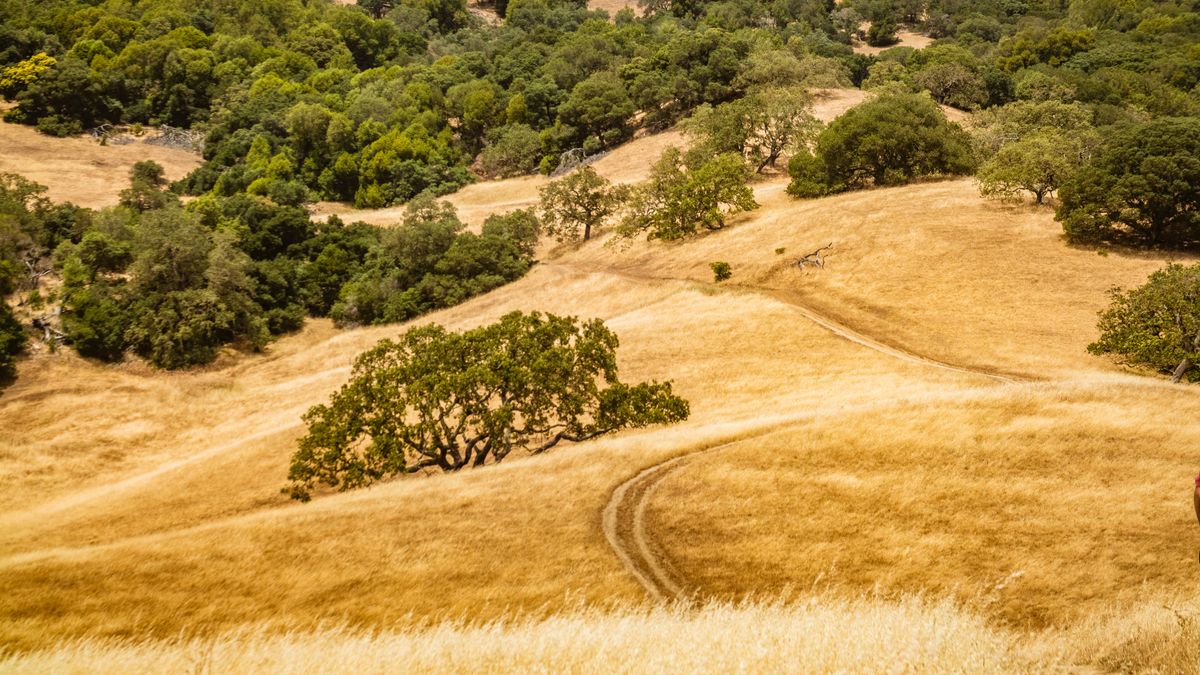
Driving from Cambria to Atascadero is a climate change in twenty minutes. The marine layer stays behind, July and August average highs sit around 82°F and 83°F, and December nights drop to about 38°F. The landscape changes with it: oak woodland and grassland on the hills, chaparral above them, the Salinas River to the east and the Santa Lucia Range to the west. Trees here are not shaped by salt wind.
They are shaped by heat, by a long dry season, and by what people have done to the ground around them.
The oak woodland’s missing generation
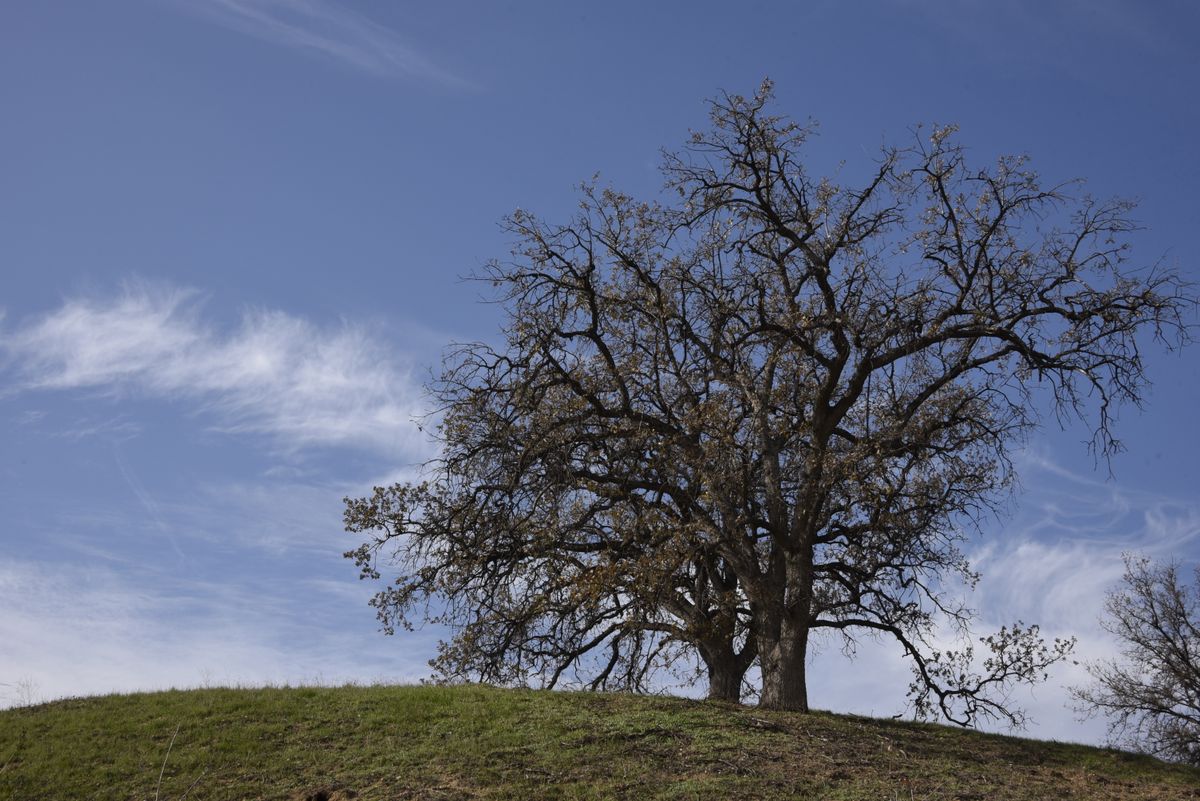
A 2007 native-tree inventory of the Atascadero area found coast live oak woodland on 6,544 of its 24,344 acres. It also found something more worrying: coast live oak and bay laurel were regenerating, while valley oak and blue oak had almost no young trees coming through. The woodland is largely old. That matters for anyone with oaks on their land, because an old stand with no replacement is a stand you cannot afford to damage.
Most of the damage we see is avoidable — soil piled against a trunk, summer irrigation where an oak wants dry ground, grading inside the root zone, or a single hard prune that removes half the canopy.
What triggers an Atascadero tree permit
Chapter 11 of the municipal code protects native trees, and the thresholds are specific. A removal permit is triggered for a deciduous native tree two inches or more in diameter at breast height, for other protected native trees at four inches or more, and for pruning that removes more than 25 percent of the live canopy in a year. Pruning below that threshold, done to ISA standards, does not need a permit.
The city’s FAQ lists a $259 fee and a mitigation requirement — replanting on the property or paying into the city’s native-tree fund. There are exemptions, including qualifying single-family residential lots, nursery stock and some emergencies, with the emergency route requiring notice to the city within 48 hours. Heritage tree removals go to the council.
Defensible space on the west side
The city’s fire-hazard page is direct: properties in a Very High Fire Hazard Severity Zone need 100 feet of defensible space around structures, and the zone maps account for vegetation, slope and extreme fire weather. On the west side of town, where the oak woodland runs up to the roofs, that means limbing up, taking out dead material, separating shrubs from low branches and keeping the first thirty feet closest to the house lean and clean.
It is work that has to be redone as things grow back, which is why we would rather set up a plan than sell a one-off cleanup.
What the permit covers, and what it does not
- Permit-aware native tree removals, including the mitigation step.
- Oak pruning kept inside the 25 percent canopy limit.
- Defensible-space work in the high fire hazard zones.
- Dead and beetle-stressed tree removal where the wood has stopped being safe.
- Stump grinding and cleanup on rural parcels.
- Storm response after winter wind and rain.
What a February storm can do
On February 13, 2019, a pine roughly 50 to 60 feet tall came down onto four rental homes on the 8000 block of Amapoa Avenue during heavy rain and sustained wind. Eight people were displaced and nobody was injured.
That is the scenario worth planning for: a tree that stood through years of ordinary weather, in ground that had been wet for weeks, on a lot where the house was inside its reach. If a tree on your property is that tree, the conversation is cheaper now than after the storm.
The Colony, the lake and the river side
The Colony streets around the old administration building and Sunken Gardens, the neighborhoods around Atascadero Lake, the Paloma Creek area, the rural parcels off Highway 41 and Highway 101, and the hillside properties where the woodland meets the house. We are straight about the drive over the grade: it affects scheduling, not the standard of the work.
Ask for a written estimate
Call (805) 927-4414. Give us the species, the trunk size if you know it, and whether the parcel sits in a fire hazard zone; from that we can usually tell you if Chapter 11 applies. Background reading: defensible space, removal planning, inspections. Every service we run sits under services, and the other towns under locations.
Everything we do in Atascadero
Each of these is a full page on how the work is done in Atascadero specifically — the soils, the species, the local rules and the access. Start with the one you need.
Questions, quotes, or just exploring — we’re here to help.