

When the Defect Is at the Base, Not the Crown
Hazardous Tree Removal in Atascadero, CA
Atascadero — this is the coast these pages are about.
Quick answer: Hazardous Tree Removal in Atascadero, CA — Removing a tree is planning before it is cutting: where the wood lands, what is under it, whether a rope or a crane takes the weight, and what is left when the crew drives away. A removal is finished when the drop zone is clear and the stump is dealt with, not when the trunk hits the ground.
- Typical timing: When the tree is a hazard, the schedule is immediate — storm damage, split leaders and leaners do not wait for good weather.
- What it involves: A written plan for the drop zone, rigging or crane work over structures, protecting driveways and roofs, and deciding the stump’s fate in advance.
- The standard: The ANSI Z133 safety standard for arboricultural operations, and ISA best practice for removals near structures.
- Where we work: Small town lots, coastal acreage and the narrow properties of the Cambria pine belt.
- Our own record: 503 pages and 291 stories published on this site. Counted from our own archive, not a stock table.
Field note. What we see here is that access decides the price more than height does: a pine over a fence on a slope with no driveway costs more to take down safely than a taller tree with a clear drop, and the plan is where that shows up.
On the other hand, removal is not the only safe answer — a tree with one failing limb, or a lean that can be corrected by reduction, is often better kept and managed than gone.
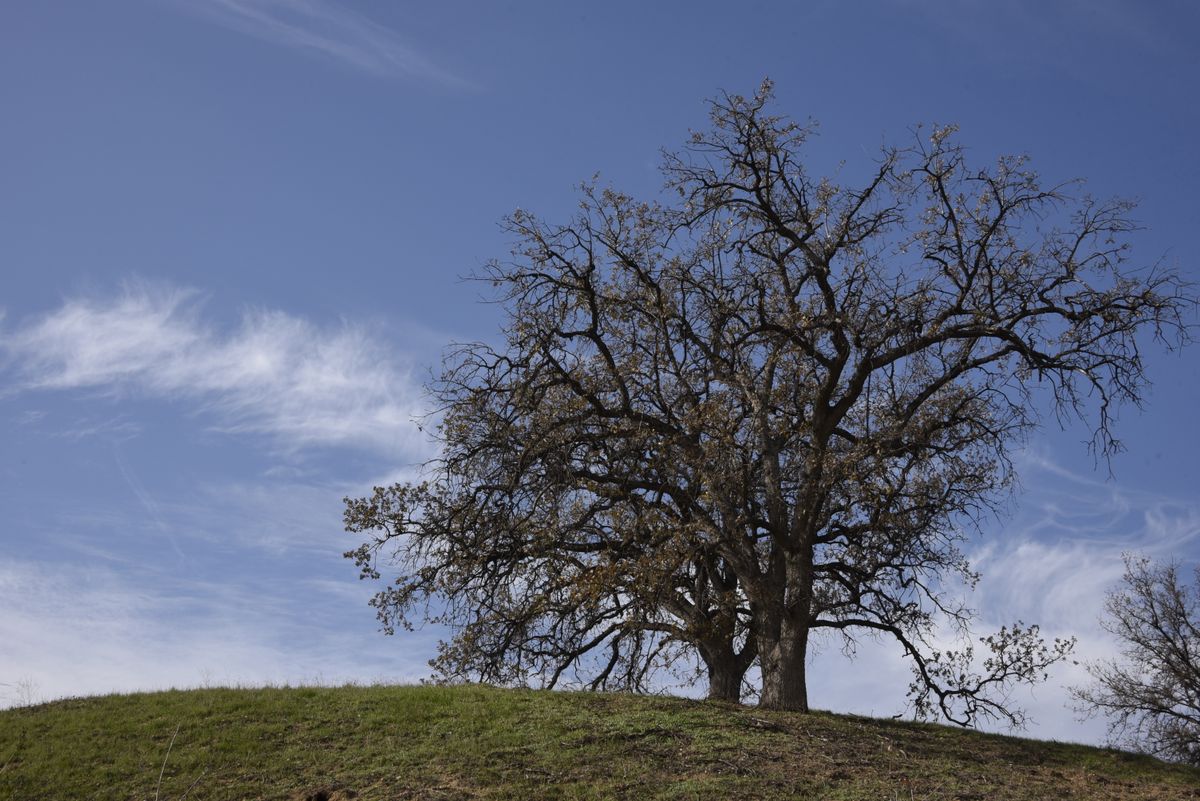
In Atascadero the hazardous tree is usually an oak on adobe clay whose defect is at the base rather than in the crown — a cavity behind an old mower scar, a butt seam holding water through every wet winter, a root plate that has begun to lift where the soil swells and shrinks. That matters because a coast live oak here can look immaculate four metres up and still be the tree we take down first.
Hazardous tree removal is not a bigger version of a routine removal; it is a different job, planned from the ground up, because the tree has stopped being predictable.
What makes a tree a hazard rather than a nuisance
Two things have to be true at once: something in the tree has failed, or is failing, and something the owner cares about sits in the way. Oak woodland over a farmhouse, a walnut leaning toward the county road, a pine over a barn roof — the target is what turns a defect into a hazard.
On Atascadero's rural parcels the targets are often unglamorous: a well head, a septic line, a power drop to a shop, a fence the cattle depend on. A tree with a hollow base standing alone in a pasture is a decision for the landowner; the same tree over the drive is our problem today.
The defects we look for before anyone climbs
The reading happens first, on the ground, and it decides the method. Sometimes that is a written risk assessment; more often it is a careful walk with the owner and a plan.
- Root and butt problems — fungal conks at the base, a raised or cracked root plate, soil heaving on the uphill side, butt seams and old fire scars that have opened into cavities.
- Included bark and codominant forks — common in the fast-grown oaks here, and the reason a large tree splits down the middle in a wind rather than dropping a limb.
- Cracks and seams — a long vertical crack is a tree already in the middle of failing, and it changes how the whole job is sequenced.
- Dead wood aloft — on beetle-killed pine, limbs that will release without warning while a climber is tied in.
Why the method changes
On a sound tree a climber can trust what they are tied into and work at their own pace. On a hazard tree that trust is gone, so the plan leans on controlled removal: a lift or a crane where access allows, or heavy rigging with each piece lowered, and sometimes a temporary support before the first cut. Nobody spikes a hollow oak over a house.
Where the tree is beyond managing at all — a lean the roots cannot hold, a base that has moved — the honest answer is to take it down and accept the cost, and we will say so plainly.
The permit question, answered early
Atascadero has its own tree permit process and the county has its own rules outside the city, and a dead or genuinely hazardous tree is normally treated differently from a healthy protected one. We identify the species and the jurisdiction before a date is set, because a removal scheduled for Saturday that needs a signature first is a wasted week. See permits and tree ordinances for how that runs.
What the ground needs afterwards
A removal on clay leaves a hole, a stump and a changed light profile across the garden, and sometimes a root mass holding a bank above Atascadero Creek. We talk about the stump and the slope in the same conversation as the removal — oak stumps re-sprout for years, and a cut flush to the ground is not a finished job.
If the stump needs to go, that is stump grinding, and where the root plate was doing structural work, the answer is usually erosion control rather than bare dirt.
Field note — Noah Lockhart plans a removal load by load: what each piece weighs, what the rope is holding, and the one cut that decides whether everything after it is routine.
Send a photograph of the tree and its surroundings, and say what sits under it. Call (805) 927-4414 or use our contact page and we will walk the property and tell you honestly whether the tree is a hazard, a maintenance item, or nothing at all.
Questions, quotes, or just exploring — we’re here to help.