
How to Mulch Around Trees the Right Way (Donut, Not Volcano)
Quick answer: How to Mulch Around Trees the Right Way (Donut, Not Volcano) — Mulch is the cheapest thing that happens to a tree: a flat layer over the root zone holds moisture through the dry season, keeps the soil temperature steady and feeds the soil life the tree depends on. Almost every mulch problem is a depth problem or a contact problem — too thick, or piled against the trunk where the bark has to stay dry.
Field note. What we see most on this coast is not too little mulch but too much, in the wrong place: the volcano against the trunk that keeps the bark wet through the fog season and invites rot where the tree cannot show it until the canopy thins.
On the other hand, a thin ring of the wrong material is worse than none at all — matted, water-repellent mulch sheds the rain it was meant to store.
Mulch seems like the easiest job in gardening — spread it, step back, admire. But around trees, the technique matters more than most people realize. Learning how to mulch around trees the right way is the difference between a tree that thrives for decades and one that slowly struggles under a well-meaning pile of bark. And no, that towering cone of mulch you have seen around neighborhood trees (and roasted on gardening subreddits) is not the goal. Here is what your trees actually want.
Why Mulch Matters for Trees
In a forest, nobody mulches — the trees do it themselves, with years of fallen leaves breaking down into rich, spongy soil. Garden mulch is our way of copying that system, and the payoff is real. A proper layer holds soil moisture through dry spells, buffers roots against temperature swings, and blocks the weeds competing with your tree for water and nutrients.
It also acts as a physical shield. String trimmers and mower decks are quietly one of the biggest killers of yard trees — a season of bumps and scrapes to the bark cuts off the pipeline that carries water and nutrients. A ring of mulch keeps the machines at a safe distance and lets the soil life underneath do its thing.
The Mulch Volcano Problem
Scroll through any landscaping forum and you will meet the same villain: the mulch volcano, a heap of mulch piled a foot deep against the trunk. It looks tidy. It is quietly disastrous. Bark is meant to be dry and exposed — bury it, and you keep it constantly damp, which invites rot, fungal disease, and insects looking for a soft entry point. Buried trunks can also sprout weak shoots, and roots that start circling inside the pile may eventually girdle the tree, strangling its own vascular system over the years.
The fix is a shape change: think donut, not volcano. The single most important rule is keeping the root flare — the spot where the trunk widens and flares into its roots — visible and dry at all times.
How to Mulch Around Trees the Right Way, Step by Step
Once you know the shape, the rest is easy. Here is the routine:
- Clear the zone.Remove grass and weeds in a ring 3 to 5 feet across (wider for big trees) so nothing competes with the trunk.
- Find the root flare.Brush away soil and old mulch until you can see the trunk widen. If it looks like a telephone pole going straight into the ground, keep digging gently.
- Water first.Moist soil holds moisture better, so water the area before you spread.
- Spread 2 to 4 inches deep.Coarse wood chips can handle closer to 4 inches; fine mulches do better at 2 to 3.
- Leave a gap at the trunk.Keep mulch 3 to 6 inches away from the bark so the root flare stays exposed.
- Go wide if you can.Ideally, mulch reaches the drip line, but even a 3-foot ring makes a real difference for a young tree.
- Settle, do not pack.A light watering settles everything in place — tamping mulch down defeats the purpose.
Choosing the Right Mulch
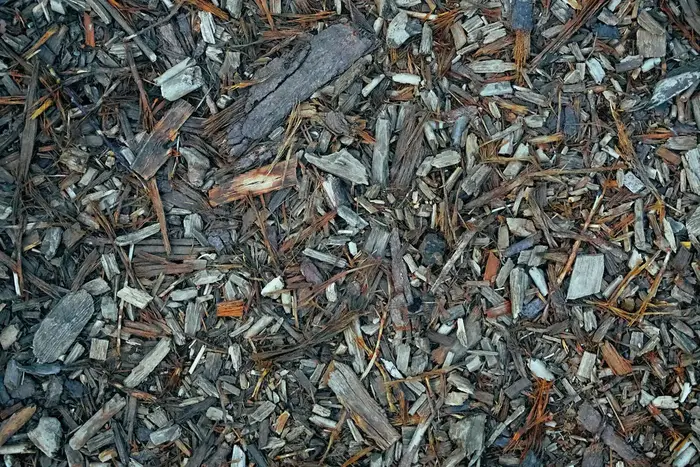
Organic mulches are the move, because they feed the soil as they break down. Arborist wood chips are the gold standard — many tree services will drop a load off for free — alongside shredded bark, compost, and shredded fallen leaves. Skip thick layers of fresh grass clippings, which mat down and turn slimy, and think twice before using stone or rubber mulch around trees: neither decomposes, both radiate heat, and neither does anything for soil health. Landscape fabric is another one to skip; roots grow into it over time and it creates more headaches than it solves.
Keep It Fresh: The Once-a-Year Refresh
Mulch is not a one-and-done project. Each spring, fluff up anything compacted, rake back any mulch that has drifted against the trunk, and top up to maintain that 2-to-4-inch depth. Resist the urge to stack a fresh layer over the old one every year — depth creeps up fast, and buried root flares are how volcanoes happen by accident. If you spot mushrooms or fungal threads, do not panic: many are just decomposers doing useful work. Slimy, matted mulch, though, is your cue that the layer is too thick or staying too wet.
The bottom line: mulch in a donut, not a volcano — 2 to 4 inches deep, pulled back 3 to 6 inches from the trunk, with the root flare always visible. Choose an organic mulch, refresh it once a year, and keep the string trimmer outside the ring. It takes one afternoon, and your trees will spend the next few decades thanking you.
The right mulch depth and ring are the cheapest long-term health investment a tree gets. mulching.
See our the Cambria tree service team for the services we offer across San Luis Obispo County.


Leave a Reply