
Tree Risk Assessments Explained: Protect Your Property
Quick answer: Tree Risk Assessments Explained: What They Find and Cost — Tree work is priced from the tree and the site rather than from a rate card: access, height, lean, what is under it, how the wood comes down, how far it has to travel and what happens to the stump all move the number. That is why a written quote names the work line by line instead of quoting one figure over the phone.
Field note. What we see is that the quotes people worry about are rarely the expensive ones: the job that costs the most is the one re-done, and a plan that protects the driveway, the fence and the roof is cheaper than the repair.
On the other hand, the cheapest quote is not automatically the worst value — the honest comparison is what each one includes, and a figure with no line items is the one that changes later.
Tree risk assessments explained in one sentence: a structured, professional evaluation of whether a tree or branch is likely to fail, how large the failing part would be, and what it would strike on the way down. That third element is where your money sits. A dead limb above a fence line is a maintenance item. The same limb above a roof, a driveway, or a play area is a liability with a countdown timer. A professional assessment converts that uncertainty into a clear, priced decision — before weather makes the decision for you.
Tree Risk Assessments Explained: The Basics
This is not a casual glance at the canopy. A tree risk assessment is a systematic inspection by a qualified arborist — many hold credentials such as ISA Certified Arborist status or a dedicated tree risk assessment qualification. The arborist weighs three variables: the likelihood of failure, the size of the part that would fail, and the target beneath it. The output is a documented risk rating, not a gut feeling.
Inspections scale in depth. A basic assessment is a careful visual examination from the ground, circling the tree on all sides. If something suspicious surfaces — suspected internal decay, a hidden cavity, root-zone trouble — the arborist can escalate to an advanced assessment, using tools like resistograph drills or sonic testing to look inside the trunk without harming the tree.
What the Arborist Actually Checks
The inspection runs from root flare to crown. Typical warning signs include:
- Dead, hanging, or broken branches in the canopy
- Cracks, cavities, or fungal conks and mushrooms at the trunk or root flare — markers of internal decay
- A new or worsening lean, especially with heaving or cracking soil behind it
- Severed, compacted, or decayed roots caused by construction, trenching, or driveway work
- Weak structure such as codominant stems and included bark that splits under load
- Old topping cuts or poor pruning that left the tree structurally compromised
- Site realities: wind exposure, saturated soil, and proximity to people, structures, and power lines
No single item condemns a tree; the skill is judging how these signals combine.
When to Schedule an Assessment
Timing is where most owners lose money — they call after the limb falls. Book proactively instead. After a major storm, inspect any tree that took a hit, because damage is not always visible from the ground. Before and after construction or excavation near the root zone, have the affected trees evaluated. Any large tree overhanging a structure, a parking area, or a space people use daily warrants an evaluation. For large, mature trees, many arborists recommend a routine check every year or two, since conditions change quietly. And when you see a sudden lean, hear cracking, or spot fungal growth at the base, move the appointment up to now.
How the Results Are Rated — and What Happens Next
The arborist combines likelihood of failure, the size of the failing part, and the value of the target into a rating: typically low, moderate, high, or extreme. High and extreme ratings demand action. Low ratings buy you time.
Here is what surprises most owners: removal is the exception, not the rule. Most assessed trees receive one of four outcomes — scheduled monitoring, corrective pruning to reduce weight, cabling or bracing to support a weak junction, or removal of a single hazardous limb. Managing the target counts too. Relocating a bench, a play set, or a parking spot can lower a risk rating without touching the tree. You end up with options and price tags, so you decide on evidence rather than fear.
Why This Inspection Pays for Itself
Run it like any investment decision. Planned pruning and support work cost a fraction of emergency removal, structural repairs, and cleanup after a failure — and emergency crews charge a premium to work in hazardous conditions. Then there is liability. If a tree on your property fails and you had documented warning signs, ignoring them is exactly the kind of detail that decides insurance claims and negligence disputes. A written assessment is your record of diligence.
Remember what you are protecting, too. Healthy mature trees raise property value, cut cooling costs, and help a home sell. The goal of a tree risk assessment is not to strip your landscape — it is to keep the valuable trees standing and remove only the ones that genuinely threaten your assets.
Tree Risk Assessments on the Coast: Cambria Conditions
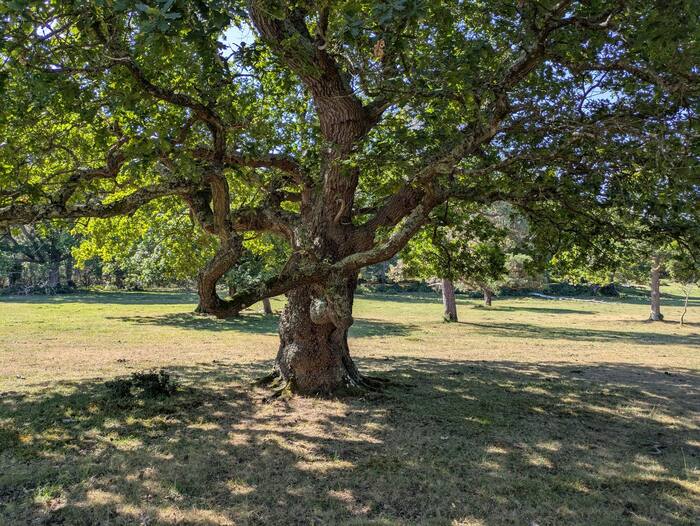
Every winter the same sequence plays out along this coast: a root zone saturated by weeks of rain, then a northwest gust that asks more of a top-heavy pine than the roots can answer. Cambria’s mature oaks, pines and eucalyptus were largely left standing when the lots were cleared, which means plenty of trees now carry decades nobody recorded — old topping cuts, hidden included bark, roots shallow because a driveway went in long after the tree. None of that shows up in a routine pruning visit. It shows up in a tree risk assessment, where the tree is read from root flare to crown and the findings are written down.
Two coastal specifics are worth knowing before storm season. Oaks that begin bleeding cankers at the base deserve an assessment sooner rather later — what sudden oak death looks like on the water explains why. And a dead limb is rarely just maintenance: what happens when dead branches are ignored is how a manageable pruning turns into an emergency call in January.
In summary, a tree risk assessment is a structured inspection that measures the chance of failure, the size of what would fail, and what sits in the strike zone, then converts them into a rating and priced options. Schedule one after storms or nearby construction, whenever a large tree looms over people or property, and on a routine cycle for mature trees. Hire a credentialed arborist, get the findings in writing, and act quickly on high-risk results. It is the least expensive insurance you will ever buy for the tallest assets on your property.
A written risk assessment is what turns “that tree looks fine” into a defensible answer. Book the inspection and get the answer in writing.
See our Cambria tree service for every service we run across the coast.
More on tree risk assessments
What Happens During a Tree Risk Assessment
The process follows industry standards such as ANSI A300 and ISA Best Management Practices. An arborist walks the property, visually inspects each tree from root crown to canopy, and may use tools like a resistograph or sonic tomography to detect internal decay. They record species, size, defects, site conditions, and targets — things like your house, driveway, or playground — that could be harmed if the tree or a large limb falls.
Key Factors Arborists Evaluate
- Structural defects:cracks, cavities, included bark, or weak branch unions
- Root health:girdling roots, construction damage, or soil compaction
- Canopy condition:deadwood, dieback, excessive lean, or unbalanced growth
- Site factors:drainage, wind exposure, proximity to structures, and soil type
- Species profile:some species are more prone to certain failures than others
Understanding the Risk Rating
After gathering data, the arborist assigns a risk rating — typically Low, Moderate, High, or Extreme — based on the combination of likelihood of failure, likelihood of impacting a target, and consequences of that impact. A large oak with a decayed trunk over a bedroom roof might rate High, while the same defect on a small ornamental tree in an open lawn could be Low. The rating helps you prioritize actions and budget for mitigation.
Tree Risk Assessments Explained: Core Principles and Metrics
At its core, a tree risk assessment is a structured audit that assigns a numeric score to each tree based on a set of observable criteria. The most widely used framework is the Scoring Risk Assessment (SRA), which evaluates factors such as trunk diameter, branch density, root stability, and disease presence. Each factor receives a weight reflecting its relative contribution to overall hazard. The resulting risk index–typically ranging from 1 (low) to 5 (critical)–guides maintenance priorities. The methodology is grounded in empirical research; studies have shown that higher SRA scores correlate with increased likelihood of failure, validating the predictive power of the model.

Leave a Reply