The Split That Hasn’t Fallen Yet
Quick answer: The Split That Hasn’t Fallen Yet — Trees on this coast live with fog, salt, wind and thin soil, and the work that keeps them healthy is decided by those conditions rather than by a calendar written inland. Structure, clearance and the root zone are what a tree here needs looked at, and small work done early is what keeps a tree out of the emergency list.
Field note. What we see on this coast is that the trees people worry about are usually not the ones in trouble: the pine with a clean crown and a lean that predates the house is often sounder than the tidy tree that has been quietly drowning in its own root zone.
On the other hand, there is no schedule that suits every tree — the same species on two sides of one street can need opposite care, which is why we look before we recommend.
Two things in a tree are more dangerous than they look: a union with bark trapped inside it, and a limb that is broken but still attached. Both are common, both are readable from the ground, and both are routinely left because the tree still has leaves.
Included bark: the union that never joined
When two stems grow up together and neither asserts dominance, the bark between them is trapped rather than fused. The result is a seam of non-structural tissue running into the crotch. From outside it looks like a narrow V. From the inside it is a gap with a hinge of wood on either side.
The tell is the seam itself: a dark line running down the crotch, sometimes with a bulge, sometimes with a crack at the top. A wide U-shaped union is strong. A tight V with a seam is the one that splits in a loaded year, and it usually splits in the direction of the heavier side.
A crack that opens and closes
A vertical crack in a trunk or a scaffold is not automatically fatal, but a crack that moves is. Measure it. Put a mark across it, or a small glass slide glued on either side, and check it after a wind event and again in a month. A crack that has widened by a millimetre is a tree in the process of failing.
What you do about it depends on the target. Over a shed, remove. Over a path, cordon and assess. Over nothing, monitor — but monitor with a date and a measurement, not with a feeling.
Hangers, and the sound they make
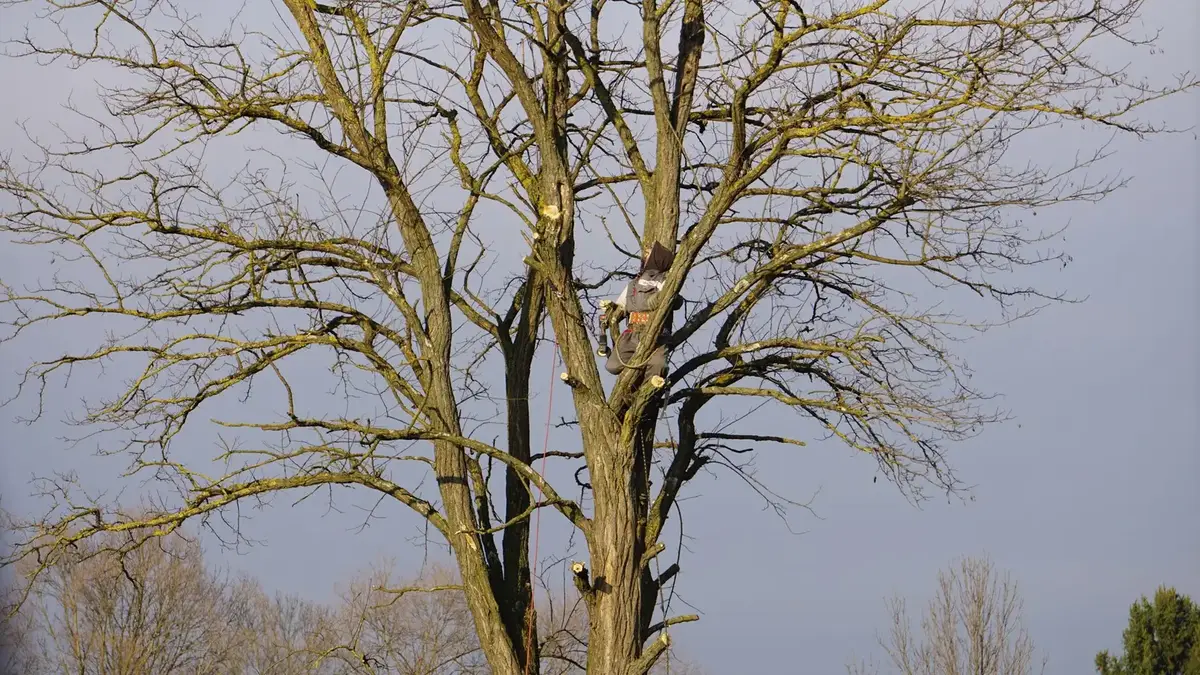
A hanger is a broken limb caught in the canopy, held by fibres or by another branch. It can sit for a year and come down on a still afternoon, which is exactly why it is the most underrated hazard on a residential property. The tell is a limb at an odd angle, a torn underside, and often a strip of hanging bark.
Never pull one down from below. The energy stored in a hung limb can throw it in an unpredictable direction. Either it comes down with a controlled cut from a climber, or it comes down on its own — which is the outcome you are trying to avoid.
What buys time, and what only looks like it
Cabling and bracing can hold a union that is sound but imperfect. It cannot repair included bark, and it cannot make a split trunk safe. A cable installed on a failing union sometimes converts a slow failure into a faster one, because it changes where the load goes without changing the wood.
Reduction is the better tool: taking weight and leverage off the heavy side of a union is the only intervention that addresses the actual mechanism. It has to be done by someone who will cut to a lateral, not to a stub, and it buys years rather than decades.
Write down what you saw, and when
If a limb does come down, the first question is whether anyone knew. A dated photograph of a seam, a note that a crack was measured at four millimetres in March, a record of the arborist who looked at it in April — that is the difference between a tree that failed and a defect that was being managed.
Keep it in the same place as the insurance documents, not in a phone camera roll. Three lines and two photographs per tree per year is enough, and it takes less time than the phone call after the failure.
It also changes the decision. A defect that is photographed and measured stops being frightening and becomes a number that either moves or does not. Most of them do not, and the ones that do tell you early.
The honest summary: a seam, a moving crack, or a hanger is a defect you can see. Photograph it, date it, get it looked at, and do not stand under it while you decide. The tree has already made its decision. You are the only one still deliberating.
And if the tree is over a path, a driveway or a bedroom, deliberate from somewhere else. That is not caution; it is the cheapest safety measure available.
The tree has no opinion about the risk. The file is where the opinion gets recorded, and the file is what is read afterwards. Two photographs and a date cost less than the conversation they replace.