August Is the Exam: Summer Care for a Coastal Garden
Quick answer: August Is the Exam: Summer Care for a Coastal Garden — Trees on this coast live with fog, salt, wind and thin soil, and the work that keeps them healthy is decided by those conditions rather than by a calendar written inland. Structure, clearance and the root zone are what a tree here needs looked at, and small work done early is what keeps a tree out of the emergency list.
Field note. What we see on this coast is that the trees people worry about are usually not the ones in trouble: the pine with a clean crown and a lean that predates the house is often sounder than the tidy tree that has been quietly drowning in its own root zone.
On the other hand, there is no schedule that suits every tree — the same species on two sides of one street can need opposite care, which is why we look before we recommend.
The fog is the most misunderstood thing about summer on this coast. It keeps the air cool, it condenses on needles and leaves by dawn, and it gives the impression that the garden is being watered nightly. It is not. Fog wets surfaces; it barely enters the soil. Under a canopy that drips every morning the soil at four inches can be powder dry, and a tree cannot drink a surface film no matter how heavy it is.
So the coastal summer is a dry season wearing a damp costume, and the mistakes we make here are the mistakes of a wet climate.
Water deeply, rarely, and out at the drip line
A tree’s absorbing roots are mostly in the outer two thirds of the rooting area, not at the trunk. Watering at the base of a mature tree is close to pointless: it wets a small column of soil next to the flare and leaves everything that matters dry. Put the water where the fine roots are — under the canopy’s edge and beyond — and deliver it slowly enough to soak in rather than run off.
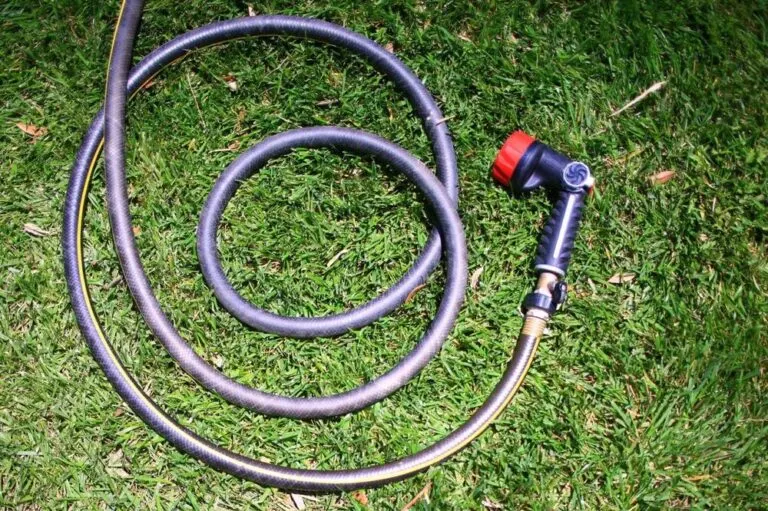
The infrequent deep soak also grows a better root system than a nightly sprinkle. Shallow watering teaches roots to stay near the surface, which is exactly where they cannot survive September. A soaker hose coiled around the drip line, or a hose left trickling and moved twice, does more in an evening than a sprinkler does in a week. The volumes involved for an established tree are worked out in watering a tree that has been here since 1950.
Water covers the ground
The cheapest summer work is also the fastest: get mulch down before the dry months rather than after the damage. Three inches of arborist chips cut evaporation dramatically, keep the soil temperature out of the range that kills fine roots, and prevent the compaction that happens when watering and traffic meet bare ground.
Keep the mulch off the trunk and out of the first five feet of a structure, where it should be gravel or managed bare ground. Beyond that ring, thickness is your friend.
Do not fertilise, and do not invent new wounds
Two mistakes are made in every hot, dry summer. The first is fertiliser: it pushes a flush of soft growth the roots cannot supply in dry soil, and it is the fastest way to convert a surviving tree into a declining one. There is no situation in which a mature tree in dry ground needs nitrogen in July.
The second is pruning. Every cut is a wound, and in the warm months the insects that specialise in fresh wounds are flying: bark beetles on pines, the pathogens that ride on airborne spores onto exposed sapwood. The signs that a beetle has already arrived are in reading a pine. A light structure is better than a tidy tree.
If a limb has to come off in summer — a hazard over a driveway, a branch on a roof — take that one limb and leave the canopy alone.
Read heat stress correctly
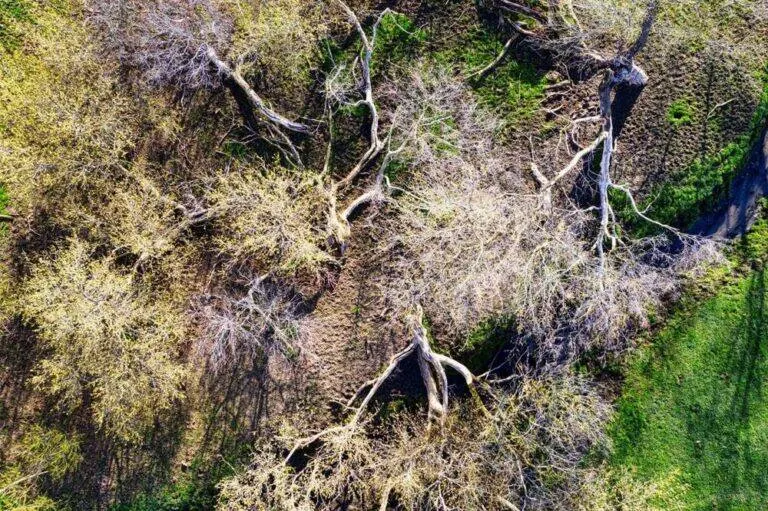
Summer is when trees send signals that get misread. Leaves that curl or hang at midday and recover overnight are defending themselves successfully — nothing needs doing. Leaves that are dull, grey-green and stay that way through the evening are telling you the soil under them is dry, and the response is water, not a diagnosis.
Needles browning from the base of a pine in a dry summer is a different story and is worth a look, because that pattern matches the beetles that follow drought.
The useful habit is a walk after each heat event, from the same angle, with a phone. Two photographs a week apart will tell you more about whether a tree is in trouble than any single inspection, because the answer is nearly always in the change.
The things that are actually summer work
If you want a list of work that belongs in July and August, it is short. Check the irrigation before the first hot spell, at the far end of every line, not at the tap. Clear dead branches that are already dead — the ones with no green, which are a hazard rather than a wound, since cutting dead wood triggers no response and invites no beetles.
Keep the first five feet of a structure free of anything that will carry fire — the standard is set out under fire clearance — and keep the gutters clear of needles.
And resist the urge to fix things. September is when this coast collects the bill for a dry season: the tree that looked fine all summer browns in three weeks, and the reason is usually that it spent the summer being watered at the wrong depth, or not at all below the root ball’s dry crust.
The three-year version of that story is told in the drought the trees have not caught up with. The work that pays is the work done early and the work not done at all.
The most useful summer fact for planning is this: the failure that follows a dry season usually arrives after the rain, not during it. A root system that shrank over three dry years cannot absorb a saturated clay soil in the first wet winter, and that is when the tree collapses and the owner blames the storm. Water this summer as though the next winter depended on it, because it does.