Sandy Lots: When the Root Plate Cannot Hold
Quick answer: Sandy Lots: When the Root Plate Cannot Hold — A stump is the part of the problem that is still in the ground: it holds the roots that lift pavement, keeps a species alive if it re-sprouts, and occupies the spot where the next planting goes. Grinding removes it below the surface so the ground can be worked again, and the roots that matter are the ones under the driveway rather than the ones beside the trunk.
Field note. On this coast the stump is rarely the end of the job: Monterey pine and eucalyptus both keep enough energy in the roots to push new growth, so we are looking at the species before we quote the grind rather than after.
On the other hand, a stump left in a garden bed is sometimes the better answer — it decays, feeds the soil and costs nothing — so grinding is a choice, not a rule.
Ask an arborist what a root system looks like and most will describe something wider than the crown and surprisingly shallow — a plate, not a taproot, spreading two or three times the radius of the canopy in the top foot or so of soil. That description was built in loam. On sand it is wrong in a specific and consequential way.
Sand drains. That is its virtue and its problem. Water moves through it fast, taking nutrients with it, and the fine roots that do the absorbing have to be where the water pauses long enough to be caught. In a sandy profile those places are thin horizons, sometimes a buried layer, sometimes the boundary where sand meets clay.
A tree on sand therefore builds a root system that is more clustered, more vertical, and less uniformly spread than the textbook plate.
What that does to the anchor
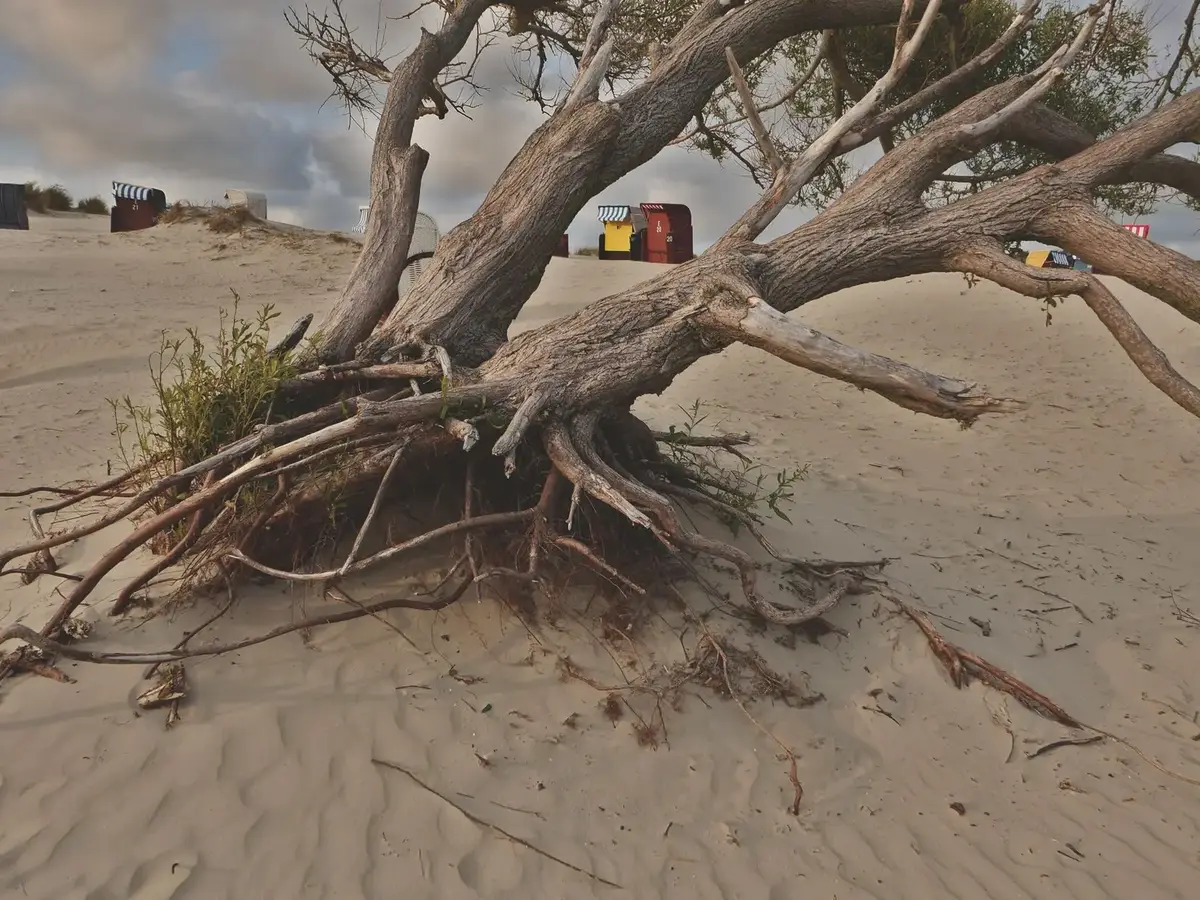
A root plate holds a tree by spreading load across a wide area of soil, and by the friction between roots and particles. Sand has less of both. It has a lower shear strength than clay, and its particles rearrange under load rather than gripping. On a sandy lot the anchor is real but it is narrower, and the failure mode shifts from the trunk snapping to the whole plate rotating.
That matters because the two failures look completely different from the ground. A trunk failure gives warning: a crack, a bulge, a seam, sometimes a year of resin or sap. A plate failure gives almost none. The tree stands straight, the crown is green, and then in saturated ground the plate lifts on the windward side — sometimes an inch, sometimes all at once.
The signs, in order of reliability
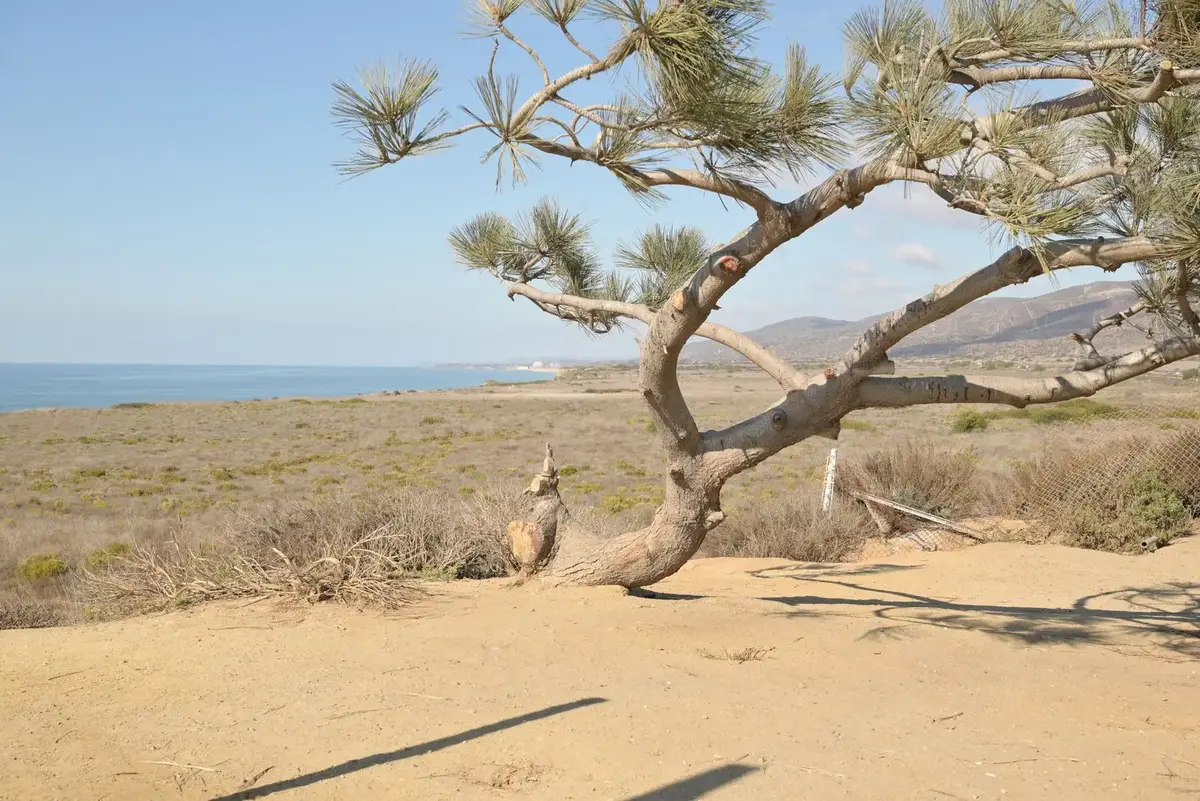
The most reliable sign is ground geometry: a rise or crack in the soil on the lee side of the lean, a gap where the soil has pulled away from the base, a mound that was not there last year. These are read best after rain, when the soil has softened and any movement is recent and visible. The second is the flare.
On sand, the root flare should be wide and buttressed; if it is buried, the tree has lost the structural transition that spreads load from trunk to roots.
The third is lean that has changed. Not a tree that has always leaned — a tree that leans more than it did. This is why a photograph with a date on it is worth more than an opinion, and why a survey stake or a fence post in the frame helps.
What makes a sandy-lot tree more vulnerable
Water is the variable. Sand at field capacity holds together reasonably; sand saturated after three days of rain behaves like a liquid with grit in it. A tree that was stable in September can be unstable in January without changing anything about itself. This is why the failures on coastal sandy lots cluster in storms and why a dry summer followed by the first atmospheric river is the worst combination.
The second variable is what has been done to the ground. A graded pad, a new driveway, a French drain that discharges at the base of a tree, a pool excavation — all of these change where water goes. Sand transmits a change in drainage much further than clay does, so an excavation thirty feet away can dewater a root zone that the owner never thought was connected.
The third is the tree’s own history: a pine that grew in shelter and then lost its neighbours to a view cut has had its wind load changed entirely.
What can be done
Less than people hope, and more than nothing. You cannot widen a root plate. You can protect the flare — remove soil that has been mounded over it, stop traffic across the root zone, keep irrigation from saturating the base. You can reduce load at the far end of the lever with a proper crown reduction, which buys time in a way that topping does not.
You can plant for the soil you have, choosing species that anchor in sand rather than species that merely tolerate it.
What you should not do is assume the tree is fine because it has been fine. On a sandy lot, the honest position is that the anchor is the limiting factor, and it is worth having assessed once, on a dry day, before the winter that tests it. The risk assessment page describes what that visit covers, and deep watering covers the irrigation side of keeping a root zone healthy without saturating it.