Tree Service for Apartment Complexes: Work Without Closing
Quick answer: Tree Service for Apartment Complexes That Stay Open — Trees on this coast live with fog, salt, wind and thin soil, and the work that keeps them healthy is decided by those conditions rather than by a calendar written inland. Structure, clearance and the root zone are what a tree here needs looked at, and small work done early is what keeps a tree out of the emergency list.
Field note. What we see on this coast is that the trees people worry about are usually not the ones in trouble: the pine with a clean crown and a lean that predates the house is often sounder than the tidy tree that has been quietly drowning in its own root zone.
On the other hand, there is no schedule that suits every tree — the same species on two sides of one street can need opposite care, which is why we look before we recommend.
Tree work at an apartment complex is a logistics problem wearing a horticulture hat. The canopy may be straightforward; the site is not. There is one access road, cars in every space, a laundry room with a vent, and a tenant who sleeps during the day because they work nights.
Every one of those is a constraint on when and how the work can happen, and none of them appear on a quote for a house.
Start with the site plan, not the tree
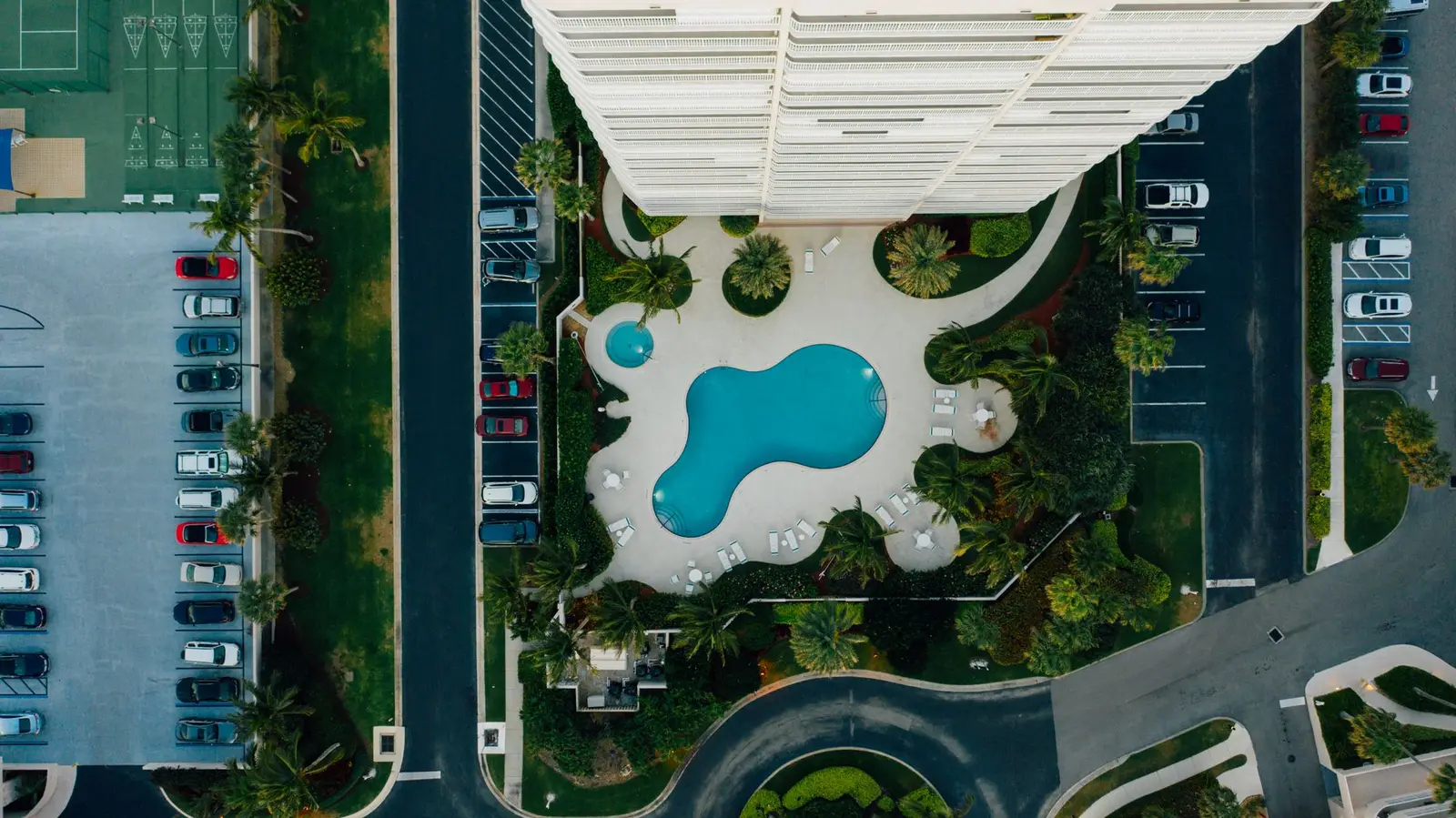
Where does the chipper sit, where does the truck turn, and where does the material leave the site? On a tight lot the answer is often a designated drop zone at the far end of the car park, with the crew walking material rather than driving to each tree. That decision changes the price more than the pruning does.
Also mark the services: the sewer lateral, the water main, the electrical conduit to the signage, the irrigation. A stump grinder through an irrigation line is a week of dead lawn and an argument about who pays.
Clearance over cars and lights
The standards here are written by insurers and lighting codes, not by arborists. Fourteen feet over a drive aisle, eight to ten over a parking space, and nothing within three feet of a pole light or a security camera. A canopy that swallows the lot lighting turns a well-lit car park into a dark one, which is both a security finding and a liability finding.
Raising is the usual answer, done in one visit rather than three so the lot is closed once. Removing a limb is cheap; closing forty spaces three times is not.
Roots and asphalt
Trees in a car park heave the surface, and the heave is a trip hazard with a measurable claim history. The fix is not to cut the roots back hard — that destabilises the tree and often kills it slowly — but to grind the stump of the tree you are removing, or to repair the surface with a flexible patch and accept the hump.
Where a tree is heaving the main aisle and the surface cannot be repaired around it, removal is the honest answer, and the replacement should go in a planting strip with a root barrier rather than a tree pit in the middle of the asphalt.
Notices, hours and the person on nights
Post the notice on every door and at the entrances at least seventy-two hours ahead, with the hours, the spaces affected, and a number for questions. Start at eight rather than seven: a chainsaw at seven in a building of shift workers generates complaints that outlast the work.
Ask the manager for the two or three tenants who will be most affected — the night worker, the person with a newborn, the one with a disability — and knock on those doors personally. It costs five minutes and it is the difference between a job that is tolerated and a job that is reported.
After the work: the site put back
The job is not finished when the last limb leaves. Asphalt needs patching where the truck stood, irrigation lines cut by the grinder need repairing, the lawn needs seed and the parking bays need restriping if the machine tracked over them. Those items are cheap individually and expensive as a complaint.
Write them into the scope as a line: reinstate surfaces, irrigation and planting to the condition recorded in the pre-work photographs. Then take the same photographs at the end, from the same positions, and walk the site with the manager before the crew leaves.
That walkthrough is also when the manager learns what to watch: the stump that will settle, the limb that was left for next year, the drain that must stay clear. Five minutes at the gate prevents the call three weeks later that starts with nobody told me.
Then the paper: the certificate of insurance naming the ownership entity, the workers on site, and a written scope that says which trees and what cuts. A complex is a commercial client, and the file should look like one.
The manager should be able to open one folder and answer every question an owner, an insurer or a buyer will ask: what was done, when, by whom, and what is planned next.
Hand that folder to the next manager and the programme survives the change of staff, which is where most apartment tree work quietly stops.