Mulch and Fire: What Belongs in the First Five Feet
Quick answer: Mulch and Fire: What Belongs in the First Five Feet — Mulch is the cheapest thing that happens to a tree: a flat layer over the root zone holds moisture through the dry season, keeps the soil temperature steady and feeds the soil life the tree depends on. Almost every mulch problem is a depth problem or a contact problem — too thick, or piled against the trunk where the bark has to stay dry.
Field note. What we see most on this coast is not too little mulch but too much, in the wrong place: the volcano against the trunk that keeps the bark wet through the fog season and invites rot where the tree cannot show it until the canopy thins.
On the other hand, a thin ring of the wrong material is worse than none at all — matted, water-repellent mulch sheds the rain it was meant to store.
Every mulch article recommends organic material, and this one mostly does not — at least not in the five feet closest to the house. That zone has a different job from the rest of the garden, and the job is to give an ember nothing to burn.
Why the first five feet
Defensible-space guidance on this coast divides the landscape around a house into zones. The immediate zone, the first five feet from the wall, is meant to be non-combustible: gravel, stone, concrete, bare mineral soil. The reason is embers. A wind-driven fire does not need a wall of flame to reach a house; it needs a landing place, and a bark bed against the siding is a landing place that will smoulder for hours.
Beyond that, organic mulch is fine and useful. The rule is about the first five feet, not the whole garden.
Which materials are worse
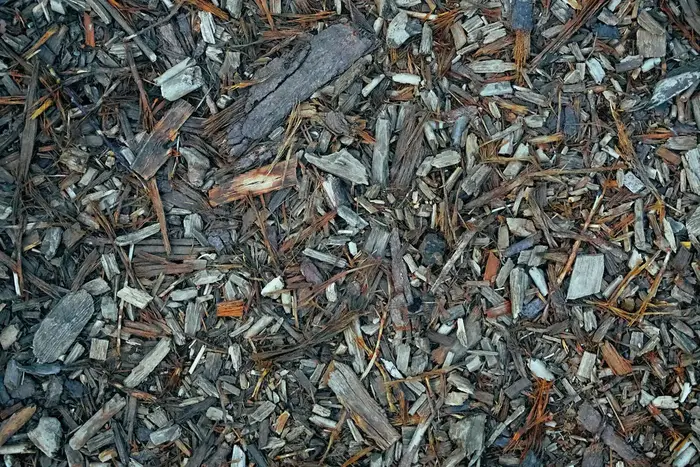
Fine, dry, resinous material is the worst: bark fines, pine needles, shredded cedar, rubber. Coarse compost is better but still organic. Gravel, crushed rock and concrete are the only genuinely non-combustible options. Wood chips are somewhere in the middle — they burn, but more slowly than fines.
The other variable is depth and contact. A thin layer against a vent is worse than a thick layer in the open, because the vent is the opening the ember is looking for.
The details that actually fail an inspection
Mulch piled against the siding. A wooden fence running to the wall with a bed beneath it. A deck with mulch under it. Shrubs under the windows. A woodpile against the house. Those are the five things an inspector looks for, and mulch is only one of them.
If you are keeping a bed near the house, keep it low, keep it clean of leaves, and keep it out of the first five feet. An irrigated, green, low herbaceous bed is far less of a problem than a dry bark bed, because the fuel is not cured.
What to do instead
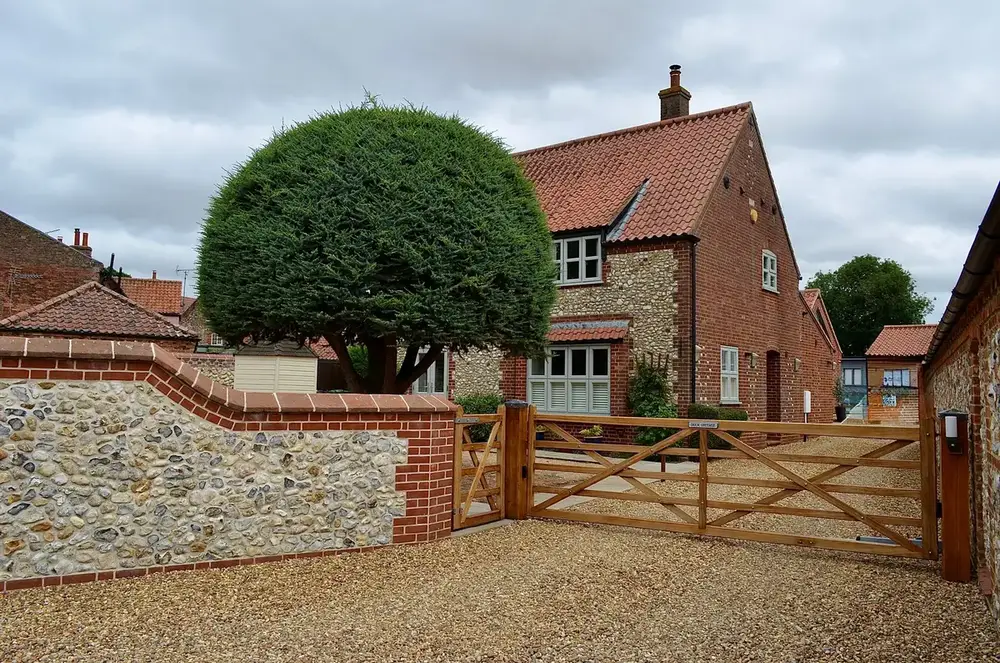
Replace the first five feet with gravel or stone over landscape fabric, or with concrete or pavers. Where the design needs planting, use low succulents or irrigated groundcover in mineral soil, not a bark layer. Keep the gutters clean and the roof free of needles — the roof is a larger ember trap than any bed.
Further out, mulch normally. The garden does not have to be bare to be defensible; it has to be arranged so that fire has to work to reach the wall.
One honest caveat: mulch flammability is a small part of a large problem. The roof, the vents, the windows and the vegetation within thirty feet matter more. But the first five feet is the part you can fix in a weekend, and it is the part that decides whether the ember has a bed to land in.