What Mulch Does That Watering Cannot
Quick answer: What Mulch Does That Watering Cannot — Mulch is the cheapest thing that happens to a tree: a flat layer over the root zone holds moisture through the dry season, keeps the soil temperature steady and feeds the soil life the tree depends on. Almost every mulch problem is a depth problem or a contact problem — too thick, or piled against the trunk where the bark has to stay dry.
Field note. What we see most on this coast is not too little mulch but too much, in the wrong place: the volcano against the trunk that keeps the bark wet through the fog season and invites rot where the tree cannot show it until the canopy thins.
On the other hand, a thin ring of the wrong material is worse than none at all — matted, water-repellent mulch sheds the rain it was meant to store.
People ask whether they should mulch or water more. It is like asking whether to insulate a house or turn up the heat. Both matter and they do different jobs. Water is a delivery; mulch is the reason the delivery is still there a week later, and the reason the soil underneath it is a place roots want to be.
The temperature effect, which nobody mentions
A bare soil surface in September on this coast can reach 90 degrees in the top inch while the soil at six inches stays near 65. A three-inch mulch layer cuts that surface swing dramatically. Roots grow within a much narrower temperature band than shoots, and the fine roots that absorb water are shallow. When the surface is too hot, root growth stops in exactly the layer that matters.
In winter the same layer works the other way: it slows the loss of soil heat and reduces the freeze-thaw churn that lifts young plants out of the ground. One material, two seasons, and neither effect is about appearance.
The biology, which is the real point
Under a mulch layer, fungi and invertebrates break the material down into exactly the compounds a tree’s fine roots are built to absorb. The soil becomes crumbly, holds air, and infiltrates water instead of shedding it. This process takes years, which is why a mulch ring applied once looks pointless and a ring maintained for five years looks like a different garden.
Fertilizer skips that process. It delivers salts directly and can suppress the fungal networks that were doing the work. If the soil is already alive, mulch is the feeding; if it is dead, mulch is how you restart it.
The water effect, stated precisely
Mulch does not create water. It reduces evaporation from the soil surface and slows runoff, so a given inch of rain or irrigation penetrates instead of running off a crusted surface. On a slope, a mulch ring is often the difference between water entering the root zone and water crossing the driveway. That is a bigger effect than most people expect and it is the one that shows up in a dry September.
The weed effect, and why it is not the main reason
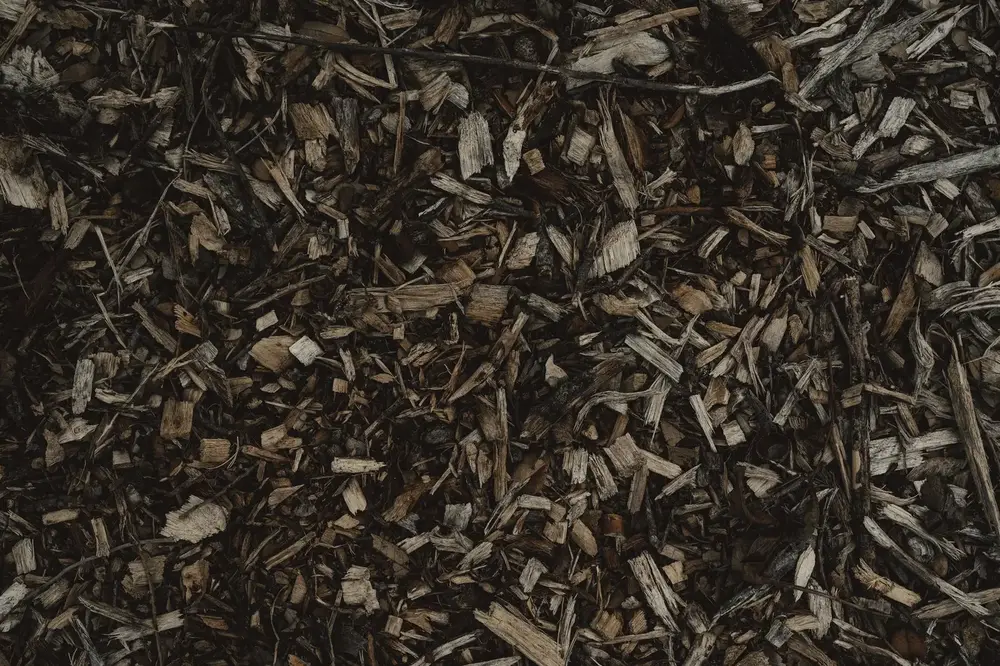
Three inches suppresses most annual weeds and makes the perennials easy to pull. But if mulch is sold to you as weed control, it will be applied too thin to do the other jobs, because thin mulch is cheaper. The weed suppression is a side effect of doing the depth correctly, not a separate product.
Keep it off the trunk. A mulch volcano holds moisture against the bark and the root flare, and that is how you get rot at the base of an oak. A flat ring, three inches deep, starting a hand’s width from the trunk and extending to the drip line, is the whole technique. Everything else is marketing.