Sudden Oak Death in Cayucos: Reading the Dieback
Quick answer: Sudden Oak Death in Cayucos: Reading the Dieback — Most tree trouble on the Central Coast is identified before it is treated: a borer, a canker and a drought-stressed root system can look the same from the ground, and each has a different answer. Diagnosis is the first cut — host, sign and season — and the least-toxic control that fits comes after it.
Field note. What we see on this coast is that the tree under fog is often the healthier one and the tree on a hot exposed edge is the one that gets hit — stress is the invitation, and the coast hides it well.
On the other hand, treatment is not always the kindest answer: for a hazard tree with internal decay, careful removal protects the neighbours, and replanting does more for the site than a season of injections.
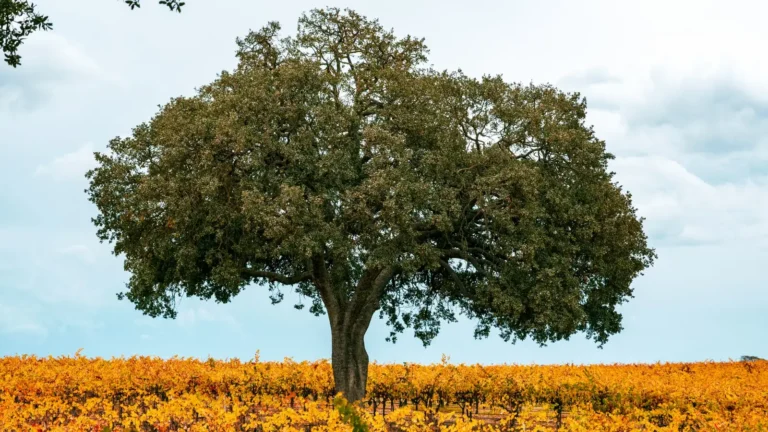
Sudden oak death is caused by Phytophthora ramorum, a water mould that moves in wet weather and infects the bark of several oak species. In Cayucos and the hills behind it, the coast live oak is the tree people call about, and the call usually comes when a crown has gone brown in a matter of weeks.
The name is the most misleading thing about it. The pathogen has been in the tree for months. The visible collapse is fast.
What it looks like
A bleeding canker on the trunk: a dark, wet-looking stain, often with a reddish or black ooze, usually within a few feet of the ground. Under the stain the cambium is dead, and the boundary between dead and live tissue is a sharp line you can find with a knife — carefully, and on a tree you are prepared to lose.
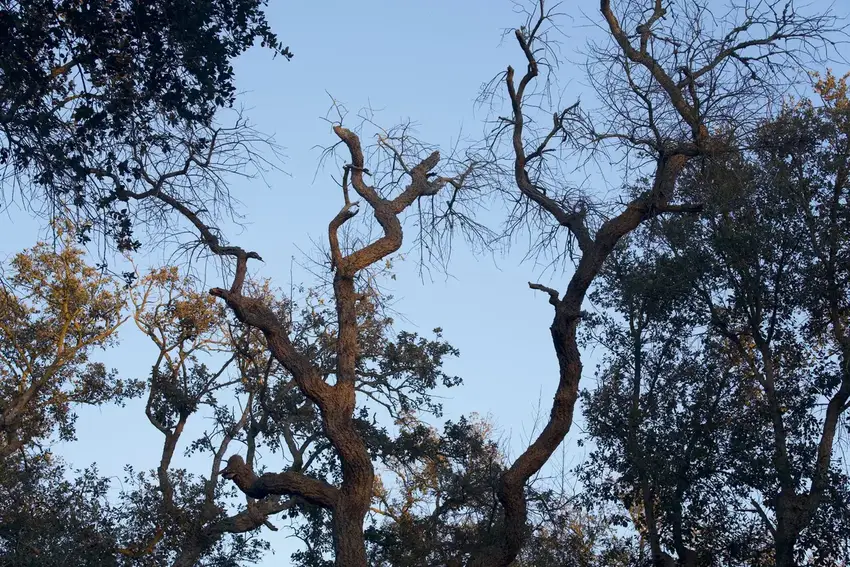
The crown then browns from the top or from one side, over a few weeks, and the leaves stay attached for a while. By the time the crown is brown the canker has usually girdled enough of the trunk that the tree will not recover.
How it spreads, and what carries it
Spores move in water: rain splash, fog drip, runoff, and soil on boots and tyres. They also move on pruning tools and on the blades of equipment that has worked in an infected stand. The pathogen needs wet conditions to infect, which is why this coast is a good home for it and why the dry months are when work is safest.
California bay laurel is the other half of the story. It carries the spores without dying, and it grows alongside the oaks. A property with bay and oak together has a transmission route that a property with oak alone does not.
What to do on a property with a suspect tree
Do not move the wood. Do not chip it and spread the chips in the garden. Do not take soil from around the base to another part of the property. If the tree is removed, the material should be disposed of in a way that does not redistribute it, and the equipment should be cleaned before it goes to the next job.
Work in dry weather, clean the saw between trees, and keep the bay that overhangs the oak from being pruned in the rain. Those three rules are the practical core of management, and none of them requires a diagnosis to be worth following.
Where the line is
A tree with a bleeding canker and a browning crown is a removal in most cases, for safety rather than for cure. A tree with a small lesion and a green crown may be worth a confirmatory test and a monitoring plan; a few individuals do wall off an infection, and knowing whether you have one is worth the sample.
Replanting is the part people skip. Replacing an oak with another oak in the same soil, beside the same bay, is how a property ends up with a second dead tree in fifteen years. Plant something that is not a host, or plant further from the bay, and give the new tree room.
Clearing, fire and the spread
Two activities accelerate the disease, and both are common here. Clearing that moves soil and chips downhill spreads the pathogen into clean ground. And fire clearance that removes the bay under an oak removes the symptom but not the inoculum — the spores are already in the soil, and the oak is still standing in them.
The defensible version of both: work in dry weather, keep the soil on site, chip and burn rather than truck, and clean the equipment before it leaves. None of that is dramatic, and it is the difference between a property that loses one tree and one that loses the stand over fifteen years.
One last thing: the diagnosis is a laboratory question, not a visual one. A bleeding canker can be several things. If it matters — a heritage tree, a property sale, a whole stand — get it sampled rather than guessed at.
And if the answer is yes, tell the neighbours. The pathogen does not respect a fence line, the spores travel on wind-driven rain, and the property next door is making decisions about its own oaks with half the information. A conversation at the fence costs nothing and buys a shared plan. Silence is how a good diagnosis becomes a dispute.