How to Assess Dead Branches Safely From the Ground
Quick answer: How to Assess Dead Branches Safely From the Ground — Trees on this coast live with fog, salt, wind and thin soil, and the work that keeps them healthy is decided by those conditions rather than by a calendar written inland. Structure, clearance and the root zone are what a tree here needs looked at, and small work done early is what keeps a tree out of the emergency list.
Field note. What we see on this coast is that the trees people worry about are usually not the ones in trouble: the pine with a clean crown and a lean that predates the house is often sounder than the tidy tree that has been quietly drowning in its own root zone.
On the other hand, there is no schedule that suits every tree — the same species on two sides of one street can need opposite care, which is why we look before we recommend.
The dangerous branch is not the one lying on the driveway. It is the one still attached, still holding, and no longer able to answer the wind the way it answered it last season. Every winter on this coast I have the same conversation: the tree looked fine in September, a limb came down in the first real rain, and the owner stands there telling me nobody could have known. Usually somebody could.
Not with certainty — trees do not deal in certainty — but with four checks that take ten minutes and a pair of binoculars.
Check one: is it still attached?
A hanger is a broken branch caught in the crown, held up by the limb below it or by the tangle of twigs around it. It is the most dangerous common condition on a residential tree, because nothing about it looks wrong from underneath: the foliage may still be green, the silhouette from the driveway is unchanged, and the only thing holding several hundred pounds of wood is friction.
Look for a branch whose angle does not match its neighbours, a piece resting across another with no union between them, or a patch of foliage sitting oddly high in a crown that has already thinned.
Check two: what is underneath it?
Now look down. Not at the branch — at the space under it. A dead limb over a hedge you trim twice a year is a maintenance item. The same limb over the bed you sleep in, the walk from the car, the dog’s run, or a service drop is a risk with a target, and the target is what turns a hazard into a risk.
This is the check that decides how fast everything else has to happen, and it is the one a photograph cannot answer from another town.
Check three: how dead is dead?
Decay is a gradient, and the clues are on the outside. A branch with no fine twigs at the tip is tissue that is no longer being fed. A branch whose bark has begun to slough, or that shows a dark ring around an old pruning wound, is losing its attachment at the union rather than merely losing its leaves.
Fungal growth on the branch itself means the wood is being consumed, and that is the finding that shortens every timeline in the file.
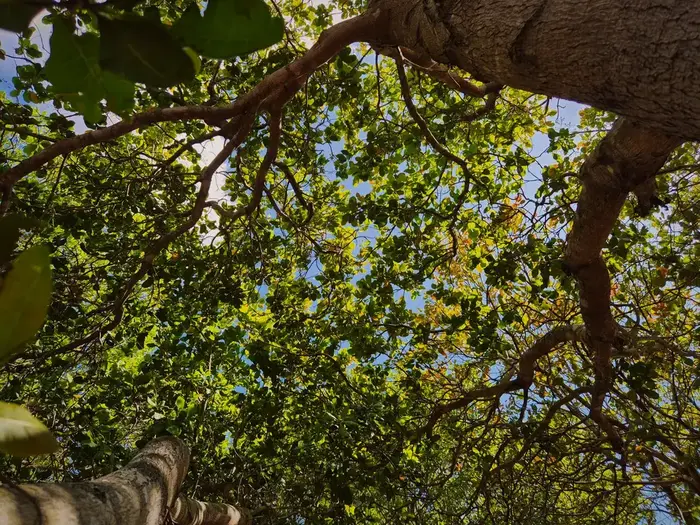
Compare the suspect against its neighbours on the same tree. A branch that is still supple and grey-green beside three that are shedding bark is not dead, and a clean stub is usually a cut the tree sealed years ago rather than a wound in progress. Binoculars are the honest tool here, because standing under a tree and craning your neck shows you the underside of everything — which is exactly where a hanger hides.
Walk thirty feet back, look up, and use the binoculars to look at the TOP of the branch rather than the bottom.
Check four: the electrical one
If any part of the branch is on, near or inside a power line, the article is over. A limb resting on a service drop, a pine touching the line between two poles, a branch the storm left lying across the wire in the street — none of that is a tree job. Stay clear, keep children and dogs clear, and call the utility.
Nobody else may touch it, and any tree company that offers to work around a live conductor is telling you how it works. This is the one check where the correct next step is not a phone call to an arborist.
What you can act on, and what needs a climber
The four checks sort a tree into three piles. A dead branch over nothing important can wait until it is worth somebody’s day — and it is worth writing down the date you first noticed it, because decay accelerates in year three faster than year one. A dead branch with a target underneath is a small, cheap job this month, and the work is a pruning visit rather than a removal.
The third pile is where the answer changes: a hanger, fungal growth on the branch, a limb that dropped without warning, or several dead branches in one crown. One dead branch is a branch. Several on the same tree, on a tree that has also dropped something, is a tree that has stopped maintaining part of itself, and the question stops being which branch to cut and becomes what the whole tree is doing.
That is a written answer with a time frame attached, and it is the document an insurer or a buyer will actually read.
The safety lesson
Never stand under the thing you are looking at. It is the first rule of every crew on this coast and it costs nothing to keep at home: put the tree between you and the sky you are worried about, look from inside a doorway, or look from across the street. The branch you are inspecting has already demonstrated that it can fail.
Give it room, then make the phone call — and if the answer is that it hangs over the room you sleep in, make it the emergency call rather than the estimate, because the difference between those two phone calls is measured in hours and in what is underneath.