How Tall Work Works Above Cayucos
Quick answer: How Tall Work Works Above Cayucos — Trees on this coast live with fog, salt, wind and thin soil, and the work that keeps them healthy is decided by those conditions rather than by a calendar written inland. Structure, clearance and the root zone are what a tree here needs looked at, and small work done early is what keeps a tree out of the emergency list.
Field note. What we see on this coast is that the trees people worry about are usually not the ones in trouble: the pine with a clean crown and a lean that predates the house is often sounder than the tidy tree that has been quietly drowning in its own root zone.
On the other hand, there is no schedule that suits every tree — the same species on two sides of one street can need opposite care, which is why we look before we recommend.
The cypresses on the bluffs here run to eighty or ninety feet, and they grow in clusters, which means most of the work is not one climb but several, each with a rigging problem attached. From the ground it looks like a person standing in a tree. From inside the canopy it is a sequence of small, deliberate decisions, and the height is the least interesting variable.
Getting up there
On a removal, the climber generally goes up on spikes — steel gaffs strapped to the boot that bite into the trunk — because the tree is coming down and the wounds do not matter. On a prune, spikes are not used: every puncture is a wound the tree has to seal, and on a thin-barked cypress they are an invitation to canker.
A prune is climbed on rope. A line is set over a high, sound limb with a throw bag and a thin line, then a climbing line is pulled through and the climber ascends it with a mechanical ascender, using the trunk for balance and never for support. The distinction matters: the rope is the life support, the tree is the workplace.
Rigging is the actual work
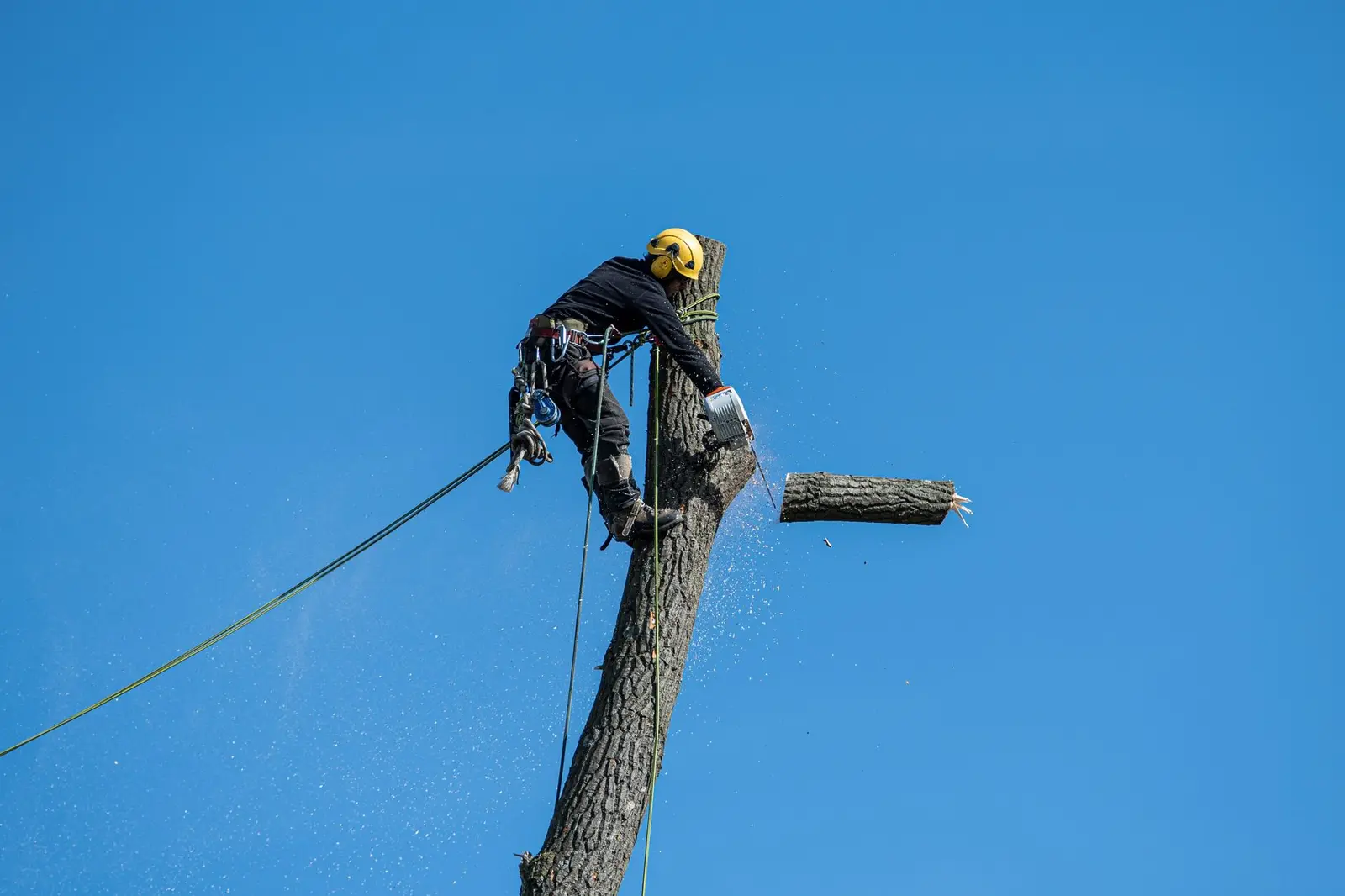
On a tall removal in a tight lot, nothing is dropped. Each piece is tied off, cut, and lowered on a rope through a block anchored above, with a ground person controlling the descent on a friction device. The climber’s job is to make each piece small enough for the rigging to hold and to cut it so it swings away from the stem rather than into it.
That calculation — how big a piece, at what angle, with how much rope — is most of the skill. A piece that is too large shock-loads the anchor point and can snap the very limb the block is hanging from; a piece that is too small turns a two-hour job into a six-hour one.
The rule of thumb is that the rigging is rated many times the weight of the piece, but the anchor wood is not, and the anchor is a tree limb.
The wind limit
There is a number, and it is lower than most homeowners expect. Sustained wind above about 20 mph, or gusts that make the top of the tree move more than a foot, stops climbing work on a tall tree. Not because the climber will be blown out of it — the ropes hold — but because a moving anchor makes the rigging unpredictable, and because a piece that swings unexpectedly in a gust is a piece nobody planned for.
On this coast that means the work is scheduled around the marine layer and the afternoon wind, which is why a tall removal is often a morning job. It also means a job can be stopped halfway, with the tree in a state that is neither up nor down, which is a cost that has to be planned into the schedule rather than discovered on the day.
The ground crew and the drop zone
Every piece that comes down has to land somewhere, and on a residential lot the landing zone is usually a strip of garden between a fence and a house. Brush is dragged out as it accumulates; logs are bucked and stacked or chipped.
The ground person controls the rope, keeps the drop zone clear of people and animals, and is the climber’s second set of eyes for everything the climber cannot see — which, ninety feet up in a dense canopy, is quite a lot.
Two people, one rope, and a plan that both of them understand before the first cut: that is what makes tall work safe. It is also why a crew that turns up with one climber and no ground support is a crew to send away.
For what the job includes and how it is priced, see tree removal and crane-assisted removal for the cases where the tree is too big or too close to rig by hand.