
Decay Pockets, Cavities and Hollow Trunks: When to Worry
Quick answer: Decay Pockets, Cavities and Hollow Trunks: When to Worry — Trees on this coast live with fog, salt, wind and thin soil, and the work that keeps them healthy is decided by those conditions rather than by a calendar written inland. Structure, clearance and the root zone are what a tree here needs looked at, and small work done early is what keeps a tree out of the emergency list.
Field note. What we see on this coast is that the trees people worry about are usually not the ones in trouble: the pine with a clean crown and a lean that predates the house is often sounder than the tidy tree that has been quietly drowning in its own root zone.
On the other hand, there is no schedule that suits every tree — the same species on two sides of one street can need opposite care, which is why we look before we recommend.
There is a particular hush that falls over a garden when you notice something you had not seen before — a dark opening in the trunk of a tree you have lived beside for years. Perhaps it is a pocket where bark should be, a hollow that gives back an echo when you knock, or a shelf of fungus that appeared after a week of rain. It is no surprise that so many people search for decay pockets, cavities and hollow trunks: when to worry, and when to simply keep watching. The honest answer is that decay is a natural chapter in a tree’s long life, and context — not the cavity itself — decides whether it is character or a hazard.
What Decay Pockets and Cavities Actually Are
Every cavity begins as a wound. A storm-torn limb, an old pruning cut, a lawnmower’s careless scrape against the bark — each is an open door for the fungi whose quiet work is to return wood to the soil. What follows is one of nature’s more elegant negotiations. A tree cannot heal the way we do; instead, it walls the infection off, sealing healthy tissue around the decayed zone in a process arborists call compartmentalization. Over time, the softened wood may crumble and drop away, leaving a cavity. When the process runs deep and long, the trunk becomes hollow.
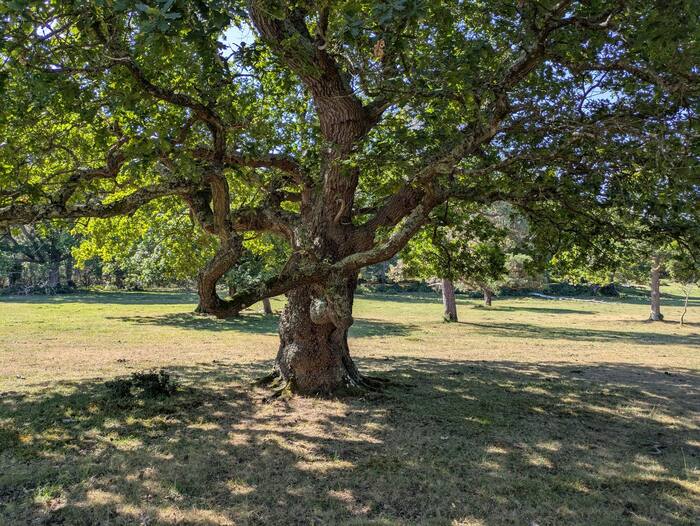
Here is the part that surprises people: a hollow tree is not necessarily a dying tree. The living, sap-conducting wood near the bark is what keeps the canopy fed; the inner heartwood is scaffolding. Many trees stand for decades — some for a century or more — with hollow centers, leafing out each spring as if nothing were amiss.
Decay Pockets, Cavities and Hollow Trunks: When to Worry
Professionals think about tree risk as two questions held together: how likely is this part of the tree to fail, and what stands beneath it if it does? A modest cavity in an old oak at the far end of a meadow is a very different matter from the same cavity in a tree leaning over a children’s play area or a parked car.
Arborists also pay close attention to how much sound wood remains around the hollow. As a working guideline, when a cavity or hollow occupies more than roughly a third to half of the trunk’s diameter, the margin of safety narrows considerably — particularly in wind, ice or saturated ground. Just as important is the pace of change. A pocket that has looked the same for ten years tells a calmer story than one that has widened this season, cracked at its edges, or begun to weep.
Warning Signs That Call for a Closer Look
Some signs are gentle hints; others are the tree raising its voice. If you notice any of the following, it is time to set aside guesswork and arrange a professional inspection:
- Fruiting bodies — bracket fungi or conks on the trunk, or clusters of mushrooms at the root flare after wet weather — are the visible fruit of decay working inside the wood.
- Cracks, bulges or sunken, discolored bark in or around the cavity, which suggest the wood behind them is failing.
- Oozing sap, sawdust-like frass, or steady carpenter ant traffic leading into the opening.
- A new or worsening lean, especially where the soil at the base has begun to heave or lift.
- Thinning foliage, unusually early autumn color, or dieback retreating from the top of the crown.
- Recent digging, trenching or construction near the roots of a tree that already shows decay.
Why a Hollow Trunk Isn’t Always a Death Sentence
Because a tree is engineered more like a tube than a solid column, a hollow trunk can carry surprising loads — the sound outer shell does most of the structural work. But no one should judge that shell by eye alone. This is where a proper tree inspection earns its keep: an experienced assessor taps the wood with a mallet to hear its density, may use a fine resistance drill or sonic imaging to map sound wood without harming the tree, and weighs the findings against the species, lean and surroundings.
Two old habits deserve retiring. Do not fill a cavity with concrete or expanding foam — a once-common practice now known to trap moisture and complicate the tree’s own defenses. And resist carving out ‘rotten’ wood yourself; every new cut is a fresh invitation to fungi. What serves the tree, and your peace of mind, is an honest assessment followed by clear options: monitoring, targeted pruning, cabling where appropriate, or removal only when the evidence truly warrants it.
In the end, the question of decay pockets, cavities and hollow trunks is less about alarm than about clarity. Worry when change is sudden, when fungi announce themselves, when the tree leans toward the places and people you love, or when the hollow seems to swallow a little more of the trunk each year. Otherwise, let a qualified inspection replace guesswork with knowledge. A tree that has been properly looked at is one you can stand beneath with confidence — and that quiet confidence, like the tree itself, is worth the small investment of care.
A written risk assessment is what turns “that tree looks fine” into a defensible answer. tree inspections.
See our Cambria Pines Tree Service for the full range of work we handle in Cambria.


Leave a Reply