Remove or Prune? The Question Behind the Question
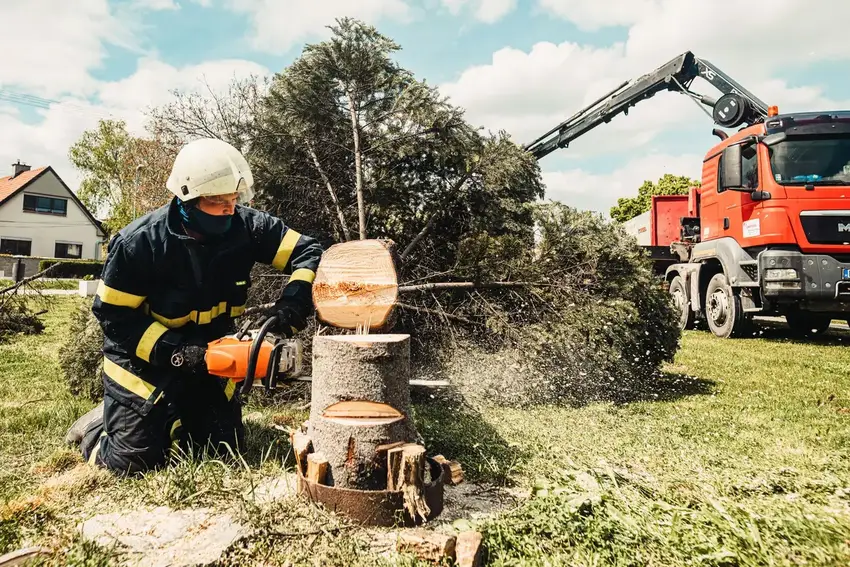
Quick answer: Remove or Prune? The Question Behind the Question — Removing a tree is planning before it is cutting: where the wood lands, what is under it, whether a rope or a crane takes the weight, and what is left when the crew drives away. A removal is finished when the drop zone is clear and the stump is dealt with, not when the trunk hits the ground.
Field note. What we see here is that access decides the price more than height does: a pine over a fence on a slope with no driveway costs more to take down safely than a taller tree with a clear drop, and the plan is where that shows up.
On the other hand, removal is not the only safe answer — a tree with one failing limb, or a lean that can be corrected by reduction, is often better kept and managed than gone.
Homeowners tend to frame this as a question about the tree: is it healthy enough to save. That is the second question. The first is whether the place the tree is standing can accommodate a tree at maturity, because if it cannot, no amount of pruning skill changes the arithmetic — you are buying years, one visit at a time, against a problem that returns.
Four tests settle it. They are cheap to apply and they almost always agree.
Test one: can the problem be solved by a cut?
If the complaint is a limb over a roof, growth into a chimney, low clearance over a drive, or a dense canopy blocking light, a specified pruning cut addresses it — and a good arborist can tell you which cut and what the tree will do in response.
If the complaint is that the trunk is against the foundation, the root plate is under the slab, or the tree is simply in the footprint of a planned structure, no cut fixes it. Topping a tree to keep it small is the most expensive way to own a problem: it creates decay, it creates regrowth that is more weakly attached than what was removed, and it needs repeating.
Test two: what is the defect, and is it mitigable?
Deadwood, a crowded crown, a crossing limb, one over-extended lateral: all prunable. A seam at a major union, extensive hollowing, root plate failure, or a pathogen that has colonised the trunk: not prunable in any meaningful sense.
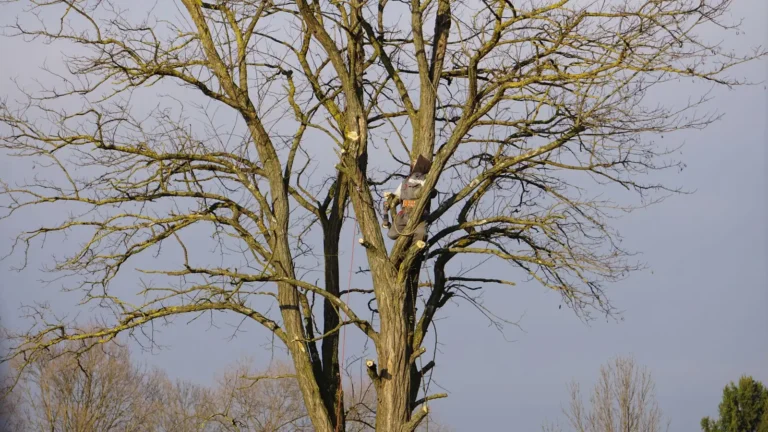
The distinction is not about how bad the tree looks. A tree can look magnificent and carry a defect that makes it a liability, and a tree can look ragged and be structurally sound. This is the one test that genuinely requires someone who climbs.
Test three: what does each cost, honestly?
| Trimming | Removal | |
|---|---|---|
| Typical range | $100-$400 under 30 ft; $400-$1,600+ over 60 ft | $226-$596 small; $1,562-$4,117 for 24-36 in trunk over 30 ft canopy |
| Recurrence | Every 3-7 years, forever | Once |
| Adds a stump cost | No | Yes, $2-$6 per inch plus a minimum fee |
| Risk profile | Low | Higher, which is what you are paying for |
Read the recurrence line twice. A tree pruned every five years for twenty years costs more in total than removing it once — and if it is in the wrong place, you have spent twenty years and a great deal of money to end up exactly here. That is the honest version of the comparison, and it is why ‘save the tree’ is not automatically the frugal choice.
Test four: what does the site want?
A tree that is right for its space needs very little from you: an occasional structural prune, deadwood removal, and nothing else. A tree that is wrong for its space needs a subscription. If you are pruning the same tree every few years to keep it inside a boundary it will always outgrow, the site is telling you something.
Removal plus replanting with a species suited to the space is often the cheaper and better-looking answer by year three — and it is the one a contractor with an incentive to prune will rarely propose.