Fruit Tree Care on the Central Coast: What Crops Here
Quick answer: Fruit Tree Care on the Central Coast: What Crops Here — Fruit trees are pruned to a different standard from shade trees: every cut is aimed at light and air reaching the fruit, at a structure that holds a heavy crop without breaking, and at a canopy low enough to pick from. On the coast the fog changes the calendar, so the cut is timed to the tree rather than to a date on a chart.
Field note. What we see is that the fog belt shifts everything later: trees here come out of dormancy slowly, so a hard winter cut taken on a warm-inland schedule can expose wood that has no leaves to shade it yet.
On the other hand, a tree that has been let run for years often does better with two or three years of patient cutting than with one hard reset.
Most fruit-growing advice is written for somewhere with a real winter and a hot summer. The fog belt has neither. Our frosts are rare, our summers rarely crack eighty, and the air is wet for months at a time — which is close to the opposite of what an apricot, a peach or a standard apple actually wants. Plant one anyway and it will grow, look healthy and crop almost nothing, for years, while you blame yourself.
Nothing about that is a failure of care. It is four mismatches, and only one of them is fixable after planting.
One: chill hours, and the winter we do not have
Deciduous fruit trees need a period of cold to break dormancy properly — typically measured in hours below about forty-five degrees. Most apples and pears in the catalogues want six hundred to a thousand of them. Cambria delivers a fraction of that, and a mild winter does not fail visibly; it produces a tree that leafs out raggedly, flowers over a long weak window, sets a sparse crop and ripens it unevenly.
The fix is not cultural, it is varietal. Low-chill apples and pears exist and crop here; so do figs, loquats, feijoas, persimmons, pomegranates and most citrus, none of which care much about our missing winter. If a tree is already in the ground and cropping badly, that is usually the answer, and no feeding programme will change it. Reshaping an established tree is a separate question, answered in best time to prune fruit trees.
Two: heat units, and where the sugar comes from
Flavour in fruit is built by photosynthesis in the weeks before harvest, and it is limited by light and warmth. Two orchards of the same variety, one inland and one here, will produce fruit with measurably different sugar. What we lose in sweetness we can partly recover with position: a south-facing wall, a spot that holds afternoon sun, a place where the fog burns off earliest.
Retaining heat against masonry is an old trick and it works — an espalier against a south wall can ripen fruit a fortnight before the same tree in the open.
What cannot be recovered is variety. A late-ripening apple chosen for a hot inland orchard will be picked green here or rot on the tree, and either way it will taste like the wrong decision.
Three: fungus, which loves us
Brown rot, apple scab and shot hole flourish in wet, still air, and a coastal spring gives them weeks of it. This is the mismatch that costs the most crop, and the one where hygiene genuinely pays: pick up and bin the fallen fruit rather than leaving it to mummify under the tree, because each rotting fruit is a reservoir that re-infects the next crop.
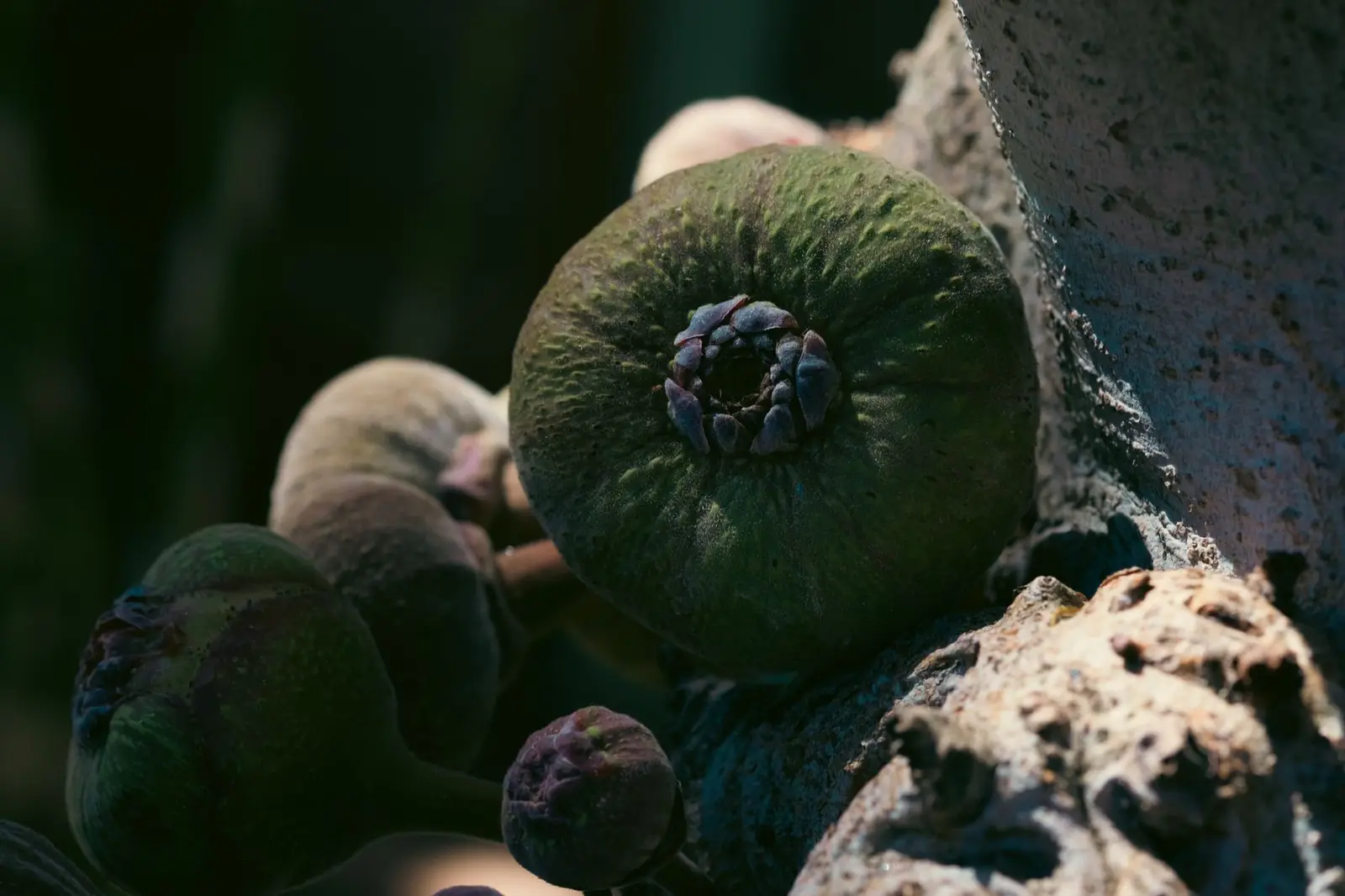
If what you are looking at is on the tree rather than under it, reading the fruiting body is the next step. Remove fruit that has died on the branch, and clear the ground under the canopy before winter.
Air movement matters as much as any spray. A fruit tree in a sheltered corner with a hedge on two sides will always be worse than the same tree with room to breathe, and promoting airflow is a design decision made at planting, not a remedy available afterwards.
Four: feeding, and the mistake of feeding too much
Most home fruit trees are over-fed rather than under-fed, and the excess is nitrogen. Nitrogen buys leaves and shoots; it also buys soft growth and more fungal pressure, and on a tree that already has plenty of canopy it delays the fruit’s ripening. What a cropping tree actually exports in a box of apples is mineral — potassium and calcium above all — and that is what a late-winter compost and mulch application returns.
The honest sequence: mulch the rooting area with arborist chips every couple of years, let the worms work it in, and judge by the growth. A tree putting on a foot of extension a year is not hungry. One that has stopped growing entirely, on a site where it used to, may be, and the answer then is a soil test rather than a guess.
Five: water, thinned fruit and the last two weeks
Steady moisture through the swell of the fruit, then a taper as it ripens — that is the whole of the irrigation story for a coastal orchard, and the commonest error is doing it in reverse, letting the tree dry out in early summer and then flooding it in August to make up. Uneven water on a ripening stone fruit cracks the skin. On any fruit it splits the crop’s quality.
Thin more than feels comfortable. Halving the count in June gives you fruit with more sugar, less disease and heavier individual weight, because the tree’s output is fixed and every apple you leave is competing with its neighbours. The fruit you removed was the fruit preventing the rest from being good.
So the order of decisions runs downwards: pick a variety that suits this climate, give it the sunniest and airiest spot on the property, keep the ground clear of fallen fruit, water steadily, thin hard. Everything else — feeding, spraying, pruning — is a refinement on those five, and none of it rescues a tree planted as the wrong answer to the only question that was never asked.
If the site is windy, foggy and shaded by pines, the most useful thing a designer can do is say so, and put in figs, loquats and feijoas instead of an orchard that was always going to disappoint. The wider list of what thrives here is in planting under the fog line. There is no shame in a fruit garden that works. The shame is nine years of apples the size of golf balls.