
What Holds a Slope: Roots, Not Walls
Quick answer: What Holds a Slope: Roots, Not Walls — A stump is the part of the problem that is still in the ground: it holds the roots that lift pavement, keeps a species alive if it re-sprouts, and occupies the spot where the next planting goes. Grinding removes it below the surface so the ground can be worked again, and the roots that matter are the ones under the driveway rather than the ones beside the trunk.
Field note. On this coast the stump is rarely the end of the job: Monterey pine and eucalyptus both keep enough energy in the roots to push new growth, so we are looking at the species before we quote the grind rather than after.
On the other hand, a stump left in a garden bed is sometimes the better answer — it decays, feeds the soil and costs nothing — so grinding is a choice, not a rule.
On this coast the question is rarely whether a slope will move. It is when, and how much. The answer is mostly about water and roots, and the roots are the part people remove without counting the cost.
How roots hold a slope
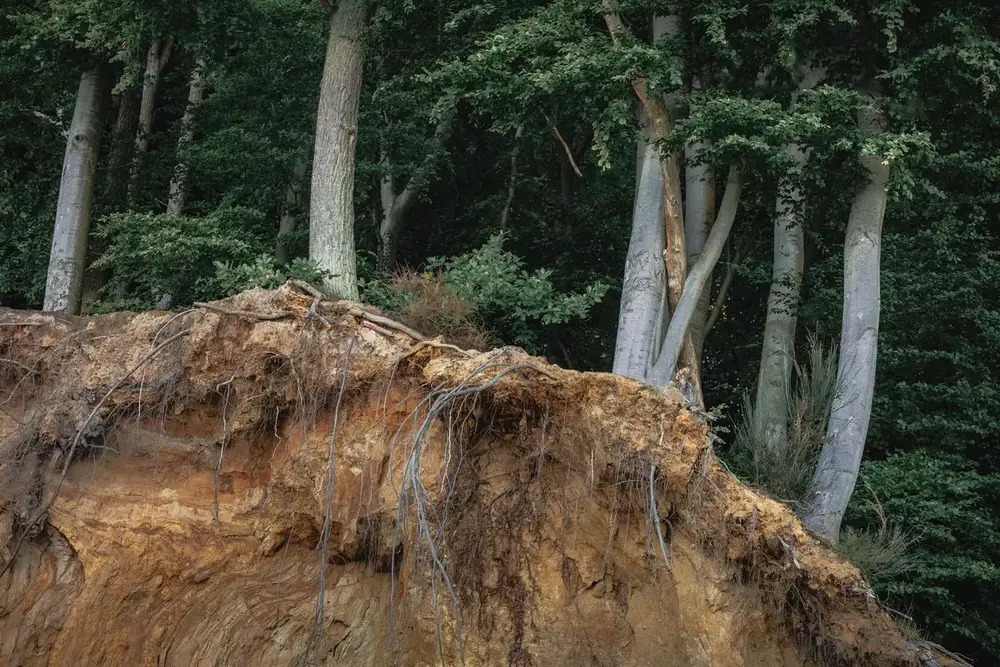
Two mechanisms. The first is mechanical: a root system binds a layer of soil into a mat that resists sliding, and it does it across the whole root plate, not just under the trunk. The second is hydrological: a tree removes water from the soil through transpiration, which lowers pore pressure and makes the soil stronger. Both stop the moment the tree is cut.
That is why a slope that has been cleared can fail in the first big winter — not because the roots rotted, but because they are no longer taking water out and no longer binding the surface.
The removal that costs more than it saves
Clearing a bank for a view is the most common way to create an erosion problem on a coastal property. The trees come off, the surface is exposed, the first storms move soil onto the road or into the neighbour’s garden, and the fix is a retaining wall that costs more than the trees were ever worth.
If a tree on a slope must come out, the replacement is not optional: plant the same season, with species that root deeply and establish quickly, and protect the surface with mulch in the meantime.
What to plant on a bank
Deep-rooted natives and dense ground cover, in layers. A tree alone leaves the surface bare between the trunk and the drip line; a tree with a shrub layer and a ground layer holds the whole profile. On this coast, toyon and ceanothus in the shrub layer, with a grass or sedge matrix, do more for a slope than any single specimen.
Plant small, plant dense, and water through the first two summers. A large specimen planted on a bank is a heavy thing on a lubricated surface, and it needs staking that then needs checking.
The drainage question underneath
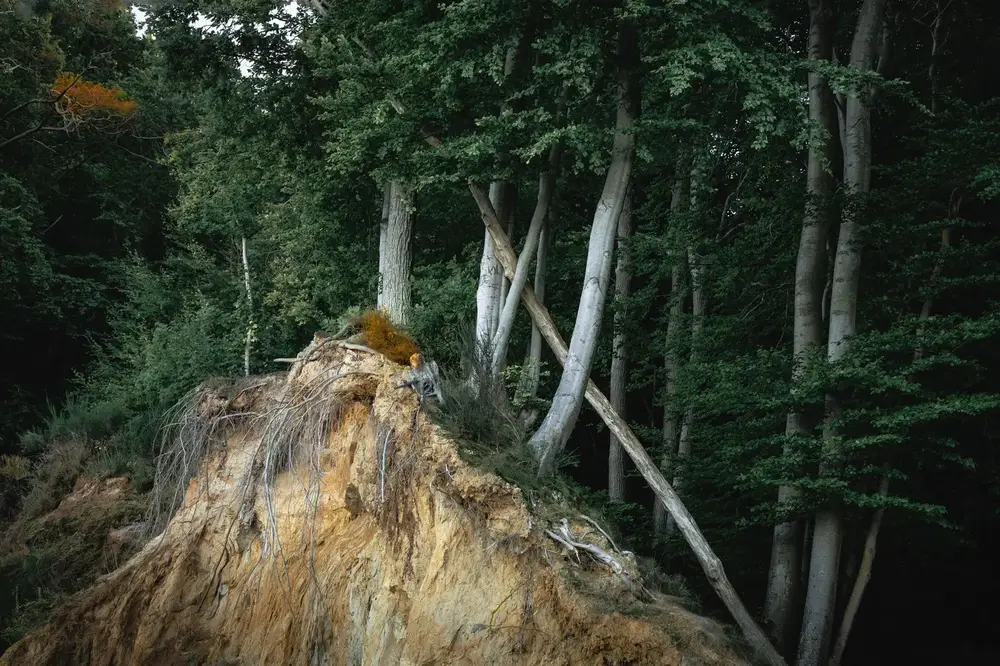
Roots cannot fix a drainage problem. If water is running through the slope from a leaking pipe, a blocked culvert or a spring above, the bank will move regardless of what is planted on it. Find the water first: a wet patch that stays wet in August, a line of vegetation that is greener than its surroundings, or a seep at the toe.
Once the water is dealt with, the planting has a chance. Before it is dealt with, planting is decoration.
Walls have a place, and it is not the top of a bank
A retaining wall holds soil that would otherwise move, and a well-built one is the right answer where there is a structure above or a road below. What walls do not do is replace the roots that were taking water out of the slope, and a wall built on a cleared bank often fails at the drainage rather than the masonry.
If a wall is needed, it needs a design: a footing, a drainage layer, weep holes and a backfill that sheds water. A dry-stacked wall two feet high is a garden feature; anything above that is an engineering question, and the permit office will tell you so. On this coast the wall that fails is almost always the one that was built without a drain behind it.
The practical version for a homeowner on a bank: do not clear it, do not change the grade, do not add fill at the top, and keep the vegetation layered. If you must remove a tree, replace it the same season and cover the ground in between. A slope is a system, and the trees are the part of the system that is doing the work.
The inspection that precedes the decision
Before clearing anything on a bank, walk the slope after rain. Where does the water sheet, where does it pool, and where has it already cut a channel? Those three answers decide more about stability than the species list does, and they are invisible in August.
Then map the trees by size and position. A bank held by three mature trees and a shrub layer is a different structure from one held by a single specimen with bare ground beneath it. Removing the specimen is a different decision from thinning the three. The map is the plan, and the plan is what a contractor should be quoting against.