Removing a Heritage Tree in Cambria: Rules and Paper Trail
Quick answer: Removing a Heritage Tree in Cambria: Rules and Penalties — Trees on this coast live with fog, salt, wind and thin soil, and the work that keeps them healthy is decided by those conditions rather than by a calendar written inland. Structure, clearance and the root zone are what a tree here needs looked at, and small work done early is what keeps a tree out of the emergency list.
Field note. What we see on this coast is that the trees people worry about are usually not the ones in trouble: the pine with a clean crown and a lean that predates the house is often sounder than the tidy tree that has been quietly drowning in its own root zone.
On the other hand, there is no schedule that suits every tree — the same species on two sides of one street can need opposite care, which is why we look before we recommend.
A heritage tree is not a tree that happens to be old. It is a tree that a jurisdiction has decided is a public asset, and that decision changes what you are allowed to do with the ground it stands on. The practical consequences are easy to underestimate, because they arrive months after the cut and they attach to the property rather than to the person who made the call.
How a tree becomes protected
There are four routes, and they can overlap. A tree can be protected by species and size under a woodland ordinance, which typically covers native oaks above a certain trunk diameter. It can be designated individually by a council or board resolution. It can be protected as habitat, which is common near creeks and on bluffs.
Or it can be protected by a private instrument: a conservation easement, a deed restriction, or a mitigation agreement recorded when the parcel was subdivided.
That last route is the one that surprises people, because it does not appear on any county map. It appears in the title report. If you are buying a parcel with large oaks, read the title report before you plan the driveway.
What unpermitted removal actually costs
The penalty structure usually has four parts, and they stack.
A fine. Often calculated per inch of trunk diameter, which means the biggest trees carry the biggest penalty, sometimes multiplied for repeat violations.
Mitigation. Replacement planting at a ratio, commonly several new trees for every one removed, plus a maintenance bond for two or three years. On a large oak that obligation can exceed the value of the landscape work that motivated the removal.
A stop-work order. Everything on the parcel stops, including the project that needed the tree gone. Carrying costs on a stalled build are frequently larger than the fine.
A recorded violation. It shows up in a title search and in disclosure. It follows the parcel, not the owner.
The emergency defence, documented properly
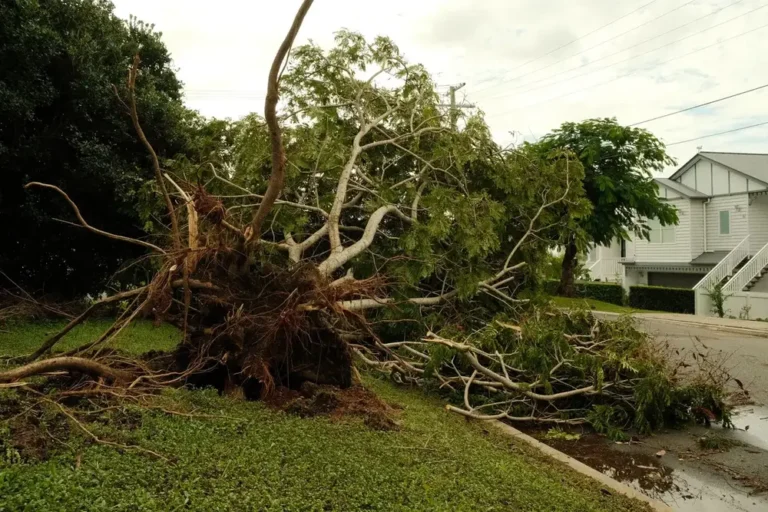
If a tree is genuinely about to fail onto a house, you remove it and you deal with the paperwork afterward. What makes that defensible is not the urgency of your memory; it is the record you create in the first hour.
Photograph the defect from two angles, with something for scale. Photograph the target: the roof, the bedroom window, the car. Note the date and time and the weather. Keep the arborist’s written assessment, even if it is a text message followed by a one-page letter the next morning. Keep the hauling receipts and the photographs of the stump. If the tree was already down, photograph it where it fell before anything is moved.
The test the county applies is whether a reasonable person, seeing what you saw, would have concluded that removal could not wait. Your record is the only way to answer that question after the fact.

The insurance angle nobody connects
Homeowners policies generally exclude fines and penalties, and they exclude damage caused by an intentional act. So if a protected tree comes down without approval, the fine is yours, and the carrier may treat the resulting dispute as uninsured. What the policy does cover is the sudden failure of a tree onto a covered structure, which is a different event and a different claim.
The reason to keep the paperwork is therefore not only regulatory. It is the difference between a claim that is paid and a claim that is investigated for two months because the timeline does not line up.
None of this argues against removing a dangerous tree. It argues for ten minutes of photographs and one phone call before the crew arrives. The trees that cause the most expensive problems are almost never the ones that fell on their own.