Hollow Is Not the Same as Doomed
Quick answer: Hollow Is Not the Same as Doomed — Trees on this coast live with fog, salt, wind and thin soil, and the work that keeps them healthy is decided by those conditions rather than by a calendar written inland. Structure, clearance and the root zone are what a tree here needs looked at, and small work done early is what keeps a tree out of the emergency list.
Field note. What we see on this coast is that the trees people worry about are usually not the ones in trouble: the pine with a clean crown and a lean that predates the house is often sounder than the tidy tree that has been quietly drowning in its own root zone.
On the other hand, there is no schedule that suits every tree — the same species on two sides of one street can need opposite care, which is why we look before we recommend.
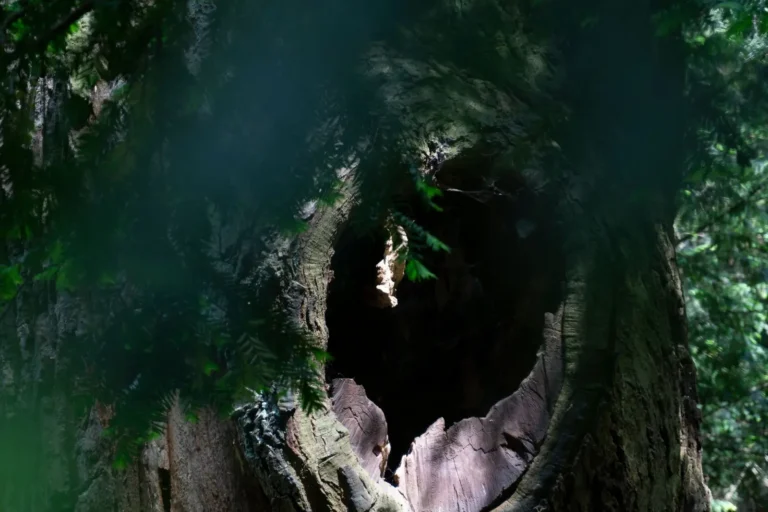
A hollow tree frightens people in a way that a cracked tree does not, and the fear is usually misplaced. A trunk that has been hollow for thirty years has also been growing a thicker wall for thirty years. The hollow is old news to the tree; the wall is its answer.
What matters is not whether there is a hole. It is how much wall is left, how the load is distributed, and what the tree would hit.
The shell, and why it holds
Wood in a trunk is strongest at the outside, where the fibres are longest and the leverage is greatest. The centre contributes comparatively little to bending strength, which is why a hollow column can be nearly as stiff as a solid one of the same diameter. The tree is not being brave. It is being efficient.
The failure mode of a hollow tree is not the hole. It is a wall that has become too thin on one side, usually the side with a wound, a root loss, or a lean. That is a local problem, and it can be measured.
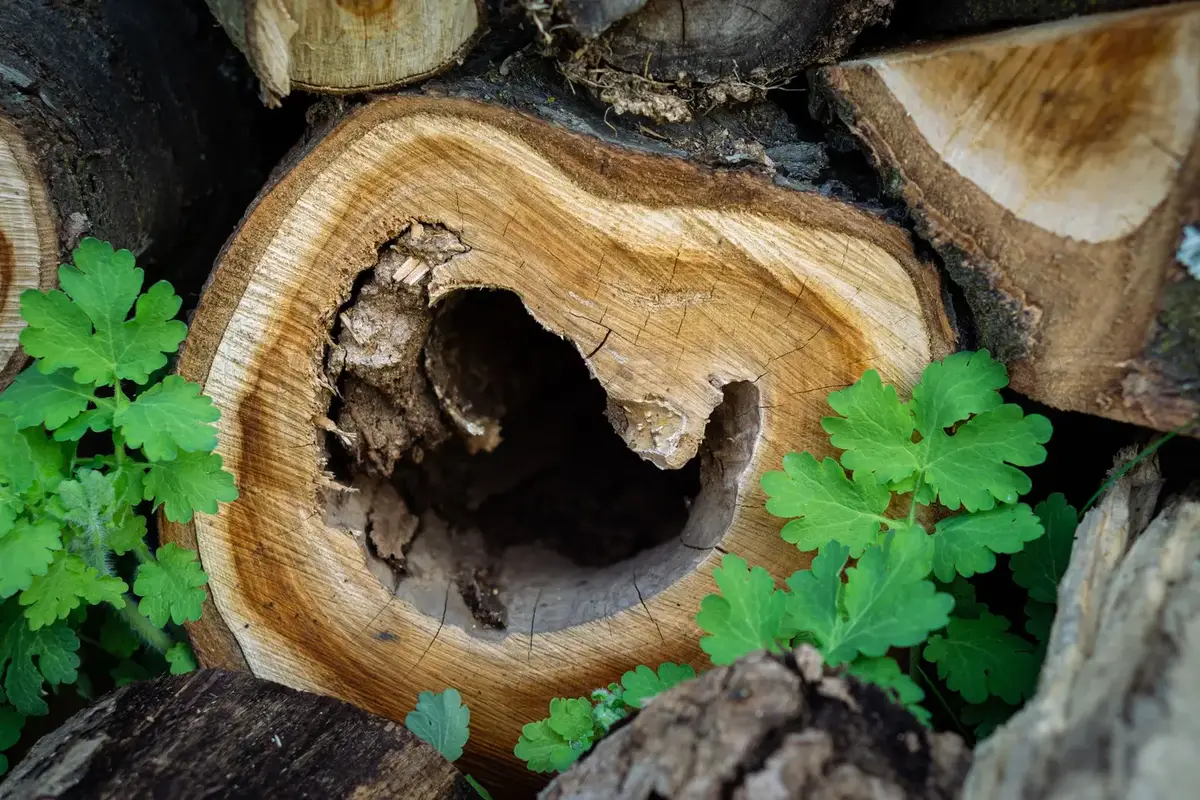
Measuring the wall, without guessing
An arborist taps with a mallet and listens, then confirms with a resistograph or a sonic tomograph. The output is a wall-thickness ratio: the remaining sound wood as a fraction of the radius. Below about a third, the margin is gone and the decision is usually removal. Between a third and a half, it depends on the target and the lean.
What you cannot do is estimate from the size of the opening. A small hole can hide a large cavity, and a large opening can sit in a trunk with four inches of sound wall all round. The hole is a doorway, not a measurement.
Where hollow is fine
An oak in a hedgerow, hollow to the base, standing in clay with no target within its height: that tree may outlive the person worried about it. Hollow trees are habitat — owls, bats, beetles — and they are a normal stage of a long life, not a disease.
Where it is not fine: a hollow tree with a lean, a hollow tree with a target, a hollow tree whose wall is thin on the tension side, and a hollow tree that has just lost a major limb. Those four conditions together are a removal, and no amount of sentiment changes the arithmetic.

The target decides, and so does the calendar
Two hollow trees with identical walls can have opposite answers because one leans over a bedroom and the other leans over a meadow. That is not inconsistency; it is the definition of risk. The tree supplies the hazard. The site supplies the consequence.
If the answer is monitor, put a date on it and a photograph with it, and re-measure in a year or after a storm. A hollow tree that is being watched is a managed tree. A hollow tree that is being worried about is a decision nobody has made.
The hollow that holds water
A hollow open at the top collects water, and water accelerates the decay that made the hollow. That is the one configuration that turns a stable cavity into a spreading one, and it is common on a tree that lost a limb years ago and never sealed the wound.
The old remedy was to fill the cavity with concrete. Do not. Concrete does not bond to wood, it holds moisture against the wall, and it makes the tree heavier in exactly the place you did not want weight. Modern practice leaves the cavity alone, or improves drainage at the base if water is standing in it.
What is worth doing is keeping the opening clear of debris so it can dry, and having the wall re-measured every few years. A hollow that is dry and stable is a habitat feature. A hollow that is wet and widening is a countdown.
And if the answer is removal, ask for the wall measurement in writing. It is the one number that turns a frightening tree into a defensible decision, whether the decision is to cut it or to leave it standing.
A number in a report is also what makes a board, an insurer or a buyer accept the answer without an argument about how the tree looked.
Measurements settle what photographs cannot, and a wall ratio in millimetres survives a change of owner, insurer or arborist.