Grind or Pull: The Stump Decision, Priced Out
Quick answer: Grind or Pull: The Stump Decision, Priced Out — A stump is the part of the problem that is still in the ground: it holds the roots that lift pavement, keeps a species alive if it re-sprouts, and occupies the spot where the next planting goes. Grinding removes it below the surface so the ground can be worked again, and the roots that matter are the ones under the driveway rather than the ones beside the trunk.
Field note. On this coast the stump is rarely the end of the job: Monterey pine and eucalyptus both keep enough energy in the roots to push new growth, so we are looking at the species before we quote the grind rather than after.
On the other hand, a stump left in a garden bed is sometimes the better answer — it decays, feeds the soil and costs nothing — so grinding is a choice, not a rule.
Two contractors, two prices, same stump. One says four hundred to grind it, the other says nine hundred to remove it. Neither is cheating you. They are quoting two different jobs, and the difference is what is left in the ground when the truck leaves.
What grinding actually does
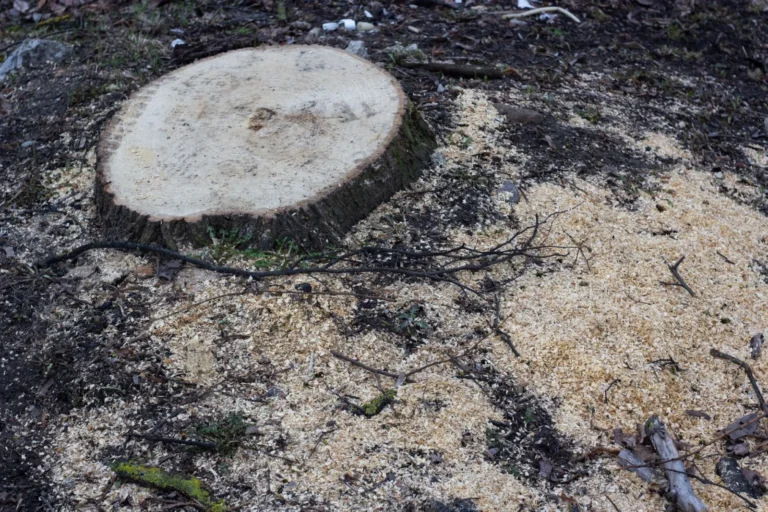
A stump grinder is a carbide wheel on a boom. It sweeps across the stump and reduces it to chips, typically to a depth of six to twelve inches below grade. The stump disappears from view. The root plate does not. The large structural roots are still in the soil, still decaying, and still taking up space.
The price is usually quoted per inch of diameter measured at the widest point, a foot or so above grade. On the Central Coast that lands somewhere around two to six dollars an inch, with a minimum charge in the low hundreds for the trip and the setup. A twenty-inch stump is therefore a small job. A four-foot eucalyptus is not, and the grinder may need to be brought in on a trailer that cannot fit through a five-foot gate.
What removal actually does
Removal means the stump and the root plate come out, usually with an excavator, sometimes with a winch and a lot of patience. That means a hole. On a mature tree the hole can be six feet across and three feet deep, and it has to be backfilled with something that will not sink. It also means access for a machine that weighs several tons, which on a steep Cambria lot is often the real constraint.
Pricing for full removal is less standardized: three hundred to nine hundred dollars for a modest stump, more when the machine has to be craned in or the hole has to be engineered. It is the right answer when something structural is going where the stump was.
The decision rule
Grind when the space is going back to lawn, groundcover or a bed, and when the stump is not in the way of anything that has to bear load.
Remove when a patio, a driveway, a retaining wall, a fence post or a foundation is going there. Building over buried wood is a code problem in most jurisdictions and a settlement problem everywhere: the root plate decays, the soil above it consolidates, and the slab cracks two winters later.
Remove also when the stump is a hazard: a rotten stump at the edge of a play area, a stump that has become a termite reservoir against a wood-sided house, or a stump on a slope where the decaying root plate is the only thing holding the bank.
Replanting in the same spot, honestly
You can replant where a tree was, but not in the same square foot. Grindings are not soil; they subside by a fifth to a third as they decay, so a hole filled with them becomes a depression within two years.
Use them as mulch around the new tree, backfill the hole with native soil, and set the new tree at least three feet off the old centre so it is not growing into the old root plate or into whatever killed the first tree.
That last point matters more than the spacing. If the tree died of Armillaria, the fungus is still in the roots, and a young tree planted into that material is a meal. If it died of drought, the soil is still depleted. The stump is a symptom; the site is the cause.
One line for the estimate: ask whether the price includes the grindings, the backfill, and the trip charge. Those three items are where a four-hundred-dollar quote becomes a seven-hundred-dollar invoice, and they are all answerable before the machine arrives.