



Drainage first, always. Downspout extensions, grading the surface so water sheets away from structures, French drains and dry wells where subsurface water is the actual driver, and careful restoration of existing drainage features that have silted or been blocked. Nothing placed on a slope holds well while water is running through it.
Erosion control in Cambria, slowing the water first
Quick answer: Erosion Control in Cambria, CA — Trees are watered at the root zone, deeply and infrequently — a long soak that reaches down, then a dry spell that lets roots look for water, rather than a daily sprinkle that keeps everything in the top inch of soil. On the fog belt the question is rarely whether there is moisture in the air but how much got down to the roots.
- Typical timing: Deep watering through the dry season, spaced further apart as the tree establishes; young trees need it far more often than mature ones.
- What it involves: Watering at the drip line rather than the trunk, checking the soil six to eight inches down, and mulching so the water stays where it landed.
- The standard: University extension guidance on landscape tree irrigation and drought response.
- Where we work: The coastal terrace from Cambria to Morro Bay, sandy soil and clay both.
- Our own record: 503 pages and 291 stories published on this site. Counted from our own archive, not a stock table.
Field note. What we see here is that salt air and wind dry a canopy faster than the thermometer suggests, so a tree can be water-stressed on a grey week when nothing looks hot to the person holding the hose.
On the other hand, more water is not a cure-all: on clay, a daily soak drowns roots more often than drought does, and the symptoms look almost identical from above.
Standards and sources: Irrigation and disease (UC IPM — University of California pest management) · Tree physiology (USDA Forest Service)
Prepared by Cambria Pines Tree Service Inc. — ISA-certified arborists working on the Central Coast.
On the Coast, the Ground Is Always in Motion
Cambria's properties sit on some of the least forgiving ground in San Luis Obispo County: bluff edges above the Pacific, canyon walls behind Lodge Hill, and lots that were graded decades ago and have been quietly moving ever since.
Add coastal rain that arrives in a handful of hard storms, and you get the pattern we see constantly — a slope that looks fine for years, then loses a winter's worth of soil in one night, taking the trees on it with it.
Erosion control is the work of slowing water down, keeping soil in place, and keeping the tree roots that hold a slope together alive and functioning. It is not landscaping. It is the difference between a yard that needs raking and a foundation that is losing its support.
The Warning Signs We Look For First
Erosion is almost always visible well before it becomes a failure. On an inspection the first questions are about water and roots:
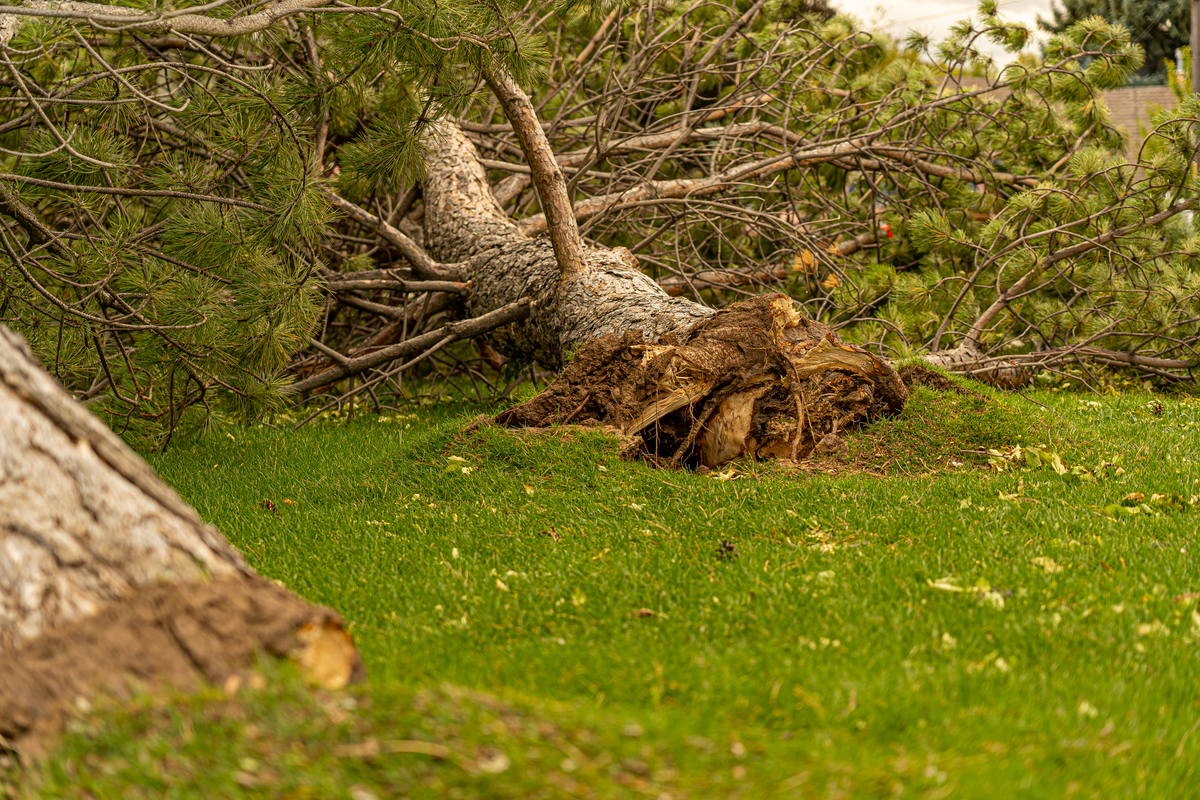
- Exposed roots — a tree standing on roots that have been washed bare has already lost the soil that anchored it. Those trees become the risk assessment conversation, because their failure mode changed.
- Rills and gullies — small channels on the surface mean water is concentrating. A gully that was not there last spring is a slope that is losing material every storm.
- Soil creep and post lean — posts, decks, fences and retaining walls that tilt downhill are showing you the direction of movement, and it is usually the same direction the trees lean.
- Mud stains on the downhill side of a trunk, or a soil gap opening beside a root flare — water is moving past the root plate and taking soil with it.
- Hard-surfaced or bare ground above a green slope — the single best predictor of a problem. Water that lands on a driveway, a patio or a cleared, compacted pad goes somewhere, and that somewhere is downhill at speed.
- Soggy ground in summer, or a spring that appears and then stops — subsurface water is being intercepted somewhere new, which usually means the soil above it is failing.
What We Do About It
Every slope is a specific case, but the work almost always combines three things: get the water under control, hold the soil, and keep the roots alive.
Surface armoring and matting on disturbed ground — erosion control blankets, coir or jute matting, and check dams or wattles in the channel to slow the water and let sediment drop out.
Soil retention that fails soft — anchored wattles and mesh rather than rigid walls wherever possible, so a wall is not the thing that undermines the slope.
Revegetation with species that belong here — deep-rooted native grasses, shrubs and trees suited to coastal fog and dry summers. Bare ground is the problem; shallow-rooted, dry-season-collapsing cover is barely a solution.
Protecting existing tree roots — mulch over the root zone instead of pavement, keeping equipment and stockpiles off it, and pruning back the vegetation that has to go without taking the root structure with it.
Where structural work is genuinely needed, we tell you so and name it, including when a soil engineer or geotechnical opinion should be involved. Retaining a slope above a habitable structure is not a landscaping decision.
Where Erosion Work and Tree Work Meet
The three jobs intersect constantly on Central Coast properties, and doing them in the wrong order undoes the earlier one.
- Clearance removes cover. Serious fire clearance work exposes ground, and on a slope that means exposed soil the first time it rains. Clearance and erosion work are scoped together here for exactly that reason — matting and revegetation go in behind the cut material.
- Removal changes the load. Taking a mature tree off a slope removes a root network that may be doing more structural work than it appears to. When we remove a tree on a steep parcel, we look at what is left holding the ground and handle the stump and root zone rather than grinding and walking away.
- Trimming decisions are root decisions. How you prune affects how a tree allocates growth, and on a slope the goal is a balanced, wind-stable crown whose roots keep working.
- Storm work is erosion work. After a hard rain, the hazard limbs get cleared by our emergency service — and the channel that opened up in the same storm is the part that causes the second failure next winter.

Permits, Bluffs and Scepticism Worth Having
Cambria sits in the coastal zone, and work on or near a bluff edge or a mapped slope can need a coastal development permit, a county review, or resource-agency sign-off before a spoon of dirt is moved. We flag what needs checking rather than guessing, and we would rather tell you a project needs an engineer than build something that fails with the next wet winter.
It is also worth saying plainly: no amount of planting stops bluff retreat at the scale the ocean works at. What erosion control does is manage your water and your slope — the runoff, the disturbed ground, the root zones and the drainage on your parcel — which is both the part you control and usually the part doing the visible damage.
Start With a Walk of the Property
Show us where the water goes in a storm, where the ground has dropped, and which trees look like they are standing on roots. Photographs of a problem area after rain are worth a lot. We will tell you what the fix involves, whether it is a drainage job, a soil-retention job, a tree job, or a combination — and whether any part of it needs a permit or an engineer first.
Call (805) 927-4414 or use our contact page. Written estimates before work begins; see the full service list for how erosion work combines with the rest of our tree care.


Next step
Ready when you are.
Questions, quotes, or just exploring — we’re here to help.