


Extra-high-strength (EHS) galvanized steel cable, sized by the split it is holding and the span it has to cross — not a generic gauge chosen by habit.
Tree cabling and bracing in Cambria, buying time for a good fork
Tree Cabling & Bracing in Cambria, CA
Quick answer: Tree Cabling & Bracing in Cambria, CA — The crew that answers the phone is the crew that climbs the tree: locally based, insured, and working to the industry standards rather than to whatever the last job allowed. That matters most where the work is delicate — over a roof, beside a wire, or on a slope where the wood has to be lowered rather than dropped.
- Credentials: ISA-certified arborists; licensed and insured for work over structures and near utilities.
- The standard: ANSI A300 for pruning and ANSI Z133 for safety on every job.
- Where we work: Cambria, San Simeon, Harmony, Cayucos, Morro Bay, Los Osos and the surrounding county.
- How we quote: A site visit and a written, line-by-line quote before any work is booked.
- Our own record: 503 pages and 291 stories published on this site. Counted from our own archive, not a stock table.
Field note. What we see is that the questions worth asking are the same on every property: who is climbing, what happens to the wood, and what the tree looks like in five years — so we answer those before we talk about dates.
On the other hand, credentials are a floor rather than a guarantee: what a tree gets is the judgment of the person in it, which is why we keep the same small crew on this coast.
Standards and sources: Certified arborists (ISA — International Society of Arboriculture) · Finding a pro (TCIA — Tree Care Tips)
Prepared by Cambria Pines Tree Service Inc. — ISA-certified arborists working on the Central Coast.
A Tree Can Sometimes Be Saved Instead of Removed
Not every dangerous tree has to come down. When a coast live oak splits into two heavy leaders, or a Monterey pine carries a limb the size of a small tree out over a bedroom, the failure you are worried about is often one union — a single fork where two stems meet at a narrow angle and grow wood that pushes outward instead of growing solid across. That fork can be supported.
Supplemental support systems — cables and braces — hold a weakened union together so the tree keeps standing and the house below it stays undamaged.
We install them on the Central Coast, mostly in Cambria, Cayucos and the canyons above Morro Bay, and we are honest about it: a cable is not a repair. It buys time, and it is right for some trees and wrong for others. The sections below explain how we decide.
What Cabling Does, and What Bracing Does
These two words get used interchangeably, but they are different jobs with different hardware.
- Cabling connects two limbs or two stems with a flexible, high-strength steel cable. The cable limits how far the limbs move apart and, critically, changes how they share load. When one leader is pushed by wind, the cable pulls the other one with it so both move together instead of failing in opposite directions.
- Bracing installs a rigid steel rod through a weak fork, drilled through both stems and anchored with a nut on each side. A brace does not let the union move at all. It is used where the fork itself is the weak point and motion in it is what tears the tree apart.
- Both together is common on a large oak with a splitting codominant stem: a brace holds the fork itself, and a cable above it shares the crown load.
Why Coastal Pines and Coast Live Oaks Are the Usual Candidates
Two species account for most of the support systems we install here, for opposite reasons.
Pitch canker and drought stress make the pine question harder, because a cable is only worth installing in wood that is still sound. That is why every support proposal starts with an inspection, not a quote.
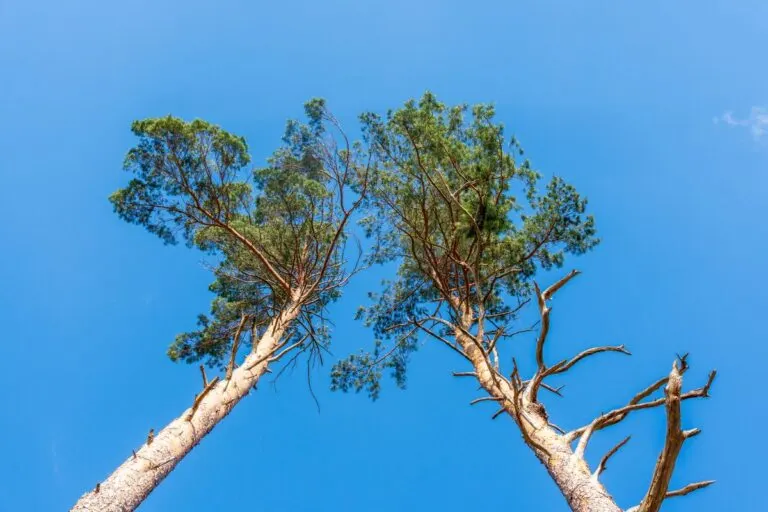
- Monterey pines grow fast in coastal fog, self-prune badly, and put on heavy limbs that spread out almost horizontally. Limb drop is normal for the species — a summer limb drop of a branch the thickness of your leg is a known behaviour, not a symptom of disease. A cable on a structurally sound pine with a heavy, well-placed limb over a driveway or roof is one of the more defensible installations we do.
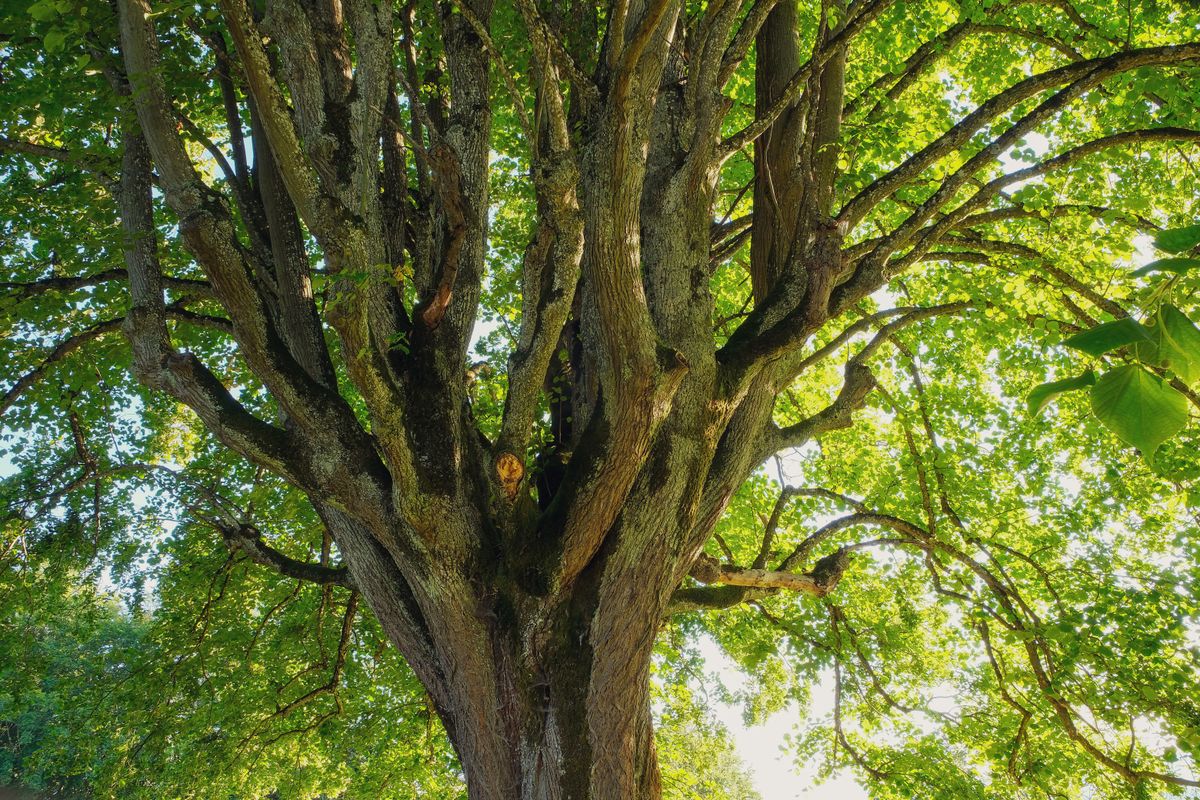
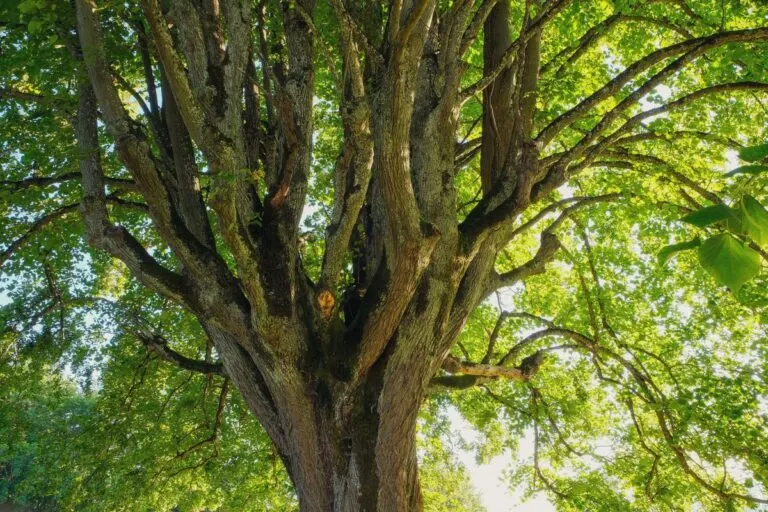
- Coast live oaks are the opposite: they are strong and slow, and they last for centuries — until they develop a V-shaped fork with included bark. Included bark means the two stems are pressing against each other with bark trapped between them, so no wood ever forms across the joint. From the outside it looks like a solid trunk. It is the single most common serious defect in the oaks we inspect.
The Conditions We Check Before We Recommend Anything
A support system is only as good as the wood it is anchored into. Before we propose one, we look at:
Our tree inspection service is exactly this assessment, and it is the first step of any support project. Where the concern is a documented hazard decision — a tree the county, an insurer or a buyer needs an opinion about — the right tool is a written tree risk assessment instead.
- Decay at the union and the root flare — a cavity, a conk, soft or hollow-sounding wood, or soil heaving at the base. If the union is more than roughly a third decayed, support is the wrong answer and removal is the honest one.
- What the tree would hit — the target. A cabled tree over open ground protects nothing; the same tree over a bedroom, a driveway, a power drop or a neighbour's roof is a different calculation.
- Root plate condition — fresh lean, cracked or lifted soil, and a gap opening on one side of the trunk. A tree whose roots are failing cannot be cabled. It has to come down.
- Species and age — a fast-growing tree with a long remaining life is a good investment; a senescent tree with crown dieback is not.
- Access and how the work will be done — a rope-access installation high in a canopy over a roof is rigging work, not a ladder job.
Hardware and Standards We Work To
Supplemental support is a real trade with a real standard: ANSI A300 (Part 3), Supplemental Support Systems, and the accompanying ISA best-management practice. What that means in practice, and what we hold to on every installation:
Through-rods with amon-eye nuts for bracing, sized to the stem diameter and installed so the rod does not carry the tree's whole load on a shrinking, drying hole.
No self-tapping lag screws as structural anchors. They hold in the outer wood only, and a cabled tree can pull them out.
Cable ends terminated through the wood or around the limb in the way the standard requires — with thimbles, dead-end grips and the right hardware for the attachment — and installed so the system does not girdle the limb as it grows.
The system installed taut enough to share load and slack enough to let the tree move. A cable rigged bar-tight puts its whole force into one hard stop; a cable too loose does nothing until it is already too late.
Nothing installed where the tree cannot grow around it. Hardware that will be swallowed by growth gets sized and placed for that now, not corrected later.
When We Tell You Not To Do It
We would rather lose a job than sell a support system that fails. We will recommend removal instead when:
When removal genuinely is the answer, our tree removal service is rigged and planned for tight coastal lots — and no support hardware will have been installed first.
- The tree is already a hazard because of root failure, basal decay or a hollow trunk — nothing bolted higher up fixes that.
- The target cannot be protected. If the tree overhangs a bedroom and the union is marginal, removal is the answer; a cable only reduces the odds, it does not make a bad tree safe.
- The tree is in irreversible decline — advanced crown dieback, extensive pitch canker, or a canopy with no remaining growth to sustain the wood you would be anchoring into.
- The real problem is elsewhere. Sometimes what looks like a failing limb is a drainage, root-zone or soil-compaction problem, and a drainage and slope fix helps the tree more than hardware does.
A Cabled Tree Needs Re-Checking
A support system is not a one-time fix. The tree keeps growing, the cable ages, and the union behind it keeps changing. We recommend the system be inspected every two to three years, and immediately after any significant storm. We do that as part of ongoing trimming and pruning work: check the anchors, look for new decay, check that the cable has not gone slack or bar-tight, and confirm the tree is still the tree we agreed to support.
Clearance Work Usually Runs Alongside It
A tree whose limb failure worries you is often also a tree that is too close to a structure — and in Cambria that can mean a fire clearance obligation as well as a structural one. Defensible-space limits, chimney and roof clearance and the branch-free zone near a habitable structure are usually addressed in the same plan, which is why we scope our fire clearance work together with structural pruning rather than as a separate visit.
Questions We Are Asked About Cabling and Bracing
Is a cable a permanent fix for a splitting tree? — No. A support system buys time and changes how a weak union shares load; it cannot restore wood that has already failed, so the tree still needs inspecting on a schedule.
How do you decide between supporting a tree and removing it? — By the wood, not the worry. If the union is mostly sound and the roots and root flare are intact, support is reasonable; where there is decay, a hollow or root failure, removal is the honest answer.
How long does a cable or a brace last? — The steel outlasts the tree in most cases. What it holds changes as the tree grows, so we re-check the anchors and the union every few seasons and after any significant storm.
Do you have to climb the tree to install one? — Usually yes. Most installations are rope-access work high in the canopy, especially above a roof or a power drop, rather than anything done from a ladder.
Does cabling need a permit or an insurer's sign-off? — No permit. Where a union is serious enough that an insurer or a buyer wants an opinion, the right document is a written risk assessment, which we can provide.
Will a cable stop a limb from failing in a storm? — It lowers the odds; it does not guarantee them. A cable shares load and limits how far a union can move, but a tree with serious decay can still fail, which is why the inspection matters as much as the hardware.
Getting an Assessment on Your Own Tree
Tell us the tree, the species if you know it, and what is underneath it. Photographs help — one of the whole tree, one of the union or the crack you are worried about, and one showing what the tree would hit. We will tell you honestly whether the tree is a cabling candidate, an inspection candidate, or a removal.
Call (805) 927-4414 or use our contact page to arrange a site visit. Written estimates come before any work begins, and we will name what a support system does not fix as clearly as what it does. If you would like the wider picture of what our tree care services cover, start there.
Next step
Ready when you are.
Questions, quotes, or just exploring — we’re here to help.