


Breaking the Run to the Canopy
Ladder Fuel & Brush Removal
San Luis Obispo — this is the coast these pages are about.
Quick answer: Ladder Fuel & Brush Removal — Removing a tree is planning before it is cutting: where the wood lands, what is under it, whether a rope or a crane takes the weight, and what is left when the crew drives away. A removal is finished when the drop zone is clear and the stump is dealt with, not when the trunk hits the ground.
- Typical timing: When the tree is a hazard, the schedule is immediate — storm damage, split leaders and leaners do not wait for good weather.
- What it involves: A written plan for the drop zone, rigging or crane work over structures, protecting driveways and roofs, and deciding the stump’s fate in advance.
- The standard: The ANSI Z133 safety standard for arboricultural operations, and ISA best practice for removals near structures.
- Where we work: Small town lots, coastal acreage and the narrow properties of the Cambria pine belt.
- Our own record: 503 pages and 291 stories published on this site. Counted from our own archive, not a stock table.
Field note. What we see here is that access decides the price more than height does: a pine over a fence on a slope with no driveway costs more to take down safely than a taller tree with a clear drop, and the plan is where that shows up.
On the other hand, removal is not the only safe answer — a tree with one failing limb, or a lean that can be corrected by reduction, is often better kept and managed than gone.
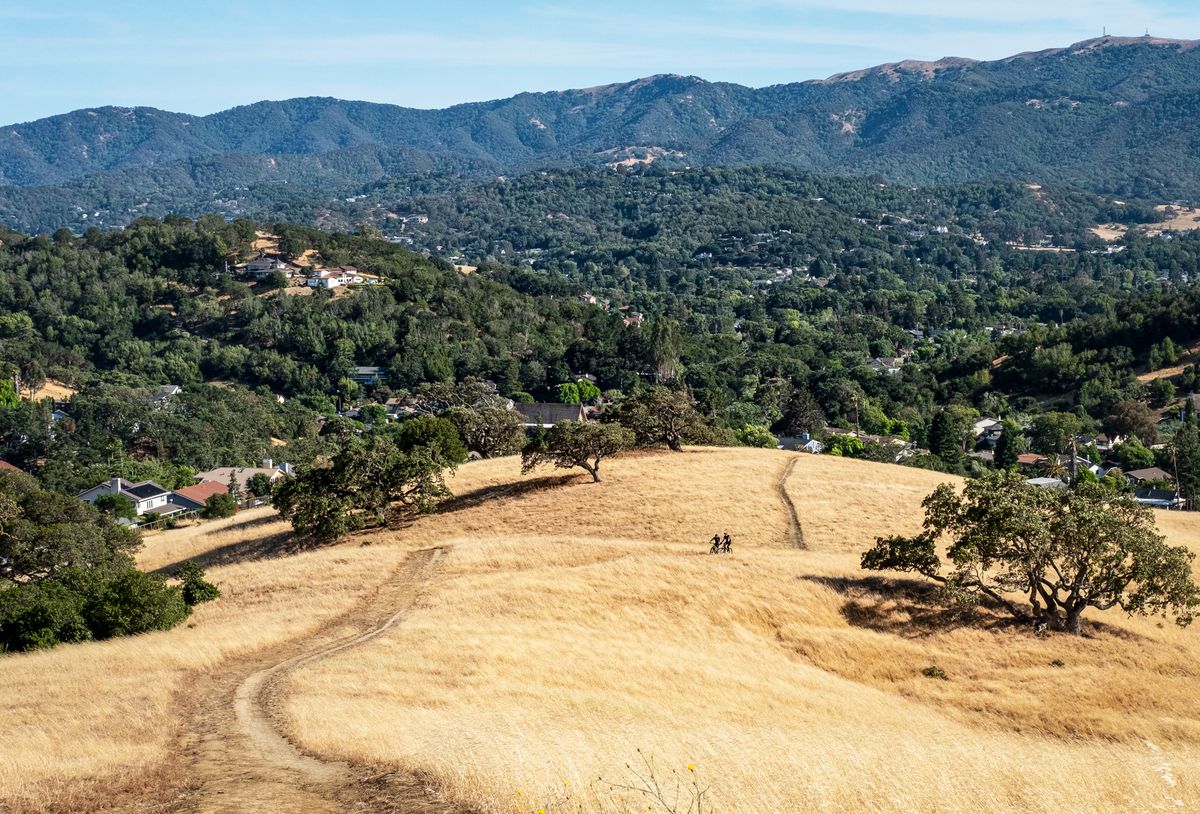
Brush removal on the hills above San Luis Obispo is the least satisfying work in the trade and the work that most changes an outcome. A fire does not need a big tree to go somewhere: it needs a continuous run from the dry grass to the shrub to the low limb to the canopy, and the whole job is about breaking that run.
On the slopes along the creek and up towards Bishop Peak, the run is usually there in July and gone by November if somebody does the cutting.
The rungs of the ladder
Fine fuels at the bottom — annual grass and the litter that cures through a dry summer — ignite on a spark and burn hot enough to light something bigger. The middle rung is the shrub layer: the poison oak, the coyote brush, the broom and the volunteer saplings that came up after a wet spring and never left.
Above it, on the oak or the pine, the lowest limbs reach down into that shrub layer, and the fire steps from one to the next without ever touching the ground again.
Horizontal spacing, not just vertical
Fire also moves sideways. Shrubs that have grown into a continuous hedge up a slope act as a wick laid against the hill, and two crowns that have grown together are one fuel body. So the work is spacing as much as clearance: shrub clumps separated rather than massed, crown gaps where the trees have merged, and a break where the ground steepens, because fire runs faster uphill.
What comes out, what stays
Dead and dying brush, broom and other invasive species near a structure, the volunteer trees crowding a mature oak, the dead limbs, and the fine dead material on the ground. What stays: the healthy natives, spaced rather than continuous, the oaks in good condition, and the low ground cover holding the soil. The instinct to clear everything is the instinct that hands the slope to the first winter rain, and on these hills the erosion risk is real.
The slash is half the job
Material left in place is fuel that has been moved. Where the work is within reach of a chipper, chipping on site and leaving the chips as mulch under the trees is usually the best answer; where it cannot be chipped, it leaves the property. There is no burn season to rely on in the city, so everything comes down to chipping and hauling.
Timing it against the season
Cut before the fuel cures and before the ground dries hard. A parcel that has never been cleared takes one heavy pass and then a lighter cycle every two or three years, because the brush does not stay gone — the seed bank in this soil is patient.
Have the parcel walked first
The assessment comes before the cutting, so the zones decide what stays. Call (805) 927-4414 or use the contact page and we will scope the brush work together with the tree work.
Questions, quotes, or just exploring — we’re here to help.