

Water That Reaches the Root Zone
Deep Watering & Drought Care
San Luis Obispo — this is the coast these pages are about.
Quick answer: Deep Watering & Drought Care — A stump is the part of the problem that is still in the ground: it holds the roots that lift pavement, keeps a species alive if it re-sprouts, and occupies the spot where the next planting goes. Grinding removes it below the surface so the ground can be worked again, and the roots that matter are the ones under the driveway rather than the ones beside the trunk.
- Typical timing: Any month the ground is workable; rain-softened soil grinds fastest and leaves the cleanest spoil.
- What it involves: Assessing re-sprout risk by species, grinding below grade, raking the spoil back, and handling surface roots separately from the stump.
- The standard: ISA guidance on root cutting and the ANSI A300 pruning standard where roots and crown are worked together.
- Where we work: Cambria, San Simeon, Harmony, Cayucos, Morro Bay, Los Osos and the Cambria pine belt.
- Our own record: 503 pages and 291 stories published on this site. Counted from our own archive, not a stock table.
Field note. On this coast the stump is rarely the end of the job: Monterey pine and eucalyptus both keep enough energy in the roots to push new growth, so we are looking at the species before we quote the grind rather than after.
On the other hand, a stump left in a garden bed is sometimes the better answer — it decays, feeds the soil and costs nothing — so grinding is a choice, not a rule.
Deep watering in San Luis Obispo is a contradiction people get backwards: the city gardens that look thirstiest in August are usually the ones being watered too often. The valley heat pulls moisture out of the adobe clay fast at the surface, so a daily five-minute sprinkle keeps the top inch damp and the root zone beneath it bone dry — and trains a tree to keep its roots in that inch.
The water a tree actually needs arrives slowly, in volume, and reaches down through the profile to where the absorbing roots live.
Water the right place, not the trunk
Feeding roots sit under and beyond the canopy line, not at the base of the stem. A soaker hose looped at and just inside the dripline delivers where it matters and leaves the trunk dry, which is also how you avoid the wet-bark problems that show up years later on a tree in a lawn.
For a young tree the ring is small; for a mature oak along the creek the practical target is the whole area under the crown, watered in sections over a few days rather than all at once.
Cycle and soak beats one long flood
Clay takes water slowly and then holds it. Run the water, stop, and come back — two or three rounds a few hours apart, so the first round has time to move down before the second arrives. That gets moisture to depth without pooling or runoff, and runoff is what carries the topsoil off a slope and into the creek.
A screwdriver or a piece of rebar pushed into the ground after watering is the honest test of how deep you got.
How often, honestly
Established trees on deep soil in this valley generally want deep irrigation a handful of times through the hot months, not weekly. New plantings want more frequent, smaller deliveries for the first two or three summers while they build a root system. Established natives are a different story entirely — see below. Mulch is what makes either schedule work, because bare clay in July loses most of what you put on it before it can move down.
The exception that matters most: native oaks
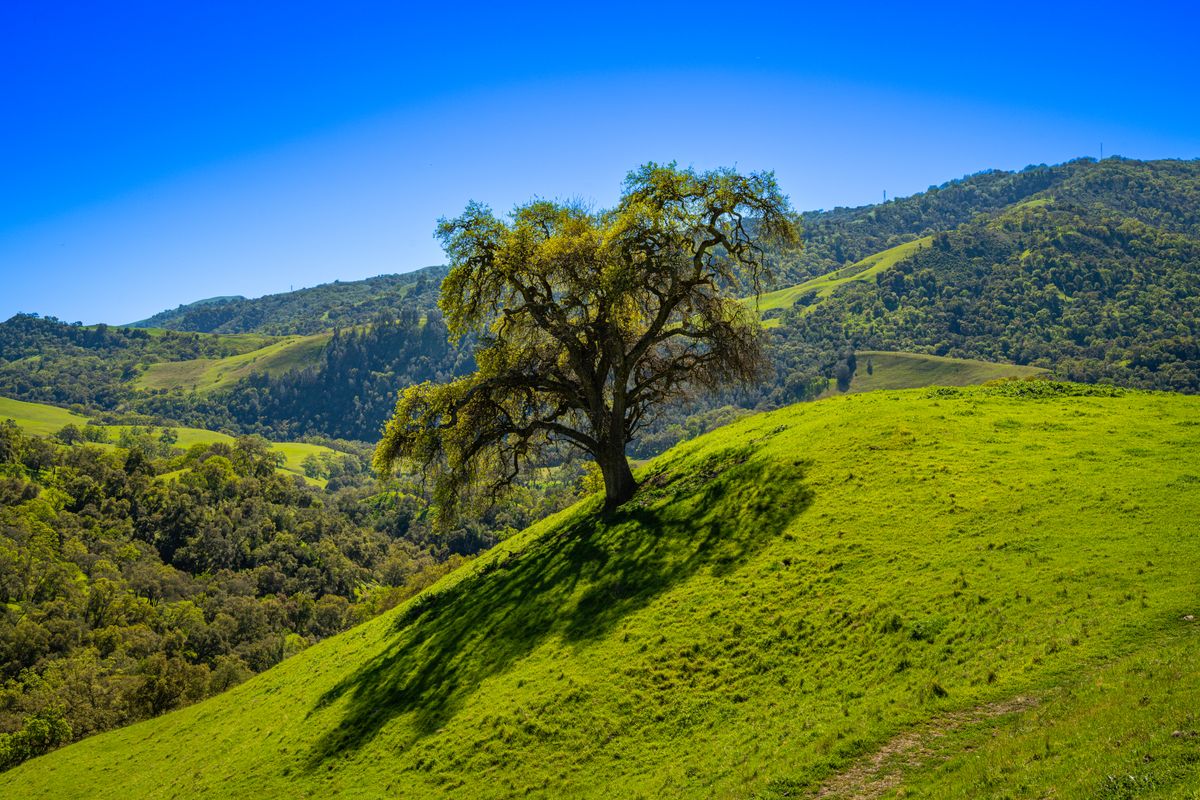
Coast live oak and valley oak belong to a rainfall pattern that stops in spring, and summer water in their root zone is how you invite crown and root rot into a tree that would otherwise live for centuries. If an oak here is showing drought stress, the answer is mulch and root-zone care, not a hose. This is the single most valuable thing to get right on an oak property in the city.
Reading the tree
Scorch on the leaf edges, early leaf drop, a thinner crown each year, dieback from the tips inward — those are symptoms and they have more than one cause, including too much water, compaction, or a grade change a decade ago. Watering harder is not a diagnosis.
Getting the schedule right
Send a photograph of the tree and the ground around it, and tell us what the watering has been. Call (805) 927-4414 or use the contact page and we will set a schedule for the soil you actually have.
Questions, quotes, or just exploring — we’re here to help.