


Mulching in Los Osos, CA
Los Osos — this is the coast these pages are about.
Quick answer: Mulching in Los Osos, CA — Mulch is the cheapest thing that happens to a tree: a flat layer over the root zone holds moisture through the dry season, keeps the soil temperature steady and feeds the soil life the tree depends on. Almost every mulch problem is a depth problem or a contact problem — too thick, or piled against the trunk where the bark has to stay dry.
- Typical depth: Two to four inches, flat, from the drip line inward — never a cone against the trunk.
- Typical timing: After planting or after a clean-up; refreshed in autumn so winter rain carries it down.
- What it involves: Keeping the root flare visible, keeping mulch off the bark, and choosing material that breaks down rather than mats.
- The standard: ISA and university extension guidance on arboricultural mulching and the root flare.
- Our own record: 503 pages and 291 stories published on this site. Counted from our own archive, not a stock table.
Field note. What we see most on this coast is not too little mulch but too much, in the wrong place: the volcano against the trunk that keeps the bark wet through the fog season and invites rot where the tree cannot show it until the canopy thins.
On the other hand, a thin ring of the wrong material is worse than none at all — matted, water-repellent mulch sheds the rain it was meant to store.
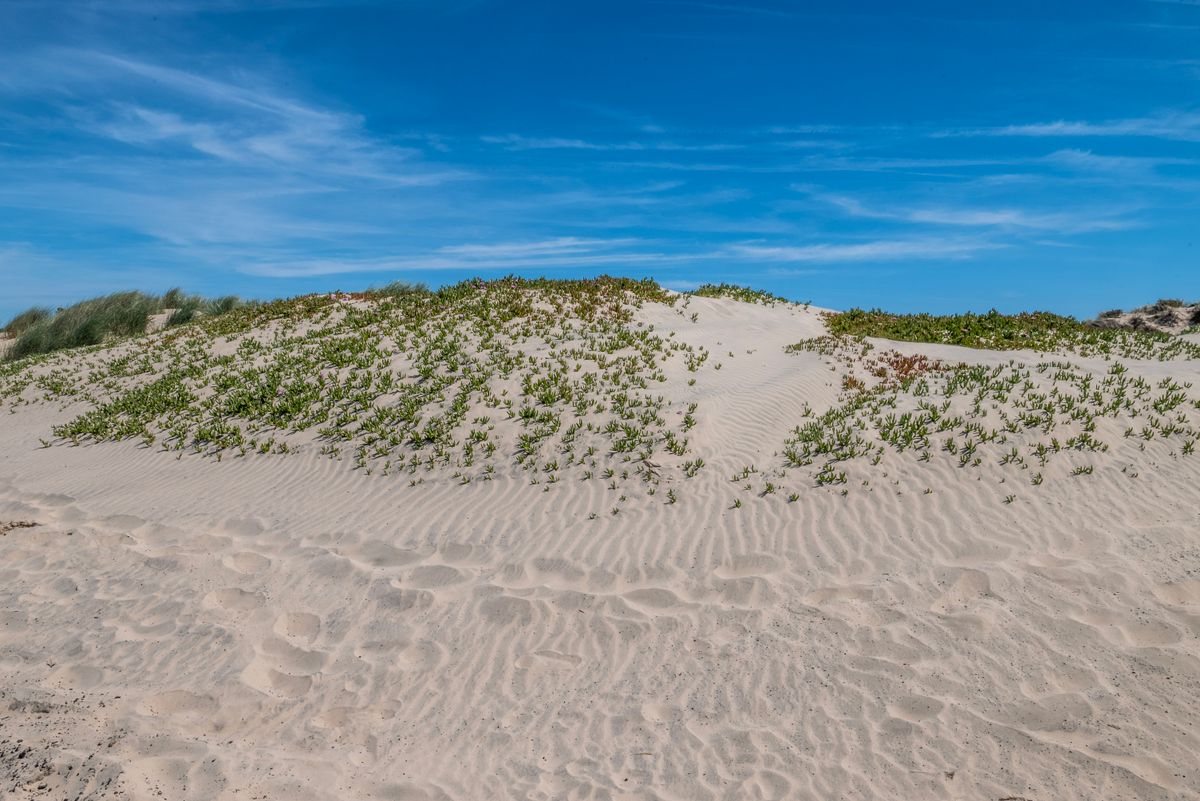
Sandy soil is generous and ungrateful at the same time. It drains in minutes, which is why the pines and oaks of Los Osos do as well as they do on old dunes, and it holds almost no water or nutrients, which is why everything planted here needs help that clay-country gardeners never think about. Mulch is the cheapest help there is.
A proper ring of arborist chips — not bark, not rubber, not a volcano against the trunk — is the difference between a young tree that establishes in three years and one that stalls for ten.
What the chips actually do here
In this town, mulch has three jobs. It slows water so the sand can absorb it instead of shedding it; it keeps root-zone soil cool through the fog-burn months when sun breaks through and bakes a south-facing yard; and it keeps weeds from competing with a tree that is already growing on a thin diet.
Chipped brush from our own pruning work — needles, leaves, small branches — is the right material, because it breaks down into exactly the crumbly layer of organic matter that dune sand lacks. It should go on four to six inches deep, pulled back a hand's width from the trunk so the bark can breathe, and out to the edge of the canopy or as far as the site allows.
The mistakes we see, in order of frequency
First is the mulch volcano — a cone against the trunk that keeps the bark wet, invites rot and gives borers cover. Second is too thin a layer, an inch or two, which does little more than hide the soil. Third is piling fresh chips over an old problem: if the tree is declining, mulch helps only after the cause is understood, and covering the root flare with a foot of chips hides the one symptom worth reading.
Where irrigation is in place, mulch and emitters have to be designed together — emitters buried in chips waste water, and dry chips shed water from the surface, so the schedule has to deliver water to the soil, not the mulch.
How much, and how to water it
A modest yard needs less mulch than the mulch yard wants to sell. A cubic yard covers roughly a hundred square feet at three inches deep, so a single-canopy tree ring is usually one to three yards, and a whole-property cleanup can run to eight or ten after years of neglect.
Spread it in fall, while the ground is warm and the winter rain will soak it, and let the top inch dry between waterings — wet mulch against bark is the one condition that reliably causes trouble. If you use drip or bubblers, check them after spreading; mulch shifts and buries emitters, and many of the dry trees we see are watered by an emitter sitting under six inches of chips.
One material to skip: unbroken bark dust sold as decorative cover, which sheds water the way a thatched roof does and does almost nothing for the soil beneath it. Arborist chips from clean pruning are the genuine article, and a pile kept in the corner of the yard keeps improving for a year after it is spread.
Because our pruning work produces the material, mulching is often the least expensive line on a Los Osos property plan. It is also the one that pays back every year: a mulched tree needs less of everything else, from water to fertilizer to replacement. If you want the whole sequence — prune, chip, spread — the pruning side is on our tree trimming and pruning page, and the crews that do both work out of the same yard.
Questions, quotes, or just exploring — we’re here to help.