

Holding the Terrace Edge
Slope & Bluff Stabilization in Harmony, CA
Harmony — this is the coast these pages are about.
Quick answer: Slope & Bluff Stabilization in Harmony, CA — Trees on this coast live with fog, salt, wind and thin soil, and the work that keeps them healthy is decided by those conditions rather than by a calendar written inland. Structure, clearance and the root zone are what a tree here needs looked at, and small work done early is what keeps a tree out of the emergency list.
- What it involves: Structural pruning, clearance from structures and wires, deadwood removal, root-zone care and hazard assessment.
- Typical timing: Structural work in the dormant months; deadwood, clearance and hazard work whenever the tree needs it.
- The standard: The ISA standards for pruning and tree risk assessment, applied by ISA-certified arborists.
- Where we work: Cambria, San Simeon, Harmony, Cayucos, Morro Bay, Los Osos and the Cambria pine belt.
- Our own record: 503 pages and 291 stories published on this site. Counted from our own archive, not a stock table.
Field note. What we see on this coast is that the trees people worry about are usually not the ones in trouble: the pine with a clean crown and a lean that predates the house is often sounder than the tidy tree that has been quietly drowning in its own root zone.
On the other hand, there is no schedule that suits every tree — the same species on two sides of one street can need opposite care, which is why we look before we recommend.
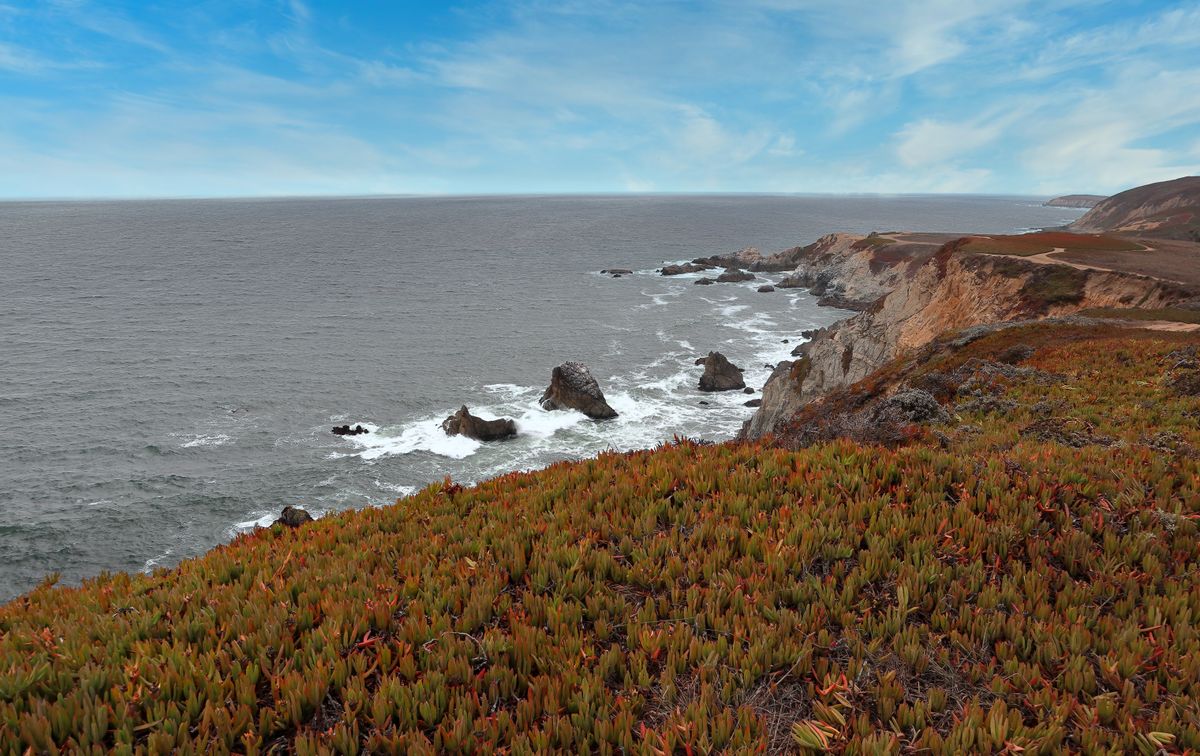
Harmony sits on a marine terrace, which means the ground is flat until it suddenly is not. Behind the buildings the land drops to the creek; along the ocean side the terrace edge falls away to the shore, and both of those edges are where the questions are.
A slope here is usually held by a combination of grass roots, an old fence line and a century of luck, and the failure that worries people is not the surface soil washing away in a storm — that is erosion, and it is a different job. This is mass movement: a block of ground that moves as a body.
Water is what starts it
Almost every slope failure on this coast begins with water that got into the wrong place. A downspout discharged at the top of a bank, a septic line leaking for two winters, irrigation from a garden chasing the season, a ditch that used to carry the orchard drainage and now carries nothing and ponds instead.
On terrace ground over a clay layer the water has nowhere to go once it is in, and the pore pressure it builds is what eventually takes the toe out. So the first tool is never a wall or a plant. It is finding where the water enters and giving it somewhere else to be.
What vegetation can and cannot do
Roots do hold soil, and a well-vegetated bank sheds rain better than a bare one. But a slope's stability is not proportional to how much is growing on it, and two of the biggest eucalyptus on the property can add more weight and more wind load at the top than their roots add strength at the bottom.
On an actively moving bank the honest answer is that a tree planted to fix it is a gesture, and the useful vegetation work is deep-rooted, low-profile cover that holds the surface without levering the mass.
The creek bank, where the rules are different
The ground either side of the creek is its own case, and not only for the reasons above. A bank there erodes from below as the winter flows take the toe out, which produces a steep face and eventually a slump above it, and the vegetation that would help most is whatever is already holding the face.
Work inside a creek corridor also runs into county and often state rules about the channel itself, so a retaining structure or a large removal on a bank is planned well ahead and with the right permission rather than taken on as a quick fix between storms. On a working parcel the practical first move is almost always the water and the stock: fences that keep animals off the face, and no more grazing on the top edge.
Getting an engineer involved, and when
There is a line past which an arborist should not be the last voice. Tension cracks along the top of the bank, a fence line that has stepped, a retaining structure that has rotated, water seeping from the face in summer — those go to a geotechnical engineer, and the planting and clearing plan follows their reading rather than replacing it.
Structural work such as a crib wall, soil nails or a toe drain is engineering, and on the coast it also runs into coastal development constraints that are slower than the work itself.
Staged work, and what to leave alone
On a bank that is merely eroding, staged treatment works: intercept the water, establish cover, keep the stock and the mower off, and stop the thing that was cutting into the toe. On a bank that is moving, watch it with markers for a season before committing to a structure, because the rate of movement decides the remedy.
What we will not do is clear a creek bank to make it look tidy, or remove the vegetation from a slope edge because it is in the way of a view.
If a bank has started to move or a terrace edge is retreating, call (805) 927-4414 and we will look at the water first. The wider ground programme is on the Harmony page; see our services or the contact page.
Field note — Samuel Delacroix walks to the bottom of a bank and then uphill from it, because the failure is usually being caused by something at the top.
Questions, quotes, or just exploring — we’re here to help.