



Emergency Tree Service in Cayucos, CA
Cayucos — this is the coast these pages are about.
Quick answer: Emergency Tree Service in Cayucos, CA — Removing a tree is planning before it is cutting: where the wood lands, what is under it, whether a rope or a crane takes the weight, and what is left when the crew drives away. A removal is finished when the drop zone is clear and the stump is dealt with, not when the trunk hits the ground.
- Typical timing: When the tree is a hazard, the schedule is immediate — storm damage, split leaders and leaners do not wait for good weather.
- What it involves: A written plan for the drop zone, rigging or crane work over structures, protecting driveways and roofs, and deciding the stump’s fate in advance.
- The standard: The ANSI Z133 safety standard for arboricultural operations, and ISA best practice for removals near structures.
- Where we work: Small town lots, coastal acreage and the narrow properties of the Cambria pine belt.
- Our own record: 503 pages and 291 stories published on this site. Counted from our own archive, not a stock table.
Field note. What we see here is that access decides the price more than height does: a pine over a fence on a slope with no driveway costs more to take down safely than a taller tree with a clear drop, and the plan is where that shows up.
On the other hand, removal is not the only safe answer — a tree with one failing limb, or a lean that can be corrected by reduction, is often better kept and managed than gone.
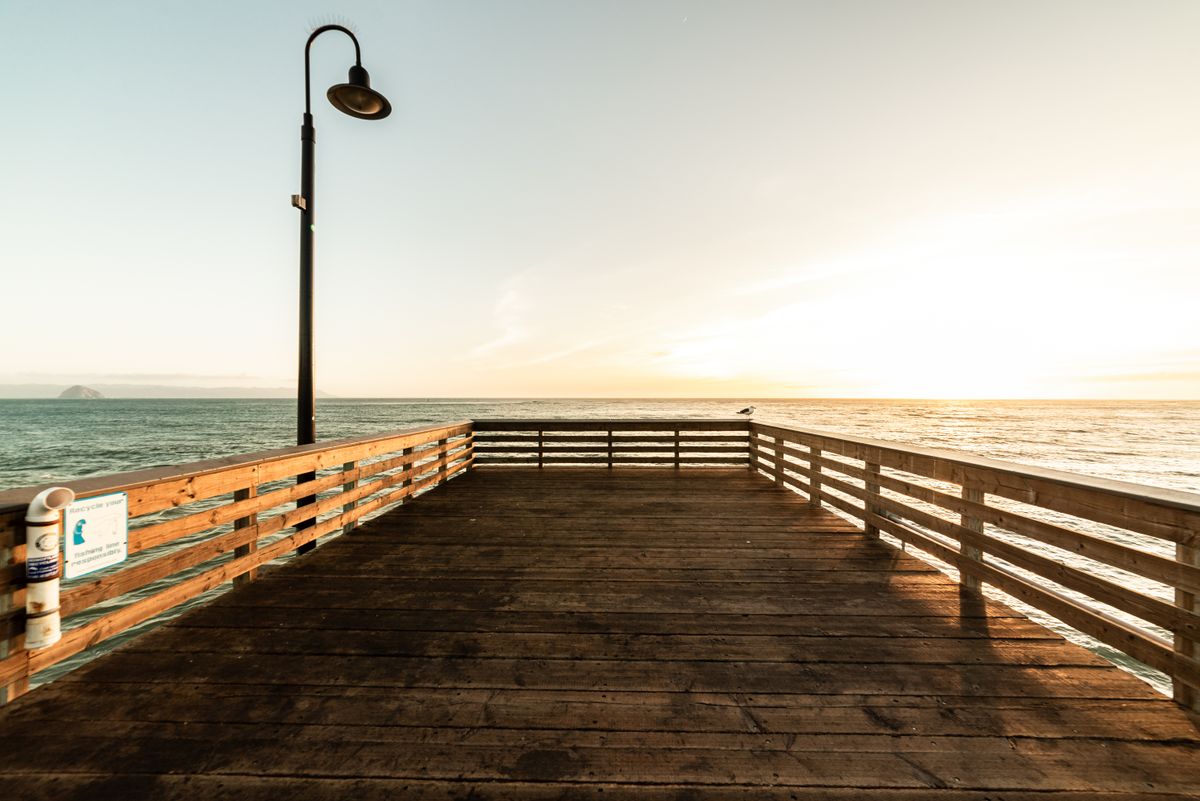
When a Cayucos tree comes down, it usually comes down in the same weather that closed the pier and pushed the surf over the seawall. The winter pattern is consistent: a saturated ground after weeks of rain, then a strong system with wind out of the southwest. Sandy soil loses its grip in exactly those conditions, and the trees with the most exposure are the ones that move first.
The first hour: triage, not cutting
The most useful thing we do in the first hour is not cutting. It is looking. Is the tree resting or still moving? Is the root plate lifting out of the ground, which means the whole tree can roll? Are wires involved — and if so, does anyone step near them before the utility has de-energized the line? Is the trunk split and holding a load in the split?
A tree under tension is the single most dangerous thing on a residential property, and it does not look it. The trunk can look stable while the wood inside it is stored energy, and the first cut can release that energy without warning.
So the emergency response is: protect people first, mark off the area, get pets and vehicles clear, and call if a conductor or a service drop is anywhere in the picture. Then we plan the release cuts — the cuts that take the load off a split or sprung piece step by step, from a position that the piece is not pointing at. Doing that with daylight and calm is a hard job.
Doing it at night in the middle of a storm is a much worse job with much worse odds, and part of our honest triage is sometimes telling a client that the safest thing until morning is distance.
What gets done right away, and what waits
Right away: any tree on a structure, blocking a driveway, or leaning over the only path out. Any situation where a limb is holding another limb that is over something you cannot replace. We work with the county and the utility when a town street is blocked, and we stage equipment on Highway 1 frontage where the narrow streets will not take a truck and a chipper at once.
What waits, with a plan: trees that are down in the yard away from anything, stumps, and cleanup of debris that is not threatening anything. It is tempting to want the whole mess gone in one day, and it costs more and risks more to do it that way. We would rather spend the first visit making the property safe and the second visit doing the work calmly.
Document everything for insurance
Take photographs before anything moves — wide shots of the tree and the property, close shots of the damage, and the plates or fence posts still pinned under the trunk. Keep every receipt, including the emergency response. Most coastal homeowners policies treat storm damage as a covered event, and the claim is built on the record you made in the first hours.
Our part is straightforward: we write down what we found and what we did, and you have a document that matches the photographs.
One more piece of honest advice. The tree that fell is not always the dangerous one. A storm that takes one tree unloads the canopy around it, and the neighbor that was crowded five seasons ago is suddenly the one catching the wind. When we are on a Cayucos property for a storm call, we look at the standing trees too, and we say which ones deserve a closer look before the next system.
The call for that assessment is the same as the emergency line — it just happens on a day when nothing is on the roof.
Questions, quotes, or just exploring — we’re here to help.