


Site and history — soil, slope, drainage, recent construction or grading, compaction, past pruning wounds, irrigation changes. Most root problems start with something that happened to the ground.
Tree risk assessment in Cambria, hazard versus risk
Quick answer: Tree Risk Assessment in Cambria, CA — Removing a tree is planning before it is cutting: where the wood lands, what is under it, whether a rope or a crane takes the weight, and what is left when the crew drives away. A removal is finished when the drop zone is clear and the stump is dealt with, not when the trunk hits the ground.
- Typical timing: When the tree is a hazard, the schedule is immediate — storm damage, split leaders and leaners do not wait for good weather.
- What it involves: A written plan for the drop zone, rigging or crane work over structures, protecting driveways and roofs, and deciding the stump’s fate in advance.
- The standard: The ANSI Z133 safety standard for arboricultural operations, and ISA best practice for removals near structures.
- Where we work: Small town lots, coastal acreage and the narrow properties of the Cambria pine belt.
- Our own record: 503 pages and 291 stories published on this site. Counted from our own archive, not a stock table.
Field note. What we see here is that access decides the price more than height does: a pine over a fence on a slope with no driveway costs more to take down safely than a taller tree with a clear drop, and the plan is where that shows up.
On the other hand, removal is not the only safe answer — a tree with one failing limb, or a lean that can be corrected by reduction, is often better kept and managed than gone.
Standards and sources: Safety standards (ISA — International Society of Arboriculture) · Homeowner guidance (TCIA — Tree Care Tips)
Prepared by Cambria Pines Tree Service Inc. — ISA-certified arborists working on the Central Coast.
What a Tree Risk Assessment Actually Is
A tree risk assessment is a structured, documented judgement about three things: how likely a tree or one of its parts is to fail, what it would hit if it did, and how bad that would be. It is not a guess dressed up in arborist language, and it is not the same thing as looking at a tree and saying it seems fine.
The distinction that matters most is between a hazard and a risk. A dead limb forty feet up in the middle of an empty field is a hazard with no target and therefore negligible risk. The same limb hanging over the bed your children sleep in is a serious risk. The tree is identical; only the target changed. That is why a real assessment always starts by identifying what is underneath.
We produce these assessments across Cambria and San Luis Obispo County — for homeowners who are worried about a specific tree, for properties changing hands, for insurance and permit requirements, and for the aftermath of a storm.
The Three Levels of Assessment
The industry-standard framework, from the International Society of Arboriculture, defines three levels of assessment that escalate with the stakes. Knowing which one you need is most of the cost question.
A written report can be produced at any level; the level determines how much of the tree was examined closely and how many assumptions the report has to name.
- Level 1 — limited visual assessment. A drive-by or walk-through of the whole property, looking for obvious defects, dead trees, visible decay and deadwood. Fast, cheap, and appropriate for routine monitoring of a healthy stand where nothing specific is worrying you.
- Level 2 — basic assessment. The workhorse. Every tree in scope is inspected from the ground, close up, by walking around the root flare, trunk, scaffold limbs and crown. This is where the great majority of decisions get made, and where most "should this tree stay" questions are answered.
- Level 3 — advanced assessment. Used when a Level 2 finds something that has to be measured rather than judged: decay detection with a resistograph or sonic tomography, crown and root excavation, sometimes a load test or a climb. Ordered when the tree matters enough — a heritage oak, a tree central to a property's value, or a tree whose removal would be a genuine loss — that the answer should be more precise than "probably".
What We Examine on Every Tree in Scope
A ground-level assessment is a systematic pass over the parts that fail, in the order they fail:
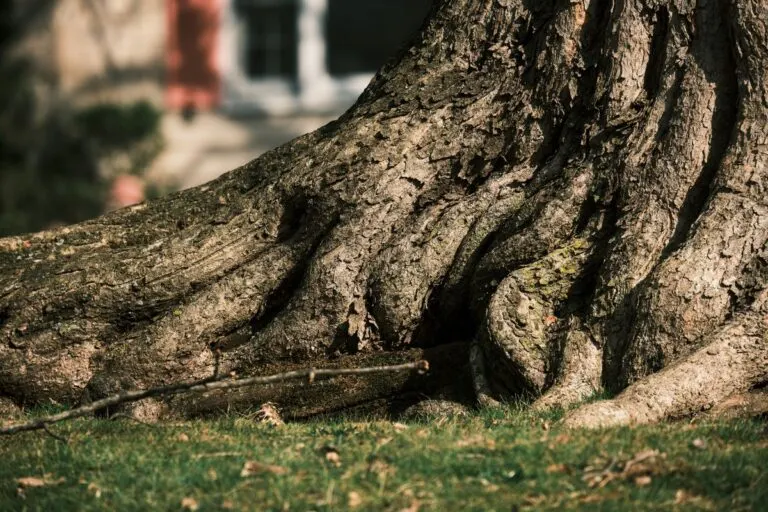
Roots and root flare — the point where the trunk meets the ground. Decay here, a missing flare on one side, cracked or heaving soil, fungal conks, and fresh lean are the most serious findings an assessment can produce, because a root failure cannot be pruned away.
Trunk — cavities, cracks, seam development, old bark wounds, stem-girdling roots, and the width of sound wood relative to the diameter of the stem.
Unions and forks — codominant stems, V-shaped forks, and included bark, which is the single most common serious defect on the coast live oaks here and the most common reason we recommend a cabling and bracing system.
Branches and crown — deadwood size and position, hangers, decay around old cuts, weak branch attachment, and canopy imbalance that loads one side of the tree.
Species and condition — what the tree is built to do, how much of it is still growing, and whether the wood we are relying on is alive.
The target — what is within reach, how often people are there, and what a failure would cost. This is where most of the risk, and most of the honest answer, actually lives.
When People Actually Need One
Requests for assessment come from a handful of recognisable situations:
- A specific worry — a new lean, a cavity, mushrooms at the base, a fork that appears to be splitting, or a limb that dropped without warning. In Cambria this is often a Monterey pine, which is known for dropping sound-looking summer limbs.
- Insurance. Carriers in high fire and high wind zones increasingly ask for documentation about trees near the structure, and an underwriter's question is answerable with a report and photographs.
- A property transaction. Buyers want to know what they are taking on, and sellers want a documented position. An assessment on the trees that matter is cheaper than a post-closing surprise.
- After a storm. A storm is the single most common trigger. Trees that survived can carry damage invisible from the ground, and the second failure — during the next wet winter — is the one that catches people.
- A dispute or a notice. Neighbour concerns, county correspondence, or an insurer's letter are all situations where a dated, written, professionally reasoned document is the point.
- Planning and permits. Work near a protected species, a bluff, or a mapped area sometimes needs a qualified opinion before it can proceed.
What the Report Contains
Our written assessments are structured so a person who was not present can follow the reasoning:
Scope — which trees, what level of assessment, what was and was not examined, and the date.
Findings per tree — the defects observed, each with its location on the tree and the photographs that support it.
Risk rating — the likelihood of failure, the likelihood of impact and the consequences of failure, combined into an overall rating, with the reasoning shown rather than asserted.
Recommendations with a time frame — from "remove within thirty days" to "re-inspect in two years", ranked so the urgent is separable from the optional.
Mitigation options — where more than one answer exists. Sometimes the right answer is pruning, sometimes support via cabling, sometimes removal, and sometimes moving the target (the bench, the shed, the parking spot) rather than the tree.
Limitations, stated plainly — a ground-level assessment cannot see inside wood, cannot examine roots without excavation, and is a professional opinion about conditions on the day. That is stated, not hidden.
Who Should Be Doing This
Tree risk assessment is a specialist skill and it is worth asking who will be doing it. The relevant credential is an ISA Certified Arborist, ideally holding the ISA Tree Risk Assessment Qualification (TRAQ), which is the training behind the level-and-matrix framework used above. If the person quoting you cannot name the methodology they follow or the credential they hold, the quote is not an assessment.
Our inspection service is the routine version of this work — ongoing monitoring of a property's trees. The assessment you are reading about is the documented version, produced when a decision has to be defensible to someone else.
How Often It Should Be Repeated
- Annually for a property in a high fire or wind zone, or with mature trees close to structures — this is usually a Level 1 or Level 2 pass.
- Re-inspect at the interval the report specifies — typically one to three years, depending on the defects found.
- Immediately after any significant storm, any construction or grading near trees, any change in drainage, and after any occurrence of a limb or tree failing nearby.
Arrange an Assessment
Tell us how many trees matter, what worries you about them, and what is underneath them. For a single tree a site visit is enough; for a property with several, we will scope which trees need a close examination. Call (805) 927-4414 or use our contact page, and see our services page if you want the assessment followed by pruning, support or removal handled by the same crew.
Next step
Ready when you are.
Questions, quotes, or just exploring — we’re here to help.