
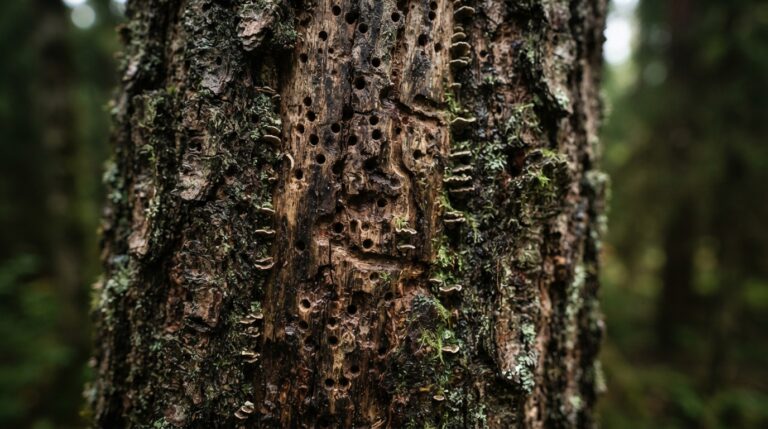
Identifying the signs of bark beetle infestation early is critical for protecting both ornamental and commercial tree stands from catastrophic loss. Recent outbreaks across the western United States have highlighted the speed at which these pests can spread, making vigilance a key component of sustainable forest management.
What Are Bark Beetles and Why They Matter
Bark beetles (family Curculionidae, subfamily Scolytinae) are small, ambrosia beetles that tunnel beneath the bark of stressed or weakened trees. Once inside, they cultivate fungal gardens that feed the beetles and degrade the tree’s defensive tissues. The result is a weakened host that is vulnerable to secondary pathogens and, eventually, death. Because bark beetles can colonize a tree animally in a matter of weeks, the early detection of infestation signs is essential.
Signs of Bark Beetle Infestation in Your Landscape
Several observable indicators can reveal an ongoing or imminent bark beetle attack. A systematic visual inspection can catch many of these clues before theyutiny leads to large‑scale damage.
- Entry and exit holes: Small, round, 0.5-1.5 mm diametrical punctures that are often spaced 1-3 cm apart along the bark. Exit holes are typically darker and may display a faint white frass line.
- Frass accumulation: Fine, dark, powdery or granular material that clings to the bark edges, indicating beetle activity.
- Resin exudation: Visible resin oozing from the tree surface, sometimes forming a dark stain or a sticky film.
- Green‑attack symptoms: A sudden, uniform green discoloration of the foliage, often followed by yellowing within a few weeks. This is a classic sign of pine beetle, pine bark beetle, Obrist or southern pine beetle infections.
- Bark splitting or flaking: The outer bark may peel away or form split lines where beetles tunnel.
- Swollen or deformed twigs: Branches that appear puffy or twisted due to fungal growth.
These signs, when combined with knowledge of local species distribution, provide a reliable early warning system. For instance, the appearance of green attack in a stand of lodgepole pine during the summer of 2024 was a clear precursor to the massive pine beetle outbreak reported by the Colorado State University in Pike National Forest.
Advanced Detection Techniques: UAVs and Remote Sensing
Traditional field scouting is labor‑intensive and often limited by terrain. Recent research has demonstrated the efficacy of UAV‑based photogrammetry and hyperspectral imaging for mapping bark beetle damage at the tree level. Sentinel‑2 and Landsat‑8 satellite data, when combined with UAV imagery, can detect early green‑attack stages with high accuracy, allowing managers to target treatment zones more precisely. Studies such as “Using UAV-Based Photogrammetry and Hyperspectral Imaging for Mapping Bark Beetle Damage at Tree-Level” (2015) and “Sentinel‑2 accurately maps green‑attack stage of European spruce bark beetle” (2018) underpin the practical application of these technologies in contemporary forest management.
FAQ: How to Distinguish Bark Beetle from Other Pests
What is the difference between bark beetle and ambrosia beetle signs?
While both create servo‑drilled holes, ambrosia beetles often leave larger, irregularly shaped exit holes and produce more extensive frass piles. Bark beetles, conversely, create small, evenly spaced entry and exit holes with minimal frass.
Can I rely solely on visual cues, or should I conduct a laboratory analysis?
Visual inspection is the first line of defense. However, confirmatory sampling–such as bark core extraction–can identify the specific beetle species and associated fungal koe Helsing. This information is vital for selecting the appropriate management strategy.
Early detection and rapid response to signs of bark beetle infestation can transform a potential disaster into a manageable event. By combining systematic field scouting with modern remote‑sensing tools, landowners and forest managers can preserve tree health, protect ecosystems,olio, and maintain the aesthetic and economic value of their landscapes.
A diagnosis is worth more than a guess when a tree is declining. tree inspections.
See our tree service in Cambria for all of our services in one place.
More on pine bark beetle signs
The Early Warning Signs of Bark Beetle Infestation
Beetle activity shows up first on the trunk and in the canopy, and no single clue tells the whole story. Confirmation gets stronger as these signals stack up:
- Pitch tubes. Popcorn-sized blobs of hardened resin on the trunk, marking spots where beetles bored in. They can look whitish, pinkish, or reddish-brown.
- Boring dust, or frass. A fine, reddish-brown powder settling into bark crevices, piling up at the base of the tree, or tangling in spider webs on the bark.
- Tiny entry holes. Small, round holes roughly the diameter of a pencil lead, scattered across the trunk.
- Fading foliage. Needles shifting from dull green to yellow to rust-red, often starting near the top of the crown.
- Woodpecker activity. Bark flaked off in patches or rows of small feeding holes where birds are hunting beetle larvae.
- Loose or cracking bark. Sections peeling away from the trunk more easily than they should.
One or two clues alone can be misleading — pitch tubes can come from other injuries, and woodpeckers probe plenty of healthy trees. The concern level rises sharply when you find fresh boring dust plus new holes, especially on more than one tree.
What the Evidence Looks Like Under the Bark
If a patch of bark is already loose, or you are pruning anyway, gently lift a section with a flathead screwdriver. A successful beetle attack leaves behind engraving-like gallery patterns: winding S-shaped tunnels, Y-shaped branching networks, or hatch-mark etchings, depending on the species. You may also spot the beetles themselves — small, dark, cylindrical insects, most no longer than a grain of rice.
Sapwood stained a blue-gray tone is another giveaway. Bark beetles carry staining fungi into the tree, so that discoloration means the attack has progressed well past the surface. One wrinkle worth knowing: Ips beetles, the group often called engraver beetles, tend to attack the upper trunk and canopy — and on already-stressed trees they frequently skip pitch tubes entirely. If the top third of a pine looks off but the lower trunk looks clean, go hunting for frass higher up.
Which Trees Are Most at Risk?
Pines get most of the headlines — species like the mountain pine beetle, southern pine beetle, and various Ips beetles can take down entire stands — but bark beetles also target spruce, fir, larch, and certain hardwoods such as elm. Stress is the common thread. Drought-weakened trees, freshly transplanted trees, roots damaged by construction, and trunks dinged by mowers or lightning all send out an unintentional dinner invitation.
Crowding matters too. Dense, unthinned groups of conifers compete for water, leaving every tree in the cluster more vulnerable — one reason outbreaks spread fast in packed stands. And do not overlook firewood: freshly cut pine logs stacked near living trees are one of the most reliable ways homeowners import a problem.