



Reading the Tree Before It Fails
Hazard Tree Evaluation in Harmony, CA
Harmony — this is the coast these pages are about.
Quick answer: Hazard Tree Evaluation in Harmony, CA — Removing a tree is planning before it is cutting: where the wood lands, what is under it, whether a rope or a crane takes the weight, and what is left when the crew drives away. A removal is finished when the drop zone is clear and the stump is dealt with, not when the trunk hits the ground.
- Typical timing: When the tree is a hazard, the schedule is immediate — storm damage, split leaders and leaners do not wait for good weather.
- What it involves: A written plan for the drop zone, rigging or crane work over structures, protecting driveways and roofs, and deciding the stump’s fate in advance.
- The standard: The ANSI Z133 safety standard for arboricultural operations, and ISA best practice for removals near structures.
- Where we work: Small town lots, coastal acreage and the narrow properties of the Cambria pine belt.
- Our own record: 503 pages and 291 stories published on this site. Counted from our own archive, not a stock table.
Field note. What we see here is that access decides the price more than height does: a pine over a fence on a slope with no driveway costs more to take down safely than a taller tree with a clear drop, and the plan is where that shows up.
On the other hand, removal is not the only safe answer — a tree with one failing limb, or a lean that can be corrected by reduction, is often better kept and managed than gone.
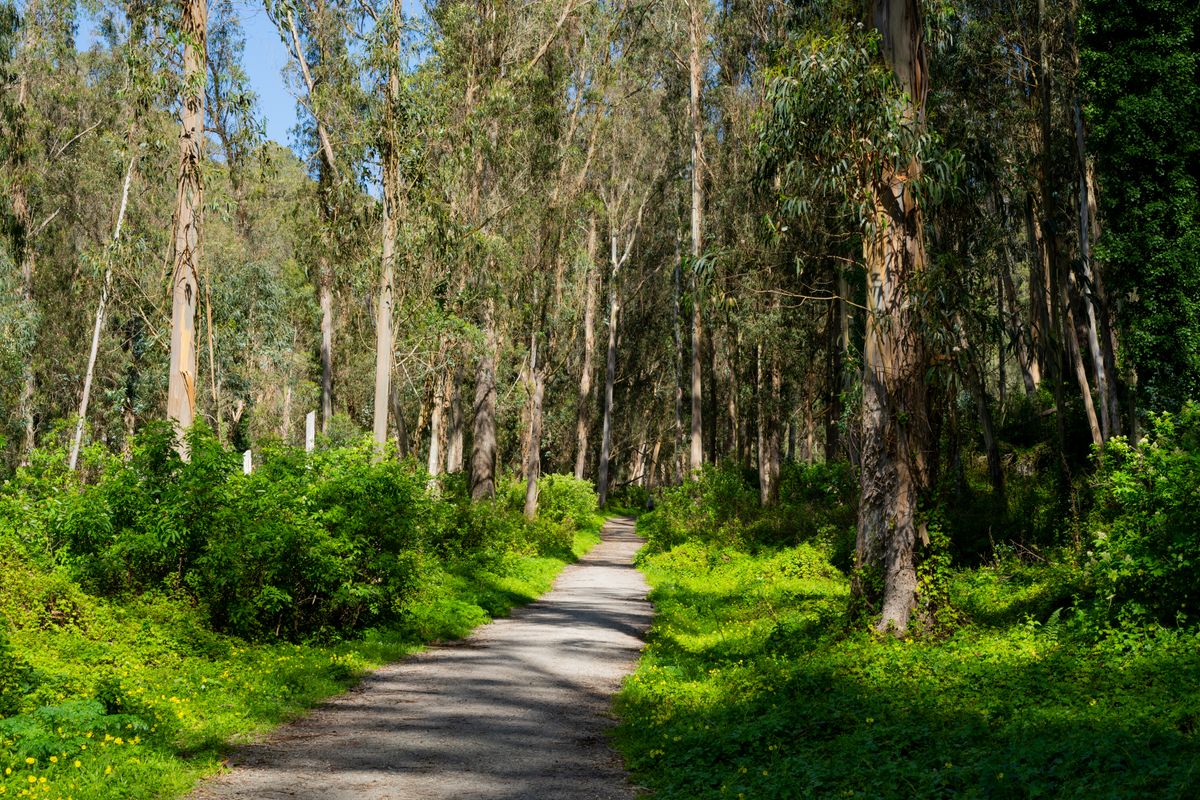
A hazard tree evaluation in Harmony is a walk with a notebook, and it usually starts because something small has already happened: a limb down on the lane, a fork that looks wrong above the winery, a cypress that has thinned from the top. The point of the walk is to read the tree's own signals rather than wait for the failure, and on century-old eucalyptus and cypress the signals are there to be read.
Fungal conks, and what each one implies
A mushroom growing out of a trunk or a root crown is the fruiting body of a fungus already inside the wood, and the species matters. A shelf conk on the butt of a eucalyptus suggests a white rot hollowing the centre, which is the classic hidden defect in these windrows — the tree looks sound and fails at the base.
A bootlace-like rhizomorph under the bark points at Armillaria, which spreads along roots between trees and is worth mapping across a parcel rather than treating tree by tree.
Cavities, cracks and seams
A hollow is only half the question: what matters is how much sound wood remains around it and whether the opening is closed or open to water. A crack or a seam running up a trunk is a different and usually more urgent signal, because it means the wood has already separated under load. Bark that has begun to split vertically, or a bulge at the base of a fork, is the tree telling you where it is working hardest.
Included bark and the fork problem
The single most common structural defect in the trees on these old farm lots is a fork of two near-equal stems with bark trapped between them. Bark never bonds, so the two stems are held together only by the wood that has grown around the outside of the joint.
In a windrow that has grown up in company, forks like this are everywhere, and they are the reason a tree can look magnificent and be a genuine hazard at the same time.
The root plate and the lean
A lean is not automatically a defect — a eucalyptus in a windrow leans because it grew that way in the wind. What matters is a lean that is new, a crown that has shifted, cracked soil or a raised mound on the tension side of the trunk, and mushrooms at the base. Those four together mean the root plate has begun to move, and that is a tree that should not wait for the next storm.
The urgency scale, and writing it down
The output of the walk is a short list in plain language: which trees are fine, which need work this season, and which are a hazard to be managed now. Where a contractor, an insurer or a buyer wants it as a document rather than a conversation, the same assessment becomes a written tree risk report. Both start the same way, with somebody walking the parcel and saying what is actually wrong.
If you would like your trees looked at properly, call (805) 927-4414 or use the contact page. Our services page has the wider picture of what we do here.
Field note — Dr. Liam Zimmerman looks at the base before the crown. On this coast most of the dangerous surprises are at ground level, not sixty feet up.
Questions, quotes, or just exploring — we’re here to help.