

Holding a Sea Cliff Is Not a Planting Job
Slope & Bluff Stabilization in Cambria, CA
Cambria — this is the coast these pages are about.
Quick answer: Slope & Bluff Stabilization in Cambria, CA — The tree that thrives here is the one chosen for this coast: fog, salt, wind and shallow soil are the local constraints, and mature size is the constraint most often ignored. Planting is a matter of putting the right species in a site that can hold it, then keeping the root flare visible and the first summers watered.
- Typical timing: Autumn planting, so winter rain does the establishment work; the first two summers decide the tree.
- What it involves: Matching mature canopy and root spread to the space, planting at the depth the tree grew in, and staking only when it is needed.
- The standard: Cal Poly’s SelecTree species data and university extension planting guidance.
- Where we work: Gardens and acreage from Cambria through Cayucos and Morro Bay.
- Our own record: 503 pages and 291 stories published on this site. Counted from our own archive, not a stock table.
Field note. What we see is that the coast is forgiving to the right species and unforgiving to the wrong one: the same tree that looks comfortable four streets in will burn on the windward side of a Cambria lot.
On the other hand, natives are not automatically the answer at every address — a species that belongs in the watershed can still be the wrong size for the garden it is standing in.
The Bluff Is a Sea Cliff, and It Is Still Moving
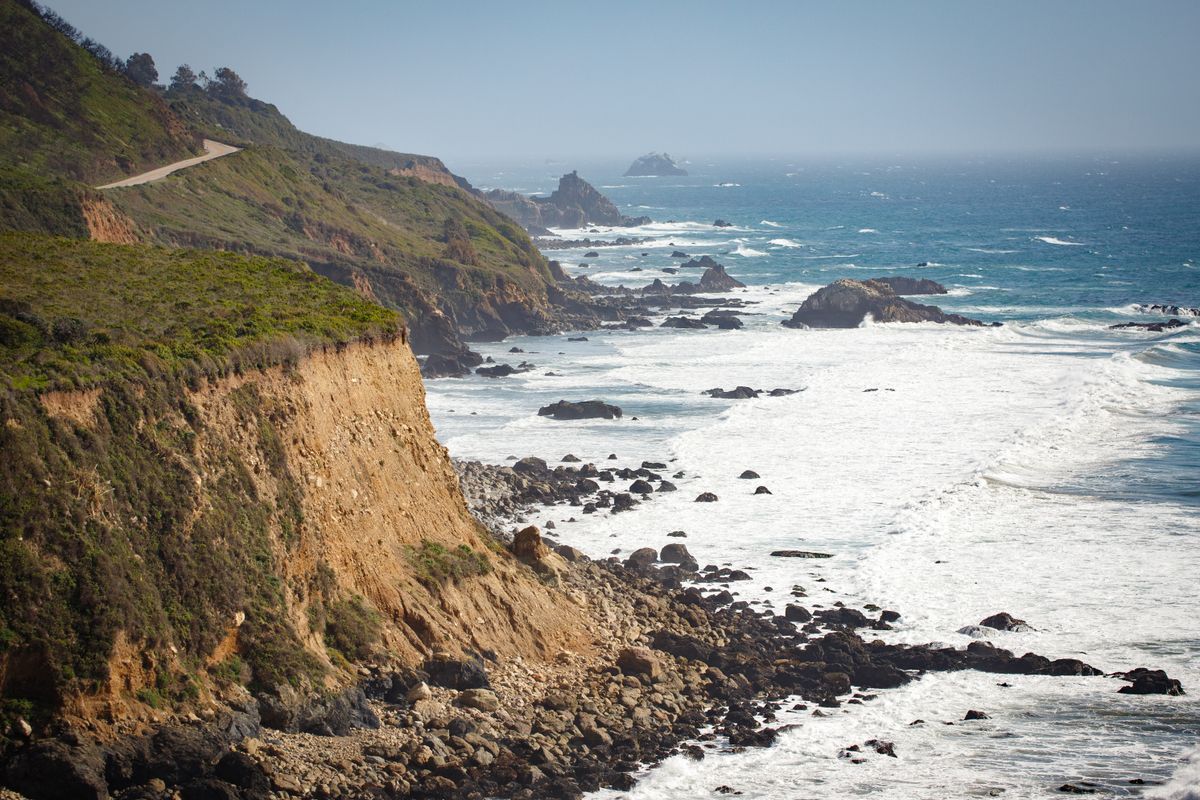
Slope and bluff stabilization on the Cambria coast is not landscaping with a dramatic name. The edge at the west end of town is a wave-cut cliff in marine terrace deposits — sand, gravel and old dune material laid down and then cut back by the sea — and it continues to retreat, slowly and then suddenly.
Anything done on or near it has to answer a geological question before an arboricultural one, and we are careful to say where our part stops and an engineer's begins.
What we can do — and it is often the most effective single thing — is manage the water and the vegetation that either help hold the slope or help unload it.
Drainage Is the First Tool
Bluffs fail from the inside out. Roof runoff discharged over the edge, a leaking septic line, a downspout that has been emptying onto the slope for a decade, an over-irrigated garden strip at the top — each adds water to a mass that fails when its pore pressure rises. Concentrated flow also cuts gullies that steepen the face.
Redirecting that water inland, into a proper drain and a dry well, is cheaper than any structural repair and prevents far more than it costs. The erosion control work in Cambria is the surface half of the same problem.
What Vegetation Really Does
Roots reinforce soil against shallow slipping, and a continuous mat of native cover along an upper slope is genuinely worth keeping. But vegetation is not free of load: a mature tree on a bluff edge adds weight near the top of a slope and catches wind, and windthrow of a large tree takes a root plate with it.
On a Cambria bluff lot, thinning and reducing a wind-sail crown can be a stabilisation measure, not merely tidying — the same logic that makes pruning in Cambria worth doing properly.
When an Engineer Is Required
Structural work — concrete crib walls, soil nails, tiebacks, drainage galleries — belongs to a geotechnical engineer, and on the coast almost anything visible near the edge also risks a coastal development permit.
Our role in that project is the trees: assessing what a design will do to the root systems it will cut, planning the removals the design requires, and protecting what can be kept with a plan rather than an afterthought. We will say plainly when the correct next call is an engineer rather than us.
What We Will Not Promise
No arborist and no planting scheme holds a retreating sea cliff. Vegetation slows surface loss and shallow movement; it does not stop mass failure, and a pitch for a bluff near Cambria is a statement about geology, not about care. The useful thing we can offer is honesty about which problem a property actually has, and a plan for the part of it that trees and drainage can affect.
Start With a Walk of the Edge
Photographs from the beach and from the top, plus whatever survey or septic records you hold, are the fastest way to a view on what is happening. Call (805) 927-4414 or use the contact page, and see our services for the rest of the work we do along this coast.
Questions, quotes, or just exploring — we’re here to help.