


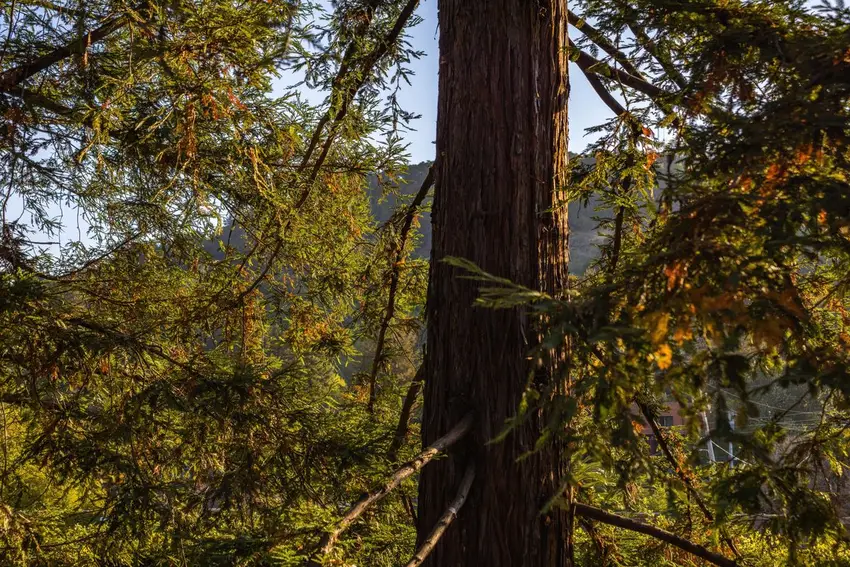
Route around the root zone whenever you can. A longer, shallower run outside the critical root zone beats a straight one through the middle of it.
Quick answer: Yard Drainage & Grading in Cambria, CA — Trees are watered at the root zone, deeply and infrequently — a long soak that reaches down, then a dry spell that lets roots look for water, rather than a daily sprinkle that keeps everything in the top inch of soil. On the fog belt the question is rarely whether there is moisture in the air but how much got down to the roots.
- Typical timing: Deep watering through the dry season, spaced further apart as the tree establishes; young trees need it far more often than mature ones.
- What it involves: Watering at the drip line rather than the trunk, checking the soil six to eight inches down, and mulching so the water stays where it landed.
- The standard: University extension guidance on landscape tree irrigation and drought response.
- Where we work: The coastal terrace from Cambria to Morro Bay, sandy soil and clay both.
- Our own record: 503 pages and 291 stories published on this site. Counted from our own archive, not a stock table.
Field note. What we see here is that salt air and wind dry a canopy faster than the thermometer suggests, so a tree can be water-stressed on a grey week when nothing looks hot to the person holding the hose.
On the other hand, more water is not a cure-all: on clay, a daily soak drowns roots more often than drought does, and the symptoms look almost identical from above.
Standards and sources: Irrigation and disease (UC IPM — University of California pest management) · Tree physiology (USDA Forest Service)
Prepared by Cambria Pines Tree Service Inc. — ISA-certified arborists working on the Central Coast.
The Water Has to Go Somewhere You Chose
Yard drainage and grading is the work of deciding where water goes instead of finding out the hard way. On this coast that decision usually has two audiences at once, because the same slope that carries a winter storm off your roof also carries it into your trees — and the two problems are often solved by the same trench.
A yard that floods is a nuisance. A root zone that has sat wet for a decade is a tree that is quietly dying.
Why Water and Trees Disagree
- Roots need air as much as water. In soil that stays saturated, oxygen runs out and roots suffocate rather than thrive.
- Standing water at the root flare is how rot starts. Basal decay, girdling roots and crown dieback very often trace back to a grade change or a blocked drain.
- Water moves soil. Concentrated runoff cuts channels, undercuts banks and exposes roots that had been protected.
- Watering adds water too. What a tree actually needs is on our deep watering guidance, and most coastal yards are giving more than that rather than less.
Surface Drainage: Swales, Grades and Channels
Most residential drainage is surface drainage, and most of it is decided by the shape of the ground. A swale — a shallow, grassed or gravel-lined channel — carries water across a yard at a controlled slope instead of letting it pool or sheet everywhere. A terrace or a retaining wall turns a grade into something water can follow predictably.
The rule that governs everything we do around a tree is that the grade must not be raised over the root flare or the critical root zone. Adding a few inches of soil to level a yard is one of the most common ways a mature tree is killed on this coast, and the tree usually takes years to die, so nobody connects the two.
Subsurface Drainage: French Drains, Dry Wells, Curtain Drains
Where the problem is soil moving off a slope rather than water sitting in a yard, that is the erosion question rather than the drainage one, and it lives on our erosion control page.
- A French drain is a gravel-filled trench with a perforated pipe, used to collect and move shallow groundwater or to intercept water before it reaches a bad place.
- A dry well is a deeper pit that stores roof or surface water long enough for it to soak away. It works only if the soil beneath can accept the water, which on shallow terrace soil over rock is the first thing to check rather than the last.
- A curtain drain intercepts water travelling down a slope above a house or a pad — the right tool when the source is uphill and the damage is below.
- Downspouts and roof runoff are the simplest fix and the most often ignored: extend them well away from the foundation into a splash block, a dry well or a designed outfall, instead of dumping at the base of the wall.
Trenching Without Killing the Tree
The awkward truth is that digging a drain is the same activity as cutting roots. A trench through a critical root zone can sever a large share of a mature tree's support, and a tree that was fine before a drainage job can be a hazard two seasons after it. The rules we work to:
Where a root zone has already been damaged by past digging, paving or fill, the repair is a separate job — see root-zone remediation. And where the ground in question is a steep slope rather than a yard, start with slope and bluff stabilization, because moving water on an unstable slope needs a different plan.
Keep the trench away from the trunk. The critical root zone is roughly a foot of radius for every inch of trunk diameter — a rule of thumb rather than a survey, but it prevents most of the damage.
Hand-dig or air-excavate near significant roots and make a clean cut where one is unavoidable, rather than tearing roots out with a bucket.
Never change the grade over the flare. If a new patio or raised bed would bury it, redesign the bed instead.
Solving the Whole Yard at Once
Tell us where water arrives on the property, where it stands, and where it leaves — and name the trees you care about before anyone picks up a shovel. Call (805) 927-4414 or use our contact page. If it helps to see the rest of what we do, our services page is the place to start.
Next step
Ready when you are.
Questions, quotes, or just exploring — we’re here to help.