


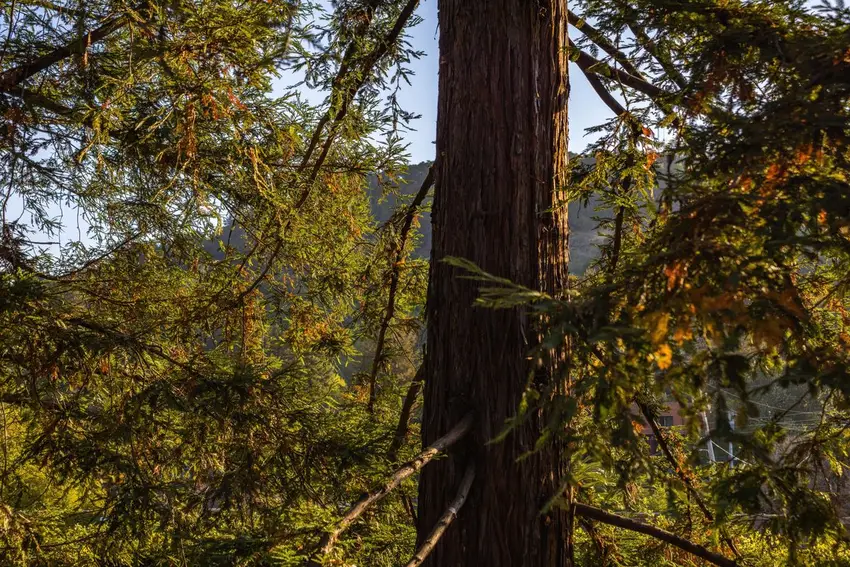

Route the trench away from the tree where the site allows. A metre of extra pipe is far cheaper than the tree it would have crossed.
Quick answer: Root Pruning & Barriers in Cambria, CA — A stump is the part of the problem that is still in the ground: it holds the roots that lift pavement, keeps a species alive if it re-sprouts, and occupies the spot where the next planting goes. Grinding removes it below the surface so the ground can be worked again, and the roots that matter are the ones under the driveway rather than the ones beside the trunk.
- Typical timing: Any month the ground is workable; rain-softened soil grinds fastest and leaves the cleanest spoil.
- What it involves: Assessing re-sprout risk by species, grinding below grade, raking the spoil back, and handling surface roots separately from the stump.
- The standard: ISA guidance on root cutting and the ANSI A300 pruning standard where roots and crown are worked together.
- Where we work: Cambria, San Simeon, Harmony, Cayucos, Morro Bay, Los Osos and the Cambria pine belt.
- Our own record: 503 pages and 291 stories published on this site. Counted from our own archive, not a stock table.
Field note. On this coast the stump is rarely the end of the job: Monterey pine and eucalyptus both keep enough energy in the roots to push new growth, so we are looking at the species before we quote the grind rather than after.
On the other hand, a stump left in a garden bed is sometimes the better answer — it decays, feeds the soil and costs nothing — so grinding is a choice, not a rule.
Standards and sources: Pest and root guidance (UC IPM — University of California pest management) · Root and pruning standards (ISA — International Society of Arboriculture)
Prepared by Cambria Pines Tree Service Inc. — ISA-certified arborists working on the Central Coast.
Roots Under the Driveway, Cuts in the Limit
Root barrier installation is the right answer to a root problem only when the root has somewhere else to go, and that single condition explains why so many root jobs on this coast quietly fail.
The pavement lifts again two years later, or the tree that was meant to be protected starts to lean, or a pipe that was cleared is blocked again by a fresh mat of fine roots. The work was done competently in each case; the diagnosis was wrong.
Roots are the least visible and least understood half of a tree, and decisions about them carry more consequences per cubic metre of soil than anything else we do. This is how we think about them.
Two Kinds of Root, Doing Two Different Jobs
The confusion in almost every root conversation comes from treating roots as one thing. They are two, and they behave very differently.
The roots under a lifted driveway are usually structural. The roots blocking a drain are usually fine. Those two problems have different answers, and neither is solved by cutting every root you can reach.
- Structural roots. The large woody roots radiating from the base of the trunk, mostly in the top metre or so of soil and usually extending one to several metres out. They hold the tree up and resist the leverage of the crown in wind. There are relatively few of them and each one matters.
- Fine roots. The vast, fibrous network of small roots that absorb water and nutrients. They live mostly in the top thirty centimetres, extend far beyond the canopy — often well past the drip line — and are continually renewed. Losing some is survivable; losing the structural set is not.
What Cutting a Root Actually Does
A root does not heal over a cut the way people imagine. It responds the same way a branch does — by sealing the wound and growing new tissue around it — but the consequences are different, because the cut root is no longer anchored to the soil beyond it.
A severed structural root has lost its hold, and the tree has lost the support that root was providing. Cut enough of them around one side and the tree's stability changes, sometimes permanently.
The variables that decide how much damage a root cut does are the root's size, its distance from the trunk, and the proportion of the root system removed in one go.
- Size. Cutting fine roots is routine and the tree replaces them. Cutting a root several centimetres across is a structural decision.
- Distance. Roots close to the trunk are the ones doing the holding. The further from the trunk a cut is made, the less stability is lost, and the more the cut is a normal part of living in a garden.
- Proportion. Standard practice conserves the root plate: keep the cuts to a modest share of the roots within the critical root zone, make them in one clean operation rather than repeated nicks, and avoid cutting structural roots on more than one side of a tree in the same season. A tree losing its support gradually in several directions is the worst case.
Trenching Safely Near a Tree
Most root damage on this coast is not deliberate pruning — it is an irrigation line, a gas service, a drainage run or a foundation, dug on the shortest line the contractor could find. A little planning prevents almost all of it.
Where a slope has already lost its vegetation cover, root loss and surface erosion compound each other, and the answer shifts from pruning to erosion control and slope stabilization.
Hand-dig or air-spade near the critical root zone. An air spade loosens soil and exposes roots without cutting them, and where a root must be crossed it is far kinder than a machine bucket.
Bore or tunnel under a tree rather than trenching through it. Directional boring passes beneath the structural roots and leaves them intact.
Never pile soil over a root zone as a substitute for removing it, and never store materials or park equipment on it. Compaction and grade change kill roots more reliably than cutting does.
Root Barriers: When They Work, and When They Don't
A root barrier is a physical obstruction installed in the ground at a set distance from something you want to protect — a kerb, a driveway, a foundation, a pipe, a wall. It comes as rigid panels (commonly deep plastic or composite sections), flexible geotextile or fabric, or occasionally a chemical treatment that discourages roots in a zone.
They work in one specific situation: a linear feature along which roots are spreading steadily, where the barrier can be placed far enough from the trunk to be safe and deep enough to intercept the root mass actually responsible. A barrier along the edge of a driveway, installed correctly and away from the tree's structural base, will redirect roots for years.
They fail, predictably, in three ways:
- Too shallow. Roots pass beneath a barrier that does not reach below the active root mass, and the uplift comes back.
- Too close to the trunk. Installing a barrier cuts or confines structural roots, and you have traded a pavement problem for a stability problem.
- Used after the fact. A barrier cannot un-lift a wall or a slab that is already raised. It manages what happens next; it does not reverse what has happened.
The Honest Limits
We will say no to root pruning or a barrier when the cut required would take structural roots close to the trunk on a tree that already leans, when the defect is a failing root plate rather than an inconvenience, or when the tree has already grown into a position where the sensible answer is removal.
A tree that has begun to move — fresh lean, cracked or lifted soil on the far side of the trunk — is not a pruning case at all, and it wants an inspection before anything else.
Conversely, when the root problem is genuinely a garden problem, we will say so and keep the work small. Most pavement lifts, path heaves and drain intrusions here can be managed with careful, measured cuts and one well-placed barrier without putting the tree at risk.
Assessing a Root Problem
Photographs of the lifted pavement or the intrusion, a note of which tree is nearest and roughly how far away it stands, and the direction of any slope are enough for a first opinion. If you can tell us the species, so much the better — root response varies a great deal between an oak, a eucalyptus and a pine.
Call (805) 927-4414 or reach us through the contact page. We will tell you whether the job is root pruning, a barrier, both, or neither. A written estimate always precedes the digging, and our full range of tree work is set out under our services.
Next step
Ready when you are.
Questions, quotes, or just exploring — we’re here to help.