

Tree Inspection Services in Atascadero, CA
Atascadero — this is the coast these pages are about.
Quick answer: Tree Inspection in Atascadero, CA — Trees on this coast live with fog, salt, wind and thin soil, and the work that keeps them healthy is decided by those conditions rather than by a calendar written inland. Structure, clearance and the root zone are what a tree here needs looked at, and small work done early is what keeps a tree out of the emergency list.
- What it involves: Structural pruning, clearance from structures and wires, deadwood removal, root-zone care and hazard assessment.
- Typical timing: Structural work in the dormant months; deadwood, clearance and hazard work whenever the tree needs it.
- The standard: The ISA standards for pruning and tree risk assessment, applied by ISA-certified arborists.
- Where we work: Cambria, San Simeon, Harmony, Cayucos, Morro Bay, Los Osos and the Cambria pine belt.
- Our own record: 503 pages and 291 stories published on this site. Counted from our own archive, not a stock table.
Field note. What we see on this coast is that the trees people worry about are usually not the ones in trouble: the pine with a clean crown and a lean that predates the house is often sounder than the tidy tree that has been quietly drowning in its own root zone.
On the other hand, there is no schedule that suits every tree — the same species on two sides of one street can need opposite care, which is why we look before we recommend.
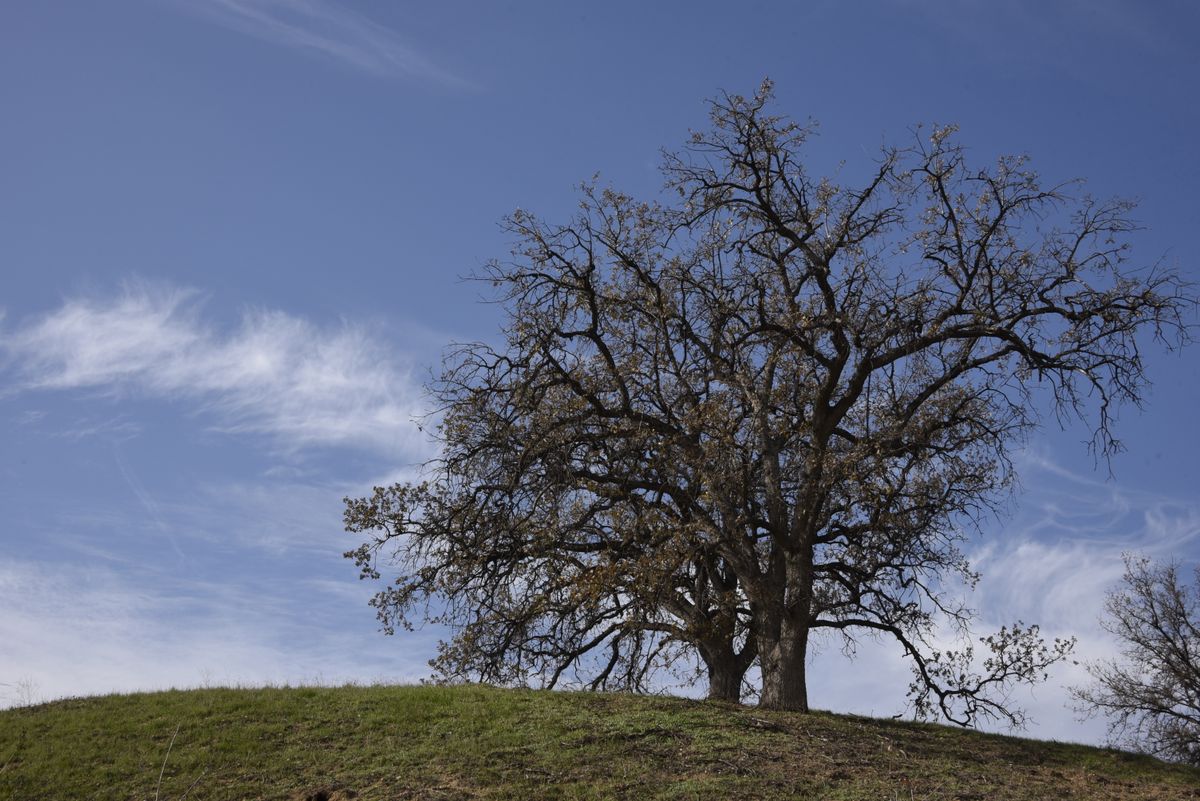
Atascadero is a town that has been through a decade of water stress, and its trees show it in ways that are easy to misread. A thinning oak crown in August might be the drought, might be a root problem three years old, or might be the bleeding canker stage of a disease that has no cure.
A pine with dull needles might be a beetle attack six weeks from being obvious to everyone, or might just be a pine in clay. Telling those apart early — while there is still a decision to make — is the work, and it is more useful here than anywhere on the coast.
The local forty-year context
The drought that began in 2012 and ran through the middle of the decade hit this valley hard, and the tree mortality that followed was measured in the thousands of acres across the county: pines killed by bark beetles that arrived on trees whose resin defence had been spent by water stress, and oaks that came out of it with dead limbs, surface root loss and an increased sensitivity to everything else.
A tree that survived those years is not undamaged. It is a tree with a thinner margin, and the useful inspection reads how much margin is left and what would use it up: another dry year, a root cut for a foundation, a grade change, a late frost on a tree that has pushed early.
What we look at, in order
The soil and the water. Clay that cracks, a slope that sheds, a bed that has been compacted, a downspout that has been discharging against the trunk for a decade. Most of the problems on this side of the county start here.
The base and the flare. A hollow, a conk, a wound from an old mower or a fence line, and any change in the lean. Then the forks, since codominant stems in a big oak are the classic failure and they fail over houses and roads.
The crown. Growth extension from the last season, deadwood, and the pattern of dieback — scattered and fading suggests a root problem; sheared on one side suggests wind or a physical injury; a crown that is fine at the outside and empty within is the pattern that deserves a hard look.
What people have done to it. Construction is the quiet one: a cut root from a foundation, fill placed over a flare, a trench for a utility, a grade raised to stop a wet patch. The decline from those arrives three to seven years later, and nobody links it back to the work that caused it.
What you get, and what to do with it
A written verdict in plain language: what the tree has, what it means over the next few seasons, the options with their costs, and the one we would choose. For drought-stressed oaks the honest answer is often an irrigation and mulch programme rather than a chainsaw — the cheapest and most effective intervention in this climate, and the one most often skipped in favour of a dramatic solution.
Where a decision turns on the inside of the wood, the report says what was measured and how. Where the answer needs a laboratory, we say that too: a test beats an opinion, and a confident guess is not a diagnosis.
Field note — Dr. Liam Zimmerman separates what has been measured from what is merely repeated, names the organism where he can, and says plainly when the honest answer is a wait rather than a cut.
Questions, quotes, or just exploring — we’re here to help.